

Home
Class 12
PHYSICS
A thin metallic spherical shell of radiu...

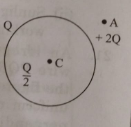
A thin metallic spherical shell of radius R carries a charge Q on its surface. A point charge `Q/2` is placed at its centre C and another charge +2Q outside the shell at a distance r from the centre as shown in figure. Find
the force on the charge at the centre of shell and at point A.

Promotional Banner

Similar Questions

Explore conceptually related problems

A thin metallic spherical shell of radius R carries a charge Q on its surface. A point charge Q/2 is placed at its centre C and another charge +2Q outside the shell at a distance r from the centre as shown in figure. Find the electric flux through the shell.

A spherical shell of radius R has a charge +Q units. The electric field due to the shell at a point

A point charge q is placed at the origin. How does the electric field due to the charge vary with distance r from the origin?

A spherical conducting shell of inner radius r_1 and outer radius r_2 has a charge Q as shown in the figure. A charge q is placed at the centre of the shell. What is the surface charge density of the inner and outer sufaces of the shell?

A hollow metallic sphere of radius 10 cm is charged, such that potential of its surface is 70 V. The potential at the centre of the sphere would be

An ellipsoidal cavity is carved within a perfect conductor. A positive charge q is placed at the centre of the cavity. The points A and B are on the cavity surface as shown in the figure. Then

A spherical conduting shell of inner radius r_1 and outer radius r_2 has a charge Q. A charge q is placed at the centre of the shell. Write the expression for the electric field at a point x > r_2 from the centre of the spherical shell.

A spherical conducting shell of inner radius r_1 and outer radius r_2 has a charge Q. A charge q is placed at the centre of the shell. What is the surface charge density on the inner and outer surfaces of the shell?

A charge q is placed at the centre of line joining two equal charges Q. Show that the system of three charges will be in equilibrium if q = -Q/4

If a point charge +q is taken first from A to C and then from C to B of a circle drawn with another point charge +q as centre as shown in the figure, then along which path more than will be done.