Home
Class 12
PHYSICS
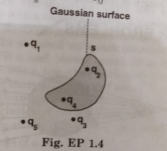
Five charges q1, q2, q3,q4 and q5 are fi...

Five charges `q_1, q_2, q_3,q_4` and `q_5` are fixed at their positions as shown in Fig. S is a Gaussian surface. The Gauss's law is given by`int E.dS = q/epsilon `

Which of the following statements is correct?

A

(a) E on the LHS of the above equation will have a contribution `q_1, q_5` and `q_3` while q on the RHS will have a contribution from `q_2` and `q_4` only.

B

(b) E on the LHS of the above equation will have a contribution from all charges while q on the RHS will have a contribution from `q_2` and `q_4` only.

C

(c) E on the LHS of the above equations will have a contribution from all charges while q on the RHS will have a contribution from `q_1, q_3 and q_5` only.

D

(d) Both E on the LHS and q on the RHS will have contributions from `q_2` and `q_4` only.

Text Solution

Verified by Experts

Promotional Banner

Similar Questions

Explore conceptually related problems

Refer to the arrangement of charges in Fig. and a gaussian surface of radius R with Q at the centre.Then,

Point charges + 4q, -q and +4 q are kept on the X-axis at points x = 0, x = a and x = 2 a respectively

A point charge q is placed at O as shown in figure. Is V_P - V_Q positive or negative when q

M_x and M_y denote the atomic masses of the parent and the daughter nuclei respectively in a radioactive decay. The Q-value for a beta^(-) decay is Q_1 and that for a beta^(+) decay is Q_2 . If m_e dentoes the mass of an electron, then which of the following statement is correct?

Which of the following statements are always correct (where Q denotes the set of rationals)?

What is the shape of equipotential surface for a given point charge q.

If q_1q_2>0 , what is the nature of force between the two charges?

Answer carefully: Two large conducting spheres carrying charges Q_1 and Q_2 are brought close to each other. Is the magnitude of electrostatic force between them exactly given by ((Q_1 Q_2 )//(4piepsilon_0r^2)) , where r is the distance between their centres?

If q_1 q_2 > 0 , what can one say about the sign of the charge?

