

Home
Class 12
PHYSICS
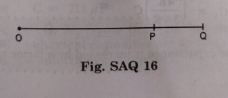
A point charge q is placed at O as shown...

A point charge q is placed at O as shown in figure.
Is `V_P - V_Q` positive or negative when q < 0.

Promotional Banner

Similar Questions

Explore conceptually related problems

A point charge Q is placed at point O as shown in the figure. is the potential difference V_A - V_B positive, negative or zero if Q is postive or negative?

If a point charge +q is taken first from A to C and then from C to B of a circle drawn with another point charge +q as centre as shown in the figure, then along which path more than will be done.

A point charge +q , is placed at a distance d from an isolated conducting plane. The field at a point P on the other side of the plane is

A wire loop carrying a current I is placed in the xy-plane as shown in figure If a particle charge +Q and mass m is placed at in centre P and given a velocity v along NP (see figure), find its instaneous acceleration.

A point charge +q is placed at the mid point of a cube of side b. The electric flux emerging from the cube is:

A thin metallic spherical shell of radius R carries a charge Q on its surface. A point charge Q/2 is placed at its centre C and another charge +2Q outside the shell at a distance r from the centre as shown in figure. Find the force on the charge at the centre of shell and at point A.

A thin metallic spherical shell of radius R carries a charge Q on its surface. A point charge Q/2 is placed at its centre C and another charge +2Q outside the shell at a distance r from the centre as shown in figure. Find the electric flux through the shell.

Three charges each of value q are placed the corers of an equilaterla triangle. A fourth charge Q is placed at the centre of the triangle. If Q = -q, will the charges at the corners move towards the centre or fly away from it?

A point charge q is placed at the origin. How does the electric field due to the charge vary with distance r from the origin?

A charge q is placed at the centre of the line joining two exactly equal positive charges Q. the system of three charges will be in equilibrium, if q is equal to: