

Home
Class 12
PHYSICS
A point charge +Q is placed at the cente...

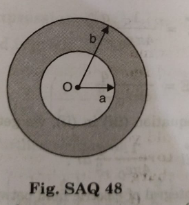
A point charge +Q is placed at the center O of an uncharged hollow spherical conductor of inner radius 'a' and outer radius 'b'. Find the following:
The magnitude of electric field vector at a distance (i) `r=a/2` and (ii) r=2b from the centre of the shell.

Promotional Banner

Similar Questions

Explore conceptually related problems

A point charge +Q is placed at the centre O of an uncharged hollow spherical conductor of inner radius 'a' and outer radius 'b'. Find the following: The magnitude and sign of the charge induced on the inner and outer surface of the conducting shell.

Fill ups A point charge is placed at the centre of a hollow conducting sphere of internal radius 'r' and outer radius '2r'. The ratio of the surface charge density of the inner surface to that the outer surface will be…………….. .

A non-conducting solid sphere of radius R is uniformly charged. The magnitude of the electric field due to the sphere at a distance r form its centre

A spherical conducting shell of inner radius r_1 and outer radius r_2 has a charge Q: Is the electric field in a cavity (with no charge) zero even if the shell is not spherical, but has any irregular shape? Explain.

Derive an expression for electric field intensity at a distance r from a point charge q.

A spherical conduting shell of inner radius r_1 and outer radius r_2 has a charge Q. A charge q is placed at the centre of the shell. Write the expression for the electric field at a point x > r_2 from the centre of the spherical shell.

A spherical conducting shell of inner radius r_1 and outer radius r_2 has a charge Q as shown in the figure. Is the electric field isnide a cavity (with no charge) zero, even if the shell is not spherical, but has any irregular shape? Explain.

A spherical conducting shell of inner radius r_1 and outer radius r_2 has a charge Q. A charge q is placed at the centre of the shell. What is the surface charge density on the inner and outer surfaces of the shell?

A point charge q is placed at the origin. How does the electric field due to the charge vary with distance r from the origin?

A spherical conductor of radius 12 cm has a charge of 1.6 xx 10^-7C distributed uniformly on its surface. What is the electric field at a point 18 cm from the centre of the sphere?