

Home
Class 12
PHYSICS
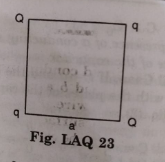
Four point charges Q, q, Q and q are pla...

Four point charges Q, q, Q and q are placed at the corners of a square of side 'a' as shown in the figure. Find the resultant electric force on a charge Q?

Promotional Banner

Similar Questions

Explore conceptually related problems

Four point charges Q, q, Q and q are placed at the corners of a square of side 'a' as shown in the figure. Find the potential energy of this system?

Five charges, q each, are placed at the corners of a regular pentagon of side a as shown in the figure. What will be the electric field at O, the centre of the pentagon? What will be the electric field at O, fi the charge from one of the corners (Say A) is removed? What will be the electric field at O, if the charge q at A is repalced by - q?

Five charges, q each, are placed at the corners of a regular pentagon of side a as shown in the figure. How would your answer to be affected, if pentagon is replaced by n-sided regular polygon with charge q at each of its corners?

Three charges, each equal to q, are placed at the three corners of a square of side a. Find the electric field at the fourth corner of the square.

Shown in the figure four point charges at the corners of a square of side 2 cm. Find the magnitude and direction of the electric field at the centre O of the square, if Q = 0.02 muC Use 1/(4piepsilon_0) = 9 xx 10^9 N m^2 C^-2

Four charges +q'+q' - q and -q are placed respe tively at the four croners A,B,C and D respectively of a square of side a . Calcualte the force on a charge Q placed at the centre of the square.

Three points charges +q,+2q and Q are placed at the three vertices of an equilateral triangle. Find the value of charge Q (in terms of q), so that electric otential energy of the system is zero.

Four point charges q_A = 2 muC , q_B = -5 muC . q_c = 2 muC , and q_D = -5 muC are located at the corners of a square ABCD of side 10 cm. What is the force on a charge of 1 muC placed at the centre of the square?

An electric charge q is placed at one of the corner of a cube of side a . The electric flux on one of its faces will be