The following table gives the length of three copper wires, their diameters and the applied potential difference across their ends. Arrange the wires in increasing order according to the following
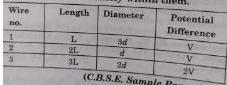
The magnitude of the electric field within them?
The following table gives the length of three copper wires, their diameters and the applied potential difference across their ends. Arrange the wires in increasing order according to the following
The magnitude of the electric field within them?
The magnitude of the electric field within them?



Similar Questions
Explore conceptually related problems
The following table gives the length of three copper wires, their diameters and the applied potential difference across their ends. Arrange the wires in increasing order according to the following The current density within them.
The following table gives the length of three copper wires, their diameters and the applied potential difference across their ends. Arrange the wires in increasing order according to the following The drift speed of electrons through them?
The potential difference across a given copper wire is increased. What happens to the drift velcoity of the charge carriers?
Two wire A & B are of the same metal and are of same length have area of cross section in the ratio of 2:1 If the same potential difference is applied across each wire. What will be the ratio of the current flowing through the wires A & B ?
Two circular coils 1 and 2 are made from the same wire but the radius of the 1st coil is twice that of the 2nd coil. What is the ratio of potentail difference applied across them so that the magnetic field at their centres is the same?
The existence of negatively charged particle in an atom was shown by J.J. Thomson as a result of the studies of the passage of electricity through gases at extremely low pressure known as discharge tube experiments. When a high voltage of the order of 10,000 volts or more was impressed across the electrodes, some sort of invisible rays moved from the negative electrode to the positive electrode these rays are called as cathode rays. Cathode rays travel in straight path in absence of electrical and magnetic field . Cathode rays consist of material part and charged particles? Cathode rays produce X-rays and light is emitted when they strike on ZnS screen. Cathode rays penetrate through thin sheets of aluminium and other metals . They affect the photogenic plate and passes heating effect when they strike on metal foil. The raito of charge to mass i.e charge/mass is same for all the cathode rays irrespective of the gas used in the tube. The existence of positively charged particle in an atom was shown be E. Goldstein. He repeated the same discharge tube experiments by using a perforated cathode. It was observed that when a high potential difference was applied between the electrodes, not only cathode rays were produced but also a new type of rays were produced simultaneoulsy from anode moving towards cathode and passes through the holes or canal of the cathode. These termed as canal rays or anode rays. These rays travel in straight lines and consists of positively charged particles. These rays have kinetic energy and produces heating effect also. The e/m ratio of these rays is smaller than that of electrons. Unlike cathode rays, their e/m value is dependent upon the nature of the gas taken in the tube. These rays produced flashes of light on ZnS screen and can pass throughs thin metal foils. They can produce physical and chemical changes and are capable to produce ionisation in gases. For cathode rays the value of e/m:
The existence of negatively charged particle in an atom was shown by J.J. Thomson as a result of the studies of the passage of electricity through gases at extremely low pressure known as discharge tube experiments. When a high voltage of the order of 10,000 volts or more was impressed across the electrodes, some sort of invisible rays moved from the negative electrode to the positive electrode these rays are called as cathode rays. Cathode rays travel in straight path in absence of electrical and magnetic field . Cathode rays consist of material part and charged particles? Cathode rays produce X-rays and light is emitted when they strike on ZnS screen. Cathode rays penetrate through thin sheets of aluminium and other metals . They affect the photogenic plate and passes heating effect when they strike on metal foil. The raito of charge to mass i.e charge/mass is same for all the cathode rays irrespective of the gas used in the tube. The existence of positively charged particle in an atom was shown be E. Goldstein. He repeated the same discharge tube experiments by using a perforated cathode. It was observed that when a high potential difference was applied between the electrodes, not only cathode rays were produced but also a new type of rays were produced simultaneoulsy from anode moving towards cathode and passes through the holes or canal of the cathode. These termed as canal rays or anode rays. These rays travel in straight lines and consists of positively charged particles. These rays have kinetic energy and produces heating effect also. The e/m ratio of these rays is smaller than that of electrons. Unlike cathode rays, their e/m value is dependent upon the nature of the gas taken in the tube. These rays produced flashes of light on ZnS screen and can pass throughs thin metal foils. They can produce physical and chemical changes and are capable to produce ionisation in gases. Which is not true with respect to cathode rays?
The existence of negatively charged particle in an atom was shown by J.J. Thomson as a result of the studies of the passage of electricity through gases at extremely low pressure known as discharge tube experiments. When a high voltage of the order of 10,000 volts or more was impressed across the electrodes, some sort of invisible rays moved from the negative electrode to the positive electrode these rays are called as cathode rays. Cathode rays travel in straight path in absence of electrical and magnetic field . Cathode rays consist of material part and charged particles? Cathode rays produce X-rays and light is emitted when they strike on ZnS screen. Cathode rays penetrate through thin sheets of aluminium and other metals . They affect the photogenic plate and passes heating effect when they strike on metal foil. The raito of charge to mass i.e charge/mass is same for all the cathode rays irrespective of the gas used in the tube. The existence of positively charged particle in an atom was shown be E. Goldstein. He repeated the same discharge tube experiments by using a perforated cathode. It was observed that when a high potential difference was applied between the electrodes, not only cathode rays were produced but also a new type of rays were produced simultaneoulsy from anode moving towards cathode and passes through the holes or canal of the cathode. These termed as canal rays or anode rays. These rays travel in straight lines and consists of positively charged particles. These rays have kinetic energy and produces heating effect also. The e/m ratio of these rays is smaller than that of electrons. Unlike cathode rays, their e/m value is dependent upon the nature of the gas taken in the tube. These rays produced flashes of light on ZnS screen and can pass throughs thin metal foils. They can produce physical and chemical changes and are capable to produce ionisation in gases. Select the incorrect statement.
A resistance is made by connecting two wires (series) of same material of radii 2 mm and 5 mm and length 8cm and 5 cm. A potential difference of 22V is applied to them. What is the potential difference on the longer wire?
Two wires A and B are of same metal, have the same area of cross-section and have their lengths in the ratio 2 : 1. What will be the ratio of currents flowing through them respectively when the same potential difference is applied across the length of each of them ?
Recommended Questions
- The following table gives the length of three copper wires, their diam...
Text Solution
|
- The following table gives the length of three copper rods, their diame...
Text Solution
|
- A potential difference of V applied at the ends of a copper wire of le...
Text Solution
|
- The length of a potentiometer wire is 10m and a potential difference o...
Text Solution
|
- If the length of a potentiometer wire is increased by keeping constant...
Text Solution
|
- A potential difference V is applied across a coper wire of diameter ...
Text Solution
|
- The following table gives the length of three copper wires, their diam...
Text Solution
|
- The following table gives the length of three copper wires, their diam...
Text Solution
|
- The following table gives the length of three copper wires, their diam...
Text Solution
|