

Home
Class 12
PHYSICS
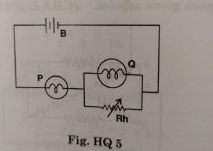
The circuit shown in the diagram contain...

The circuit shown in the diagram contains battery B, a rheostat Rh.and the identical lamps P and Q. what will happen to the brightness of the lamps, if the resistance through the rheostat is increased? Give reasons.

Promotional Banner

Similar Questions

Explore conceptually related problems

The circuit shown in the figure contains two diodes each with a forward resistance of 30 Omega and with infinite backward resistance. If the battery is 3 V, the current through the 100 Omega resistance (in ampere)

In the circuit shown in Fig.a voltage V is connected across lamp L. What changes would occur at lamp and the voltage V, if the resistance R is reduced in value?

An capacitor C, a variable resistor R and a bulb B are connected in series to the ac mains in circuits as shown in Fig. The bulb glows with some brightness. How will the glow of the bulb change if the resistance R is increased keeping the same capacitance.

A current of 1 ampere flows in series circuit contains an electric lamp and a conductor of 5 ohm when connected to a 10V battery. Calculate the resistance of the electric lamp. Now if a resistance of 10 ohm is connected in parallel with this series combination, what change in current flowing through 5 ohm conductor and potential difference across the lamp will take place? Give reason.

An electric lamp,whose resistance is 20 Omega and a conductor of 4 Omega resistance are connected to a 6V battery as shown in the figure.calculate (a) total resistance of the circuit(b) the current through the circuit (c) the p.d.across the electric lamp and conductor.

A copper coil L wound on a soft iron core and a 15 W - 110 V lamp are connected to a 30 V battery through a tapping key as shown in the figure. When the key is closed, the lamp glows dimly. But when the key is suddenly opend, the lamp flashes for an instant to much greater brightness. Explain, why.

Figure shows a metal rod PQ resting on the smooth rails AB and positioned between the poles of a permanent magnet. The rails, the rod, and the magnetic field are in three mutual perpendicular directions. A galvanometer G connects the rails through a switch K. Length of the rod =15 cm, B = 0.50 T, resistance of the closed loop containing the rod = 9.0 mOmega . Assume the field to be uniform and the rod is moved with a speed of 12 cm/s. How much power is dissipated as heat in the closed circuit? What is the source of this power? :

Figure 6.20 shows a metal rod PQ resting on the smooth rails AB and positioned between the poles of a permanent magnet. The rails, the rod, and the magnetic field are in three mutual perpendicular directions. A galvanometer G connects the rails through a switch K. Length of the rod =15 cm, B = 0.50 T, resistance of the closed loop containing the rod = 9.0 mOmega Assume the field to be uniform. Suppose K is open and the rod is moved with a speed of 12 cm s^-1 in the direction shown. Give the polarity and magnitude of the induced emf. :

In a p-n junction diode, the current I can be expressed as I = I_0 exp ((eV)/(2k_BT)) where I_0 is called the reverse saturation current, V is the voltage across the diode and is positive for forward bias and negative for reverse bias, and I is the current through the diode, k_B is th Boltzmann constant (8.6xx 10^-5 (eV)/K) and T is the absolute temperature. If for a given diode I_0 = 5 xx 10^-12 A and T = 300 K, then - What is the dynamic resistance when the voltage is increased to 0.7 V from 0.6 V?

Light from a sodium lamp(S) passes through two Polaroid sheets P_1 and P_2 as shown in the figure. What will be the effect of the intensity of the light transmitted by P_1 and by P_2 on rotating Polaroid P_1 about the direction of propagation of light? justify your answer in both cases.