

Home
Class 12
PHYSICS
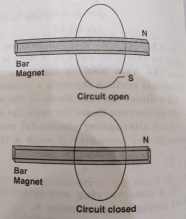
Consider a magnet surrounded by a wire w...

Consider a magnet surrounded by a wire with an on/off switch S (Fig. EP 6.11). If the switch is thrown from the off position (open circuit) to the on position (closed circuit), will a current flow in the circuit? Explain.

Promotional Banner

Similar Questions

Explore conceptually related problems

Show the switch signs in circuit in (i) open(ii) closed circuit.

In the circuit shown in fig. 14.25- Would any of the bulb glow when the switch is in the 'OFF' position?

Consider a metal ring kept on the top of a fixed solenoid (say on a cardboard) (Fig. EP 6.14). The centre of the ring coincides with the axis of the solenoid. If the current is suddenly switched on, the metal ring jumps up. Explain.

A circuit is connected as shown in the figure with the switch S open. When the switch is closed, the total amount of charge that flows from Y to X is

What is the direction of induced current when main current in an inductive circuit is switched off.

A 6 V battery for internal resistance 2 ohm is connected across a 10 ohm resistor and a switch in series, as shown: If the switch is kept in the off positions, as shown in the figure, then

Zubeda made n electric circuit using a cell holder shown in fig.14.4, a switch and a bulb. When she put the switch in the 'ON' position, the bulb did not glow. Help zubeda in identifying the possible defects in the circuit.

A current of 10 A flow around a closed path in a circuit which is in the horizontal plane as shown in the figure. The circuit consists of eight alternative arcs of radii r_(1)=0.08m and r_(2)=0.12m . Each subtends the same angle at the centre. An infinitely long straight wire carrying a current of 10 A is passing throgh the entre of the above circuit vertically with the direction of the current being into the plane of the circuit. What is the force acting on the wire at the centre due to the current in the circuit? What is the force acting on the arc AC and the straight segment CD due to the current at the centre?

Assume that the silicon diode in the circui shown in fig. requires a minimum current of 1mA to be above the knee point (0.7V) of its I-V characteristics. Aslo assume that the voltage across the diode is independent of current above the knee point. What is the power dissipated in the resistance R and in the diode, when a current of 5mA flows in the circuit at V_(B)=6V ?