

Home
Class 12
PHYSICS
Consider a closed loop C in a magnetic f...

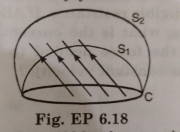
Consider a closed loop C in a magnetic field (Fig. EP 6.18). The flux passing through the loop is defined by choosing a surface whose edge coinides with the loop and using the formula `phi=B_1dA_1 + B_2.dA_2 +…………..`. Now if we choose two differnet surfaces `S_1` and `S_2` having as thier edge, would we get the same answer for flux. Justify your answer.

Promotional Banner

Similar Questions

Explore conceptually related problems

The magnetic flux passing perpendicular to the plane of the coil and directed into the paper is varying according to the relation phi=6t^2 +7t+1 Where phi is in milliweber and t is in seconds. what is the magnitude of e.m.f. induced in the loop when t=2s?

An a.c. generator consists of a coil of 50 turns and area 2.5 m^(2) rotating att an angular speed of 60 rad s^(-1) in a uniform magnetic field B = 0.3 T between two fixed pole pieces. The resistance of the circuit including that of coil is 500 Omega . Find Would the generator work if the coil were stationary and instead, the pole pieces rotated together with the same speed as above ?

An a.c. generator consists of a coil of 50 turns and area 2.5 m^(2) rotating att an angular speed of 60 rad s^(-1) in a uniform magnetic field B = 0.3 T between two fixed pole pieces. The resistance of the circuit including that of coil is 500 Omega . Find What will be the orientaiton of the coil w.r.t. the magnetic field to have (a) maximum (b) zero magnetic flux ?

A small retangular coil ABCD contains 140 turns of wire. The sides AB and BC of the coil are of length 4.5 and 2.8 cm respectively, as shown in the figure The coil is held between the poles of a large magnet so that the coil can rotate about an axis thorugh its centre. The magnet produces a uniform magnetic field of flux density B between its poles. When the current in the coil is 170 mA, the maximum torque produced in the coil is 2.1 xx 10^-3 N m . Use your answer to show that the magnetic flux density B between the poles of the magnet is 70 mT.

If hydrogen atoms (in the ground state ) are passed through an homogeneous magnetic field, the beam is split into two parts. This interaction with the magnetic field shows that the atoms must have magnetic moment. However, the moment cannot be due to the orbital angular momentum since l=0. Hence one must assume existence of intrinsic angular momentum, which as the experiment shows, has only two permitted orientations. Spin of the electron produce angular momentum equal to S=sqrt(s(s+1))(h)/(2pi) where S=+(1)/(2) . Total spin of an atom = +(n)/(2) " or "-(n)/(2) where n is the number of unpaired electrons. The substance which contain species with unpaired electrons in their orbitals behave as paramagnetic substances. The paramagnetism is expressed in terms of magnetic moment. The magnetic moment of an atom mu_(s)sqrt(s(s+1))(eh)/(2pimc)=sqrt((n)/(2)((n)/(2)+1))(eh)/(2pimc)" "s=(n)/(2) impliesmu_(s)=sqrt(n(n+1)) B.M. 1. B.M. (Bohr magneton)= (eh)/(4pimc) If magnetic moment is zero the substance is diamagnetic. If an ion of _(25)Mn has a magnetic moment of 3.873 B.M. Then oxidation state of Mn in ion is :

If hydrogen atoms (in the ground state ) are passed through an homogeneous magnetic field, the beam is split into two parts. This interaction with the magnetic field shows that the atoms must have magnetic moment. However, the moment cannot be due to the orbital angular momentum since l=0. Hence one must assume existence of intrinsic angular momentum, which as the experiment shows, has only two permitted orientations. Spin of the electron produce angular momentum equal to S=sqrt(s(s+1))(h)/(2pi) where S=+(1)/(2) . Total spin of an atom = +(n)/(2) " or "-(n)/(2) where n is the number of unpaired electrons. The substance which contain species with unpaired electrons in their orbitals behave as paramagnetic substances. The paramagnetism is expressed in terms of magnetic moment. The magnetic moment of an atom mu_(s)sqrt(s(s+1))(eh)/(2pimc)=sqrt((n)/(2)((n)/(2)+1))(eh)/(2pimc)" "s=(n)/(2) impliesmu_(s)=sqrt(n(n+1)) B.M. 1. B.M. (Bohr magneton)= (eh)/(4pimc) If magnetic moment is zero the substance is diamagnetic. Which of the following ion has lowest magnetic moment?