

Home
Class 12
PHYSICS
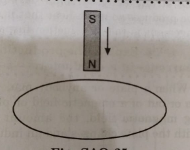
A small magnet falls through a metal rin...

A small magnet falls through a metal ring. Will its acceleration be equal to g?

Promotional Banner

Similar Questions

Explore conceptually related problems

A bar magnet falls from a heigh h through a metallic ring. Will its acceleraton be equal to g? Give reason for your answer.

A copper ring is held horizontally and a bar magnetic is dropped through the ring with its length along the axis of the ring (shown in the figure) will the acceleration of the falling magnet be equal to , greater than or less than that due to gravity?

A copper ring having a cut such as not to form a complete loop is held horizontally and a bar magnet is dropped through the ring with its length along the axis of the ring. Then acceleration of the falling magnet is:

An object falling through a fluid is observed to have acceleration given by a = g - bv where g = gravitational acceleration and b is constant. After a long time of release, it is observed to fall with constant speed.What must be the value of constant speed?

Direction. In the following questions, a statement of assertion is followed by a statement of reason. While answering a question, you are required to choose the correct are out of the given four responses and mark it as (A). If both assertion and reason are true and reason is the correct explanation of the assertion, (B) if both assertion and reason are true but reason is not correct explanation of the assertion. (C) if assertion is true, but reason if false, (D) if both assertion and reason are false Assertion : When a bar magnet falls freely along the axis of a solenoid held vertically, its acceleration is less than the acceleration due to gravity Reason: The falling magnet induces current in the solenoid and according to Lenz's law, the induced current opposes the falling motion of the magnet

Name the oxometal anions of the first series of the transition metals in which the metal exhibits the oxidation state equal to its group number.

Name the oxometal anions of the first series of transition metals in which the metal exhibits the oxidation state equal to its group number.

Why does the acceleration of a magnet falling through a long solenoid decrease?

A copper ring is suspended in a vertical plane by a thread. A steel bar is passed through the ring in a horizontal direction and then a magnet is similarly passed through. Will the motion of the bar and the magnet affect the position of the ring?