Home
Class 12
PHYSICS
Consider a light beam incident from air ...

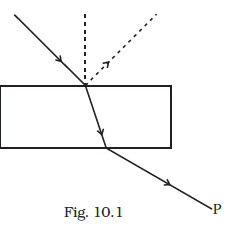
Consider a light beam incident from air to a glass slab at Brewster's angle as shown in Fig. EP 10.1.
A polarised is placed in the path of the emergent ray at point P and rotated about an axis passing through the center and perpendicular to the plane of the polaroid.

A

(a) For a particular orientation there shall be darkness observed through the Polaroid.

B

(b) The intensity of light as seen through the Polaroid shall be independent of the rotation.

C

(c) The intensity of light as seen through the Polaroid shall go through a minimum but not zero for two orientation of the polaroid.

D

(d) the intensity of light as seen through the Polaroid shall go through a minimum for four orientation of the Polaroid.

Text Solution

Verified by Experts

Promotional Banner

Similar Questions

Explore conceptually related problems

Consider a ray of light incident from air onto a slab of glass (refractive index n) of width d, at angle theta . The phase difference between the ray reflected by the top surface of the glass and the bottom surface is:

A right angled crown glass prism with critical angle 41^@ is placed before an object PQ in two positions are shown in figure SAQ 29 (a) and (b). Trace the path of the ray P and Q passing through the prisms in the two cases.

A diverging beam of light from a point source S having divergence angle alpha , falls symmetrically on a glass slab as shown. The angles of incidence of the two extreme rays are equal. If the thickness of the glass slab is t and the refractive index n, then the divergence angle of the emergent beam is .

A ray of light strikes a plane mirror at an angle of incidence 45^@ as shown in the figure 9.115. After reflection, the ray of passess through a prism of refractive index 1.5 whose apex angle is 4^@ . Through what angle must the mirror be rotated if the total deviation of hte ray be 90^@ ?

A narrow beam of light is incident normally on one face of a glass prism having refractive index 1.48 . Find the angle of prism if the ray makes a grazing emergence along the other face. Draw a diagram showing the path of rays.

A beam of plane polarised light falls normally on a polariser (cross-sectional area 3 xx 10^(-4) m^2 ),which rotates about the axis of the ray with an angular velcity of 31.4 rads^(-1) .Find the energy of light passing through the polariser per revolution and the intensity of emergent beam,if flux of energy of the incident ray is 10^-3)W .

A line is drawn from a point P(x, y) on the curve y = f(x), making an angle with the x-axis which is supplementary to the one made by the tangent to the curve at P(x, y). The line meets the x-axis at A. Another line perpendicular to it drawn from P(x, y) meeting the y-axis at B. If OA = OB, where O is the origin, the equation of all curves which pass through ( 1, 1) is

A vessel ABCD of 10 cm width has two small slits S_(1) and S_(2) sealed with idebtical glass plates of equal thickness. The distance between the slits is 0.8 mm. POQ is the line perpendicular to the plane AB and passing through O, the middle point of S_(1) and S_(2) . A monochromatic light source is kept at S, 40 cm below P and 2 m from the vessel, to illuminate the slits as shown in the figure. Calculate the position of the central bright fringe on the other wall CD with respect of the line OQ. Now, a liquid is poured into the vessel and filled up to OQ. The central bright fringe is fiund to be at Q. Calculate the refractive index of the liquid.

Two monochromatic rays of light are incident normally on the face AB of an isosceles right-angled prism ABC.The refractive indices of the glass prism for the two rays 1 and 2 are respectively 1.35 and 1.45[Fig.2.76]Trace the path of these rays after entering through the prism .

