

Home
Class 12
PHYSICS
A silicon transistor amplifier circuit i...

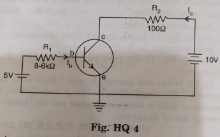
A silicon transistor amplifier circuit is given below. If current amplification factor `beta=100`, determine

Base current `I_b`.
Take voltage drop between base and emitter as 0.7 V.

Promotional Banner

Similar Questions

Explore conceptually related problems

A silicon transistor amplifier circuit is given below. If current amplification factor beta=100 , determine Collector current I_c . Take voltage drop between base and emitter as 0.7 V.

A silicon transistor amplifier circuit is given below. If current amplification factor beta=100 , determine Collector base voltage. Take voltage drop between base and emitter as 0.7 V.

A silicon transistor amplifier circuit is given below. If current amplification factor beta=100 , determine Collector emitter voltage. Take voltage drop between base and emitter as 0.7 V.

A n-p-n transistor is connected in common emitter configuration in which collector supply is 9V and the voltage drop across the load resistance of 700Omega connected to the collector circuit is 0.7V. If the current amplification factor alpha is 25//26, determine collector emitter voltage and base current. If the input resistance of the transistor is 100Omega, calculate the voltage gain and the power gain.

Calculate emitter current for which beta = 100 and base current I_b = 20 muA .

For a CE-transistor amplifier, the audio signal voltage across the collected resistance of 2 k omega is 2 V. Suppose the current amplificationfactor of the transistor is 100, find the input signal voltage nd base current, if the base resistance is 1 k omega .

What is an amplifier ? Draw a circuit diagram for an amplifier withPNP transistor in common emitter configuration. Also define current gain, voltage gain and power gain for it.