Home
Class 12
MATHS
Find the values of m for which roots of ...

Find the values of `m` for which roots of equation `x^(2)-mx+1=0` are less than unity.

Text Solution

Verified by Experts
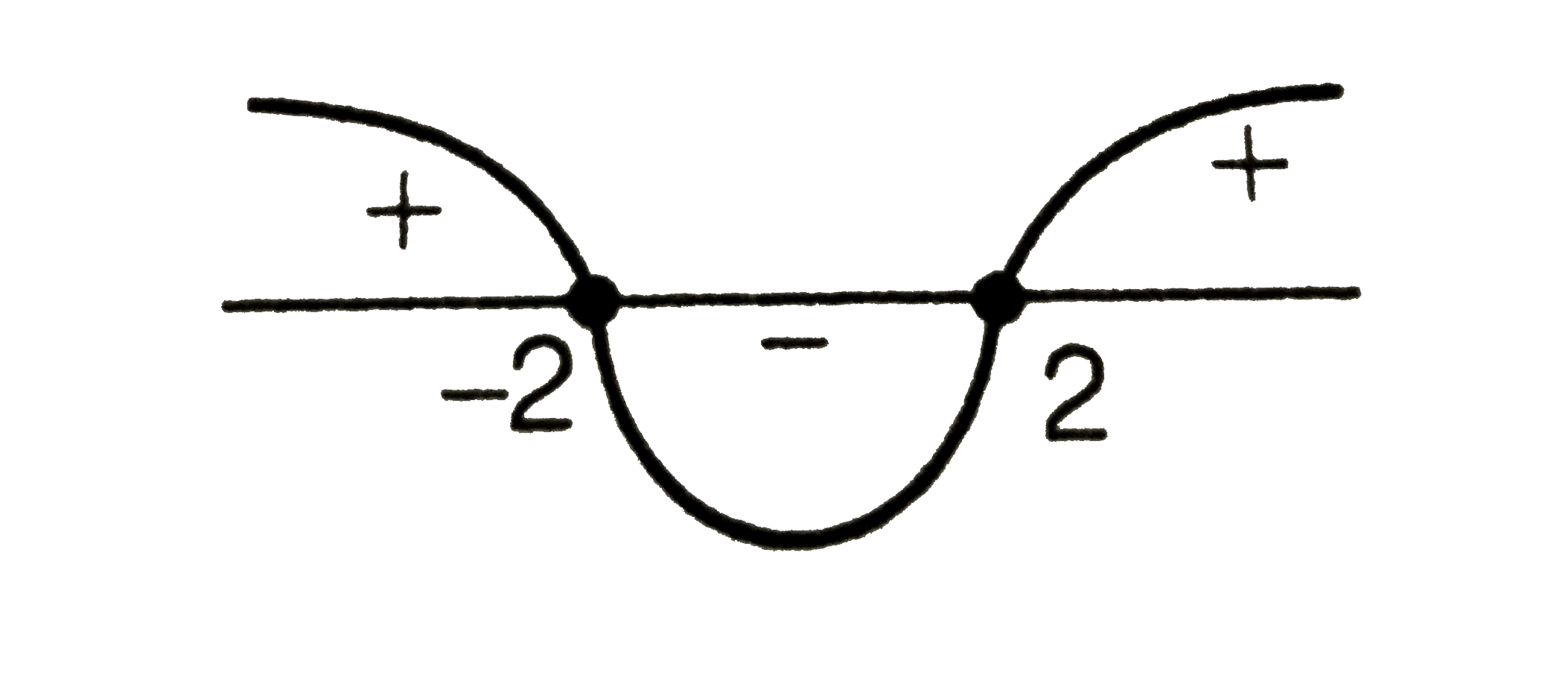
Let `f(X)=x^(2)-mx+1` as both roots of `f(x)=0` are less than 1 we can take `Dge0, af(1)ge0` and `-b/(2a)lt1`
ltBrgt (i) Consider `Dge0(-m)^(2)-4.1.4ge0`

`implies(m+2)(m-2)ge0`
`impliesm epsilon (-oo,-2[uu[2,oo)`…......i
(ii) Consider af `(1) gt01(1-m+1)gt0`
`impliesm-2lt0impliesmlt2`
`impliesm epsilon (-oo,2)` .......ii
(iii) Consider `(-b/(2a)lt1)`
`m/2lt1impliesmlt2`
`impliesm epsilon (-oo,2)`........iii
Hence the values of `m` satisfying Eqs. (i), (ii) and (iii) at the same time are `m epsilon (-oo,-2]`
Promotional Banner

Similar Questions

Explore conceptually related problems

Find roots equation 2x^(2)-x-3=0 .

Find the values of a for which one root of equation (a-5)x^(2)-2ax+a-4=0 is smaller than 1 and the other greater than 2.

Find the valuesof m for which exactly one root of the equation x^(2)-2mx+m^(2)-1=0 lies in the interval (-2,4)

All the values of m for whilch both the roots of the equation x^2-2m x+m^2-1=0 are greater than -2 but less than 4 lie in the interval

Find the values of a for which all the roots of the euation x^4-4x^3-8x^2+a=0 are real.

Number of integral value (s) of k for which the equation 4x^(2)-16x+k=0 has one root lie between 1 and 2 and other root lies between 2 and 3, is

Let x^2-(m-3)x+m=0 (m in R) be a quadratic equation . Find the values of m for which the roots are: (ix)one root is smaller than 2 & other root is greater than 2 (x) both the roots are greater than 2. (xi) both the roots are smaller than 2. (xii) exactly one root lies in the interval (1,2) (xiii) both the roots lies in the interval (1,2) (xiv) at least one root lies in the interval (1,2) (xv) one root is greater than 2 and the other root is smaller than 1

If both roots of the equation x^(2)-(m-3)x+m=0(m in R) are positive, then

Find the values of k for which the following quadratic equation has real and equal roots: x^(2)+k(2x+k-1)+2=0

Find the roots of the equation x+(1)/(x)=3, x ne 0
