Home
Class 12
MATHS
Solve the equation x^(3)-[x]=3, where [x...

Solve the equation `x^(3)-[x]=3`, where `[x]` denotes the greatest integer less than or equal to `x`.

Text Solution

Verified by Experts
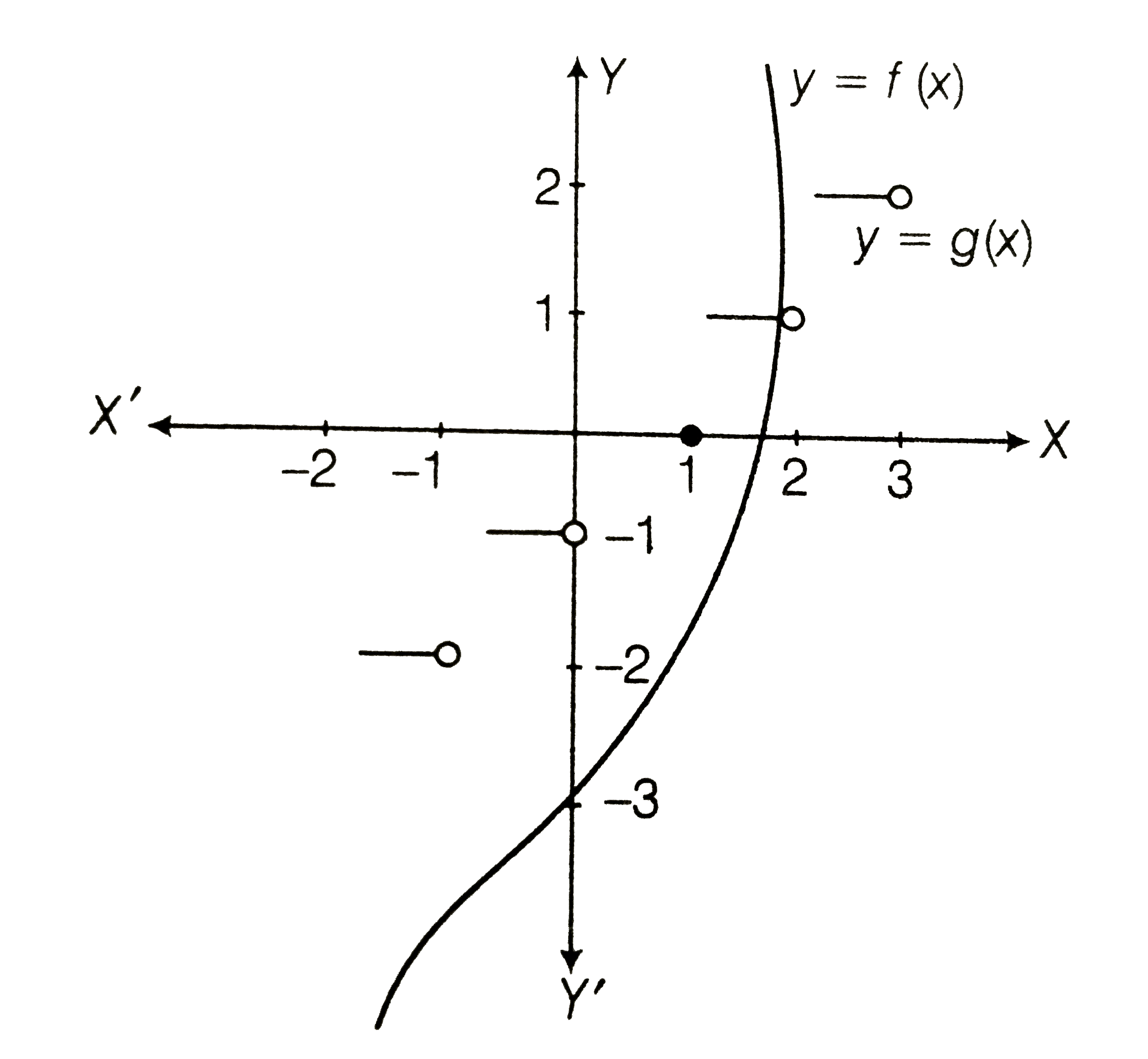
We have `x^(3)-[x]=3`
`impliesx^(3)-3=[x]`
Let `f(x)=x^(3)-3` and `g(x)=[x]`
It is clear from the graphs, the point of intersection of two curves `y=f(x)` and `y-g(x)` lies between (1,0) and (2,0).

`:.1ltxlt2`
We have `f(x)=x^(3)-3` and `g(x)=1`
or `x^(3)-3=1impliesx^(3)=4`
`:.x=(4)^(1//3)`
Hence `x=4^(1//3)` is the solution of the equation `x^(3)-[x]=3`
Aliter
`:'x=[x]+f,0leflt1`
Then given equation reduces to
`x^(3)-(x-f)=3impliesx^(3)-x=3-f`
Hence it follows that
`2ltx^(3)-xle3`
`implies2ltx(x+1)(x-1)le3`
Further for `xge2`, we have `x(x+1)(x-1)ge6lt3`
For `xlt-1`, we have `x(x+1)(x-1)lt0lt2`
For `x=-1`, we have `x(x+1)(x-1)=0lt2`
For `-1ltxle0`, we have `x(x+1)(x-1)le-xlt1`
adn for `0ltxle1`, we have `x(x+1)(x-1)ltxltx^(3)le1`
Therefore `x` must be `1ltxlt2`
`:.[x]=1`
Now the original equation can be written as
`x^(3)-1=3impliesx^(3)=4`
Hence `x=4^(1//3)` is the solution of the given equation.
Promotional Banner

Similar Questions

Explore conceptually related problems

Find all the points of discontinuity of the greatest integer function defined by f(x)= [x], where [x] denotes the greatest integer less than or equal to x.

Prove that the Greatest Integer Function f : R rarr R , given by f(x) = [x] , is neither one - one nor onto , where [x] denotes the greatest integer less than or equal to x.

The number of solutions of |[x]-2x|=4, "where" [x]] is the greatest integer less than or equal to x, is

Solve the equation [x]{x}=x, where [] and {} denote the greatest integer function and fractional part, respectively.

Show that the function defined by g(x)= x - [x] is discontinuous at all integral points. Here [x] denotes the greatest integer less than or equal to x.

f(x)= 1/sqrt([x]+x) , where [*] denotes the greatest integeral function less than or equals to x. Then, find the domain of f(x).

Find the number of solution of the equations |cos x |=[x] , (where [.] denotes the greatest integer function ).

Let f : R rarr R be the Signum Function defined as f(x) = {(1,xgt0),(0,x = 0),(-1,xlt0):} and g : R rarr R be the Greatest Integer Function given by g(x) = [x] , where [x] is greatest integer less than or equal to x. Then , does fog and gof coincide in (0,1] ?

