Home
Class 12
MATHS
Let a ,b ,c be real. If a x^2+b x+c=0 ha...

Let `a ,b ,c` be real. If `a x^2+b x+c=0` has two real roots `alphaa n dbeta,w h e r ealpha<<-1a n dbeta>>1` , then show that `1+c/a+|b/a|<0`

Text Solution

Verified by Experts
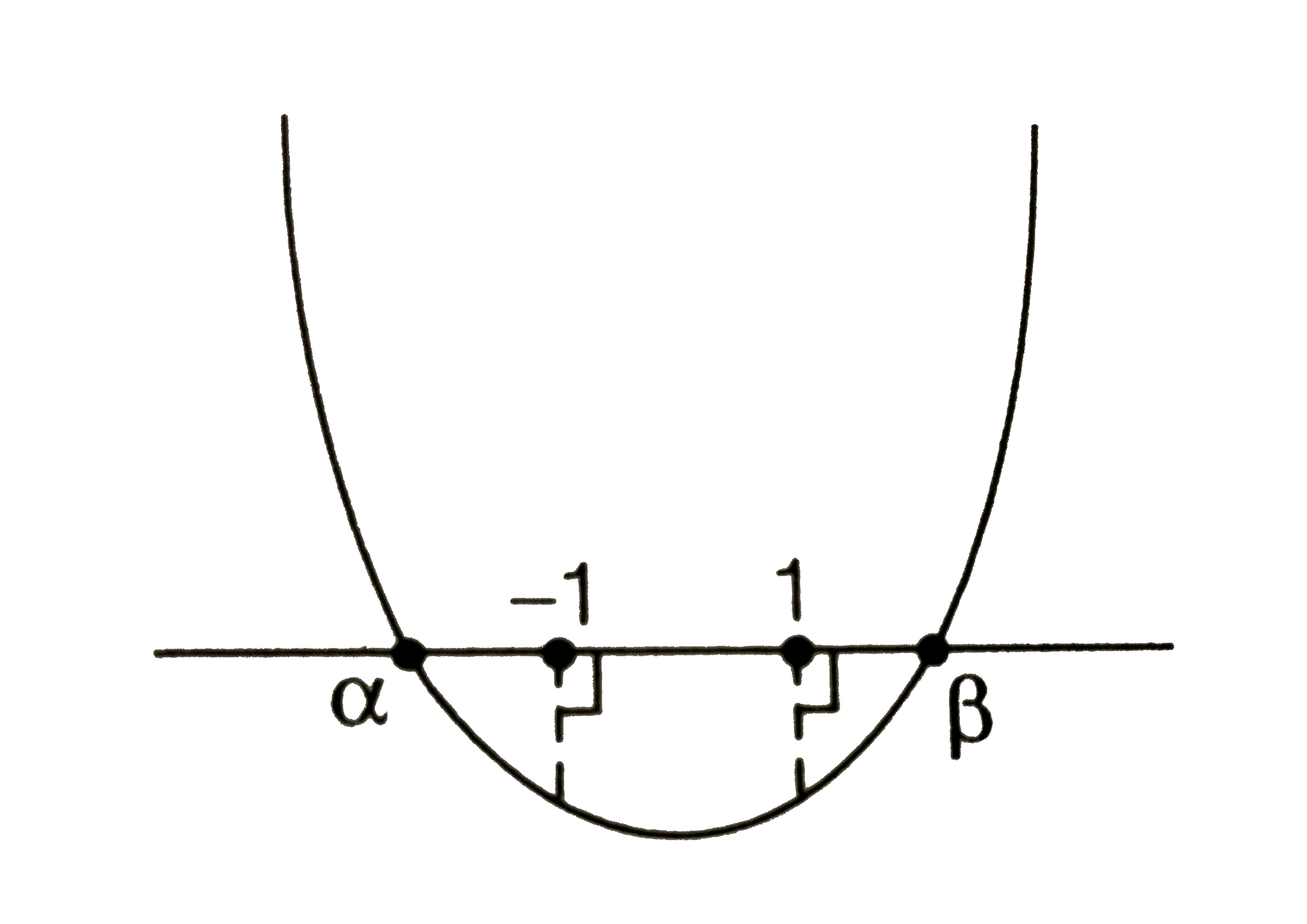
Since `alpha lt -1` and `betagt1`
`alpha+lamda=-1` and `beta=1+mu [ lamda, mugt0]`
Now `1+c/a+|b/a|=1+alpha beta+|alpha+beta|`
`=1+(-1-lamda)(1+mu)+|-1-lamda+1+mu|`
`=1-1-mu-1lamda-lamdamu+|mu-lamda|`
`=-mu-lamda-lamda mu+mu-lamda` [if `mugtlamda`]
and `=-mu-lamda-lamda mu+lamda-mu` [if `lamdagtmu`]
`:.1+c/a+|b/a|=-2lameda-lamda mu` or `-2mu-lamda mu`
On both cases `1+c/a+|b/a|lt0 [ :' lamda, mugt0]`
Aliter
`:'ax^(2)+bx+c=0, a!=0`
`x^(2)+b/ax+c/a=0`
Let `f(x)=x^(2)+b/ax+c/a`
`f(-1)lt0` and `f(1)lt0`
`implies1-b/a+c/alt0` and `1+b/a+c/alt0`
Then `1+|b/a|+c/alt0`
Promotional Banner

Similar Questions

Explore conceptually related problems

If a x^2+(b-c)x+a-b-c=0 has unequal real roots for all c in R ,then

If 2x^3 +ax^2+ bx+ 4=0 (a and b are positive real numbers) has 3 real roots, then prove that a+ b ge 6 (2^(1/3)+ 4^(1/3))

If 2a+3b+6c = 0, then show that the equation a x^2 + bx + c = 0 has atleast one real root between 0 to 1.

Let f(x)=x^(2)+bx+c and g(x)=x^(2)+b_(1)x+c_(1) Let the real roots of f(x)=0 be alpha, beta and real roots of g(x)=0 be alpha +k, beta+k fro same constant k . The least value fo f(x) is -1/4 and least value of g(x) occurs at x=7/2 The roots of g(x)=0 are

Let f(x) = x2 + b_1x + c_1. g(x) = x^2 + b_2x + c_2 . Real roots of f(x) = 0 be alpha, beta and real roots of g(x) = 0 be alpha+gamma, beta+gamma . Least values of f(x) be - 1/4 Least value of g(x) occurs at x=7/2

If x^2+3x+5=0 and a x^2+b x+c=0 have common root/roots and a ,b ,c in N , then find the minimum value of a+b+c .

If r be the ratio ofthe roots of the equation ax^2 +bx + c = 0 , show that (r+1)^2/r =(b^2)/(ac)

Let a and b be the roots of the equation x^2-10 c x-11 d=0 and those of x^2-10 a x-11 b=0 are c ,d then find the value of a+b+c+d when a!=b!=c!=d

Let a , b , c be nonzero real numbers such that int_0^1(1+cos^8x)(a x^2+b x+c)dx =int_0^2(1+cos^8x)(a x^2+b x+c)dx=0 Then show that the equation a x^2+b x+c=0 will have one root between 0 and 1 and other root between 1 and 2.

Let a ,b ,c be real numbers with a^2+b^2+c^2=1. Show that the equation |a x-b y-c b x-a y c x+a b x+a y-a x+b y-cc y+b c x+a c y+b-a x-b y+c|=0 represents a straight line.

