Home
Class 12
MATHS
The adjoining graph of y=ax^(2)+bx+c sho...

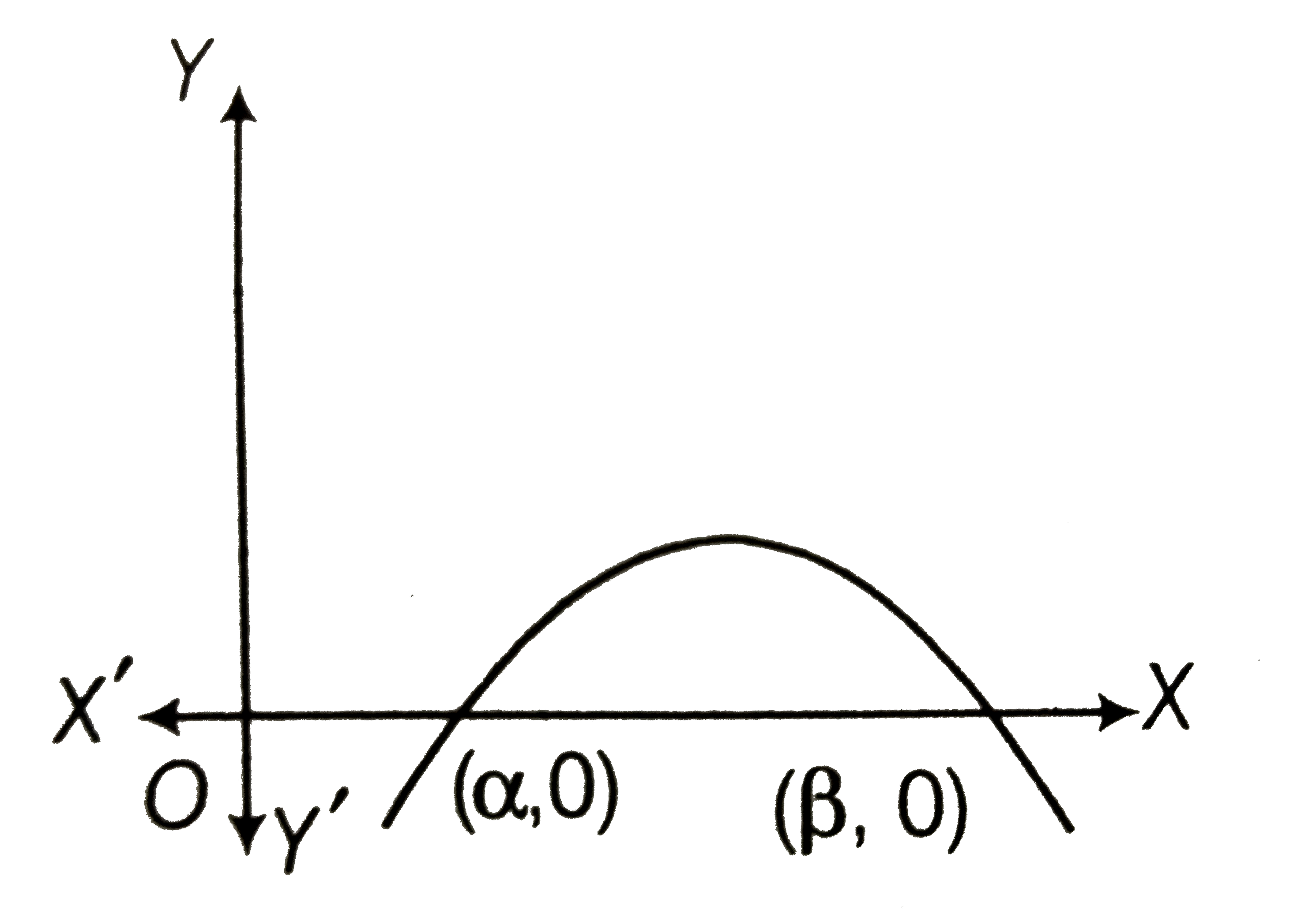
The adjoining graph of `y=ax^(2)+bx+c` shows that

A

`alt0`

B

`b^(2)lt4ac`

C

`cgt0`

D

a and b are of opposite signs

Text Solution

Verified by Experts

The correct Answer is:

A, D

It is clear from graph that the equation `y=ax^(2)+bx+c=0` has two real and distinct roots. Therefore
`b^(2)-4acgt0`………..i

`:.` Parabola open downwards.
`alt0`
and `y=ax^(2)+bx+c` cuts off `Y` axis at `x=0`
`:.y=clt0`
`implies c lt 0`
and x-coordinate of vertex `gt0`
`implies-b/(2a)gt0impliesb/alt0`
`impliesbgt0 [ :' a lt 0]`
It is clear that a and b are of opposite signs.
Promotional Banner

Similar Questions

Explore conceptually related problems

If r be the ratio ofthe roots of the equation ax^2 +bx + c = 0 , show that (r+1)^2/r =(b^2)/(ac)

Statement -1 The quadratic polynomial y=ax^(2)+bx+c(a!=0 and a,b, epsilonR) is symmetric about the line 2ax+b=0 Statement 2 Parabola is symmetric about its axis of symmetry.

If (-2,7) is the highest point on the graph of y =-2x^2-4ax +lambda , then lambda equals

Each coefficient in the equation ax^(2)+bx+c=0 is determined by throwing an ordinary die. The probability that roots of quadratic are imaginary, is

The equation formed by decreasing each root of ax^(2)+bx+c=0 by 1 is 2x^(2)+8x+2=0 then

Each coefficient in the equation ax^(2)+bx+c=0 is determined by throwing an ordinary die. Q. The probability that roots of quadratics are real and district, is

In the given figure graph of y = P(x) = ax^(5) + bx^(4) + cx^(3) + dx^(2) + ex + f , is given. The minimum number of real roots of equation (P''(x))^(2) + P'(x).P'''(x) = 0 , is

The number of polynomials of the form x^(3)+ax^(2)+bx+c that are divisible by x^(2)+1 , where a, b,c in{1,2,3,4,5,6,7,8,9,10} , is

Draw the graph of y=||x|^(2)-2|x|-3|, if the graph for y=x^(2)-2x-3 is given.

If alpha an beta are roots of ax^(2)+bx+c=0 the value for lim_(xto alpha)(1+ax^(2)+bx+c)^(2//x-alpha) is
