Home
Class 12
MATHS
If alpha, beta be the roots of 4x^(2) - ...

If `alpha, beta` be the roots of `4x^(2) - 16x + c = 0, c in R` such that `1 lt alpha lt 2 and 2 lt beta lt 3`, then the number of integral values of c is

Text Solution

Verified by Experts

The correct Answer is:
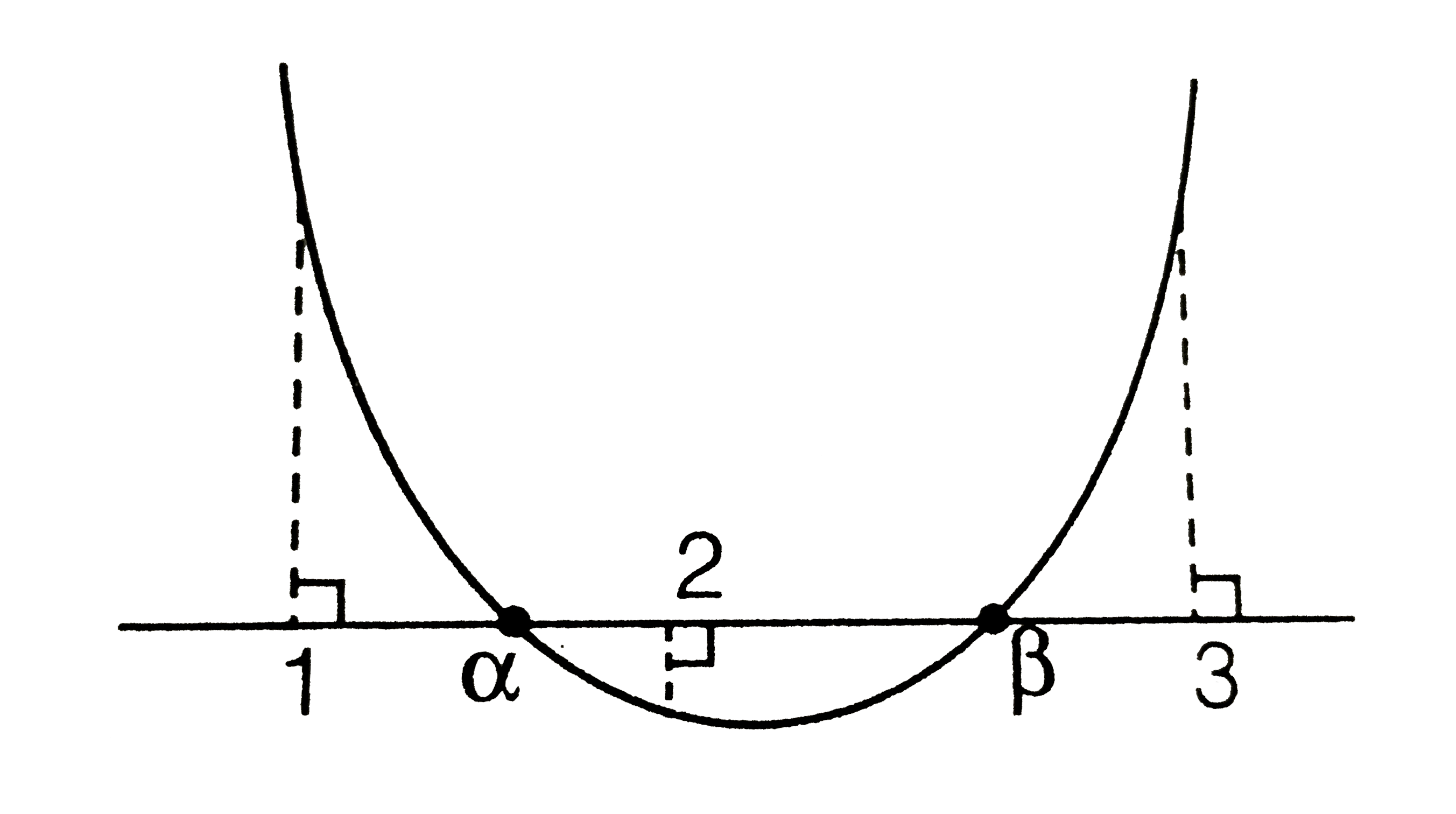
3

`:'4x^(2)-16x+c=0`
`implies x^(2)-4x+c/4=0`
Let `f(x)=x^(2)-4x+c/4`
Then the following case arises:

Case I `Dgt0`
`=16-cgt0`
`:.clt16`
Case II `f(1)gt0` ltbr `implies1-4+c/4gt0`
`impliesc/4gt3`
`:.cgt12`
Case III `f(2)lt0`
`implies4-8+c/4lt0`
`impliesc/4lt4`
`clt16`
Case IV `f(3)gt0`
`implies9-12+c/4gt0`
`impliesc/4gt3`
`impliescgt12`
Combining all cases, we get
`12ltclt16`
Thus, integral values of c are 13, 14 and 15.
Hence number of integral values of c is 3.
Promotional Banner

Similar Questions

Explore conceptually related problems

If alpha, beta are the roots of x^(2)-3x+1=0 , then the equation whose roots are (1/(alpha-2),1/(beta-2)) is

Let alpha and beta be the roots of x^2-x+p=0 and gamma and delta be the root of x^2-4x+q=0. If alpha,beta,a n dgamma,delta are in G.P., then the integral values of p and q , respectively, are

If alpha and beta (alpha lt beta) are the roots of the equation x^(2) + bx + c = 0 , where c lt 0 lt b , then

If alpha and beta are the roots of the equation 2x^2-3x + 4=0 , then the equation whose roots are alpha^2 and beta^2, is

Let alpha and beta be the roots of x^2-6x-2=0 with alpha>beta if a_n=alpha^n-beta^n for n>=1 then the value of (a_10 - 2a_8)/(2a_9)

Let alpha and beta be the roots of equation px^2 + qx + r = 0 , p != 0 .If p,q,r are in A.P. and 1/alpha+1/beta=4 , then the value of |alpha-beta| is :

ax^2 + bx + c = 0(a > 0), has two roots alpha and beta such alpha 2, then

If alpha, beta are the roots of the quadratic equation x^2 + bx - c = 0 , the equation whose roots are b and c , is

Let alpha and beta be roots of the equation X^(2)-2x+A=0 and let gamma and delta be the roots of the equation X^(2)-18x+B=0 . If alpha lt beta lt gamma lt delta are in arithmetic progression then find the valus of A and B.

If alpha and beta are the roots of x^2 - p (x+1) - c = 0 , then the value of (alpha^2 + 2alpha+1)/(alpha^2 +2 alpha + c) + (beta^2 + 2beta + 1)/(beta^2 + 2beta + c)

