Home
Class 12
MATHS
Suppose the cubic x^(3)-px+q has three d...

Suppose the cubic `x^(3)-px+q` has three distinct real roots, where `pgt0` and `qgt0`. Then which one of the following holds?

A

The cubic has minima at `(-sqrt(p/3))` and maxima at `sqrt(p/3)`

B

The cubic has minima at both `sqrt(p/3)` and `(-sqrt(p/3))`

C

The cubic has maxima at both `sqrt(p/3)` and `(-sqrt(p/3))`

D

The cubic has minima at `sqrt(p/3)` and maxima at `(-sqrt(p/3))`

Text Solution

Verified by Experts

The correct Answer is:
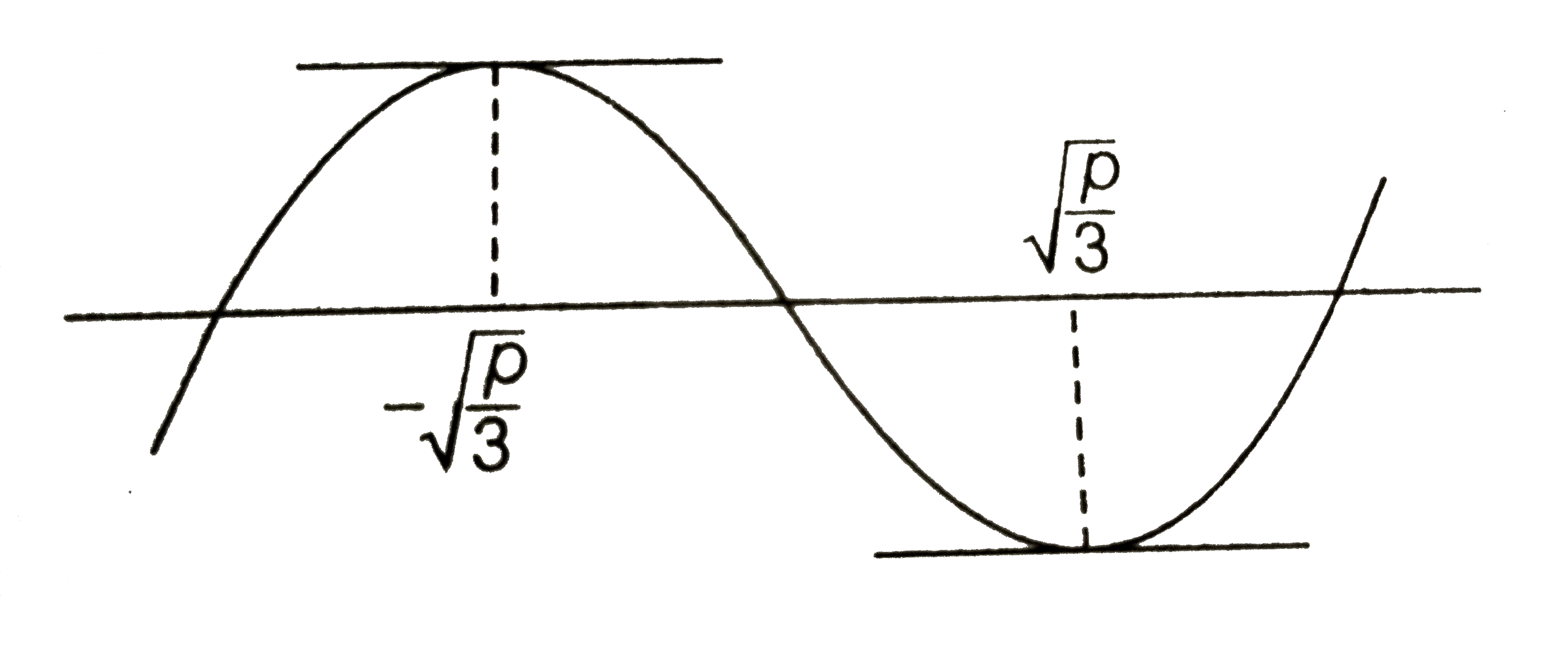
C

Let `f(x)=x^(3)-px+q`
`:.f'(x)=3x^(2)-p`
`impliesf''(x)=6x`

For maxima or minima `f'(x)=0`
`:.x=+-sqrt(p/3)`
`impliesf''(sqrt(p/3))=6sqrt((p/3))gt0`
and `f''(-sqrt(p/3)=-6sqrt(p/3)lt0`
Hence given cubic minima at `x=sqrt(p/3)` and maxima at `x=-sqrt(p/3)`
Promotional Banner

Similar Questions

Explore conceptually related problems

Find the value of a if x^3-3x+a=0 has three distinct real roots.

If the equation x^(3) +px +q =0 has three real roots then show that 4p^(3)+ 27q^(2) lt 0 .

Let S be the set of all non-zero numbers alpha such that the quadratic equation alphax^2-x+alpha=0 has two distinct real roots x_1, and x_2 satisfying the inequality |x_1-x_2|lt1 which of the following intervals is(are) a subset of S?

Given f(x)={3-[cot^(-1)((2x^3-3)/(x^2))]forx >0{x^2}cos(e^(1/x))forx<0 (where {} and [] denotes the fractional part and the integral part functions respectively). Then which of the following statements do/does hold good?

If the function f(x)=x^(3)-9x^(2)+24x+c has three real and distinct roots alpha, beta and gamma , then the value of [alpha]+[beta]+[gamma] is

If the equation x^(4)+px^(3)+qx^(2)+rx+5=0 has four positive real roots, find the maximum value of pr .

If p(q-r)x^2+q(r-p)x+r(p-q)=0 has equal roots, then;

f(x) is a cubic polynomial x^3 + ax^2+ bx + c such that f(x)=0 has three distinct integral roots and f(g(x)) = 0 does not have real roots, where g(x) = x^2 + 2x - 5, the minimum value of a + b + c is

Determine k so that the equation x^(2)-3kx+64=0 has no real roots.

Statement -1 If the equation (4p-3)x^(2)+(4q-3)x+r=0 is satisfied by x=a,x=b nad x=c (where a,b,c are distinct) then p=q=3/4 and r=0 Statement -2 If the quadratic equation ax^(2)+bx+c=0 has three distinct roots, then a, b and c are must be zero.

