Home
Class 12
MATHS
6 balls marked as 1,2,3,4,5 and 6 are ke...

6 balls marked as 1,2,3,4,5 and 6 are kept in a box. Two players A and B start to take out 1 ball at a time from the box one after another without replacing the ball till the game is over. The number marked on the ball is added each time to the previous sum to get the sum of numbers marked on the balls taken out. If this sum is even, then 1 point is given to the players. the first player to get 2 points is declared winner. at the start of the game, the sum is 0. if A starts to take out the ball, find the number of ways in which the game can be won.

Text Solution

Verified by Experts

The correct Answer is:
96

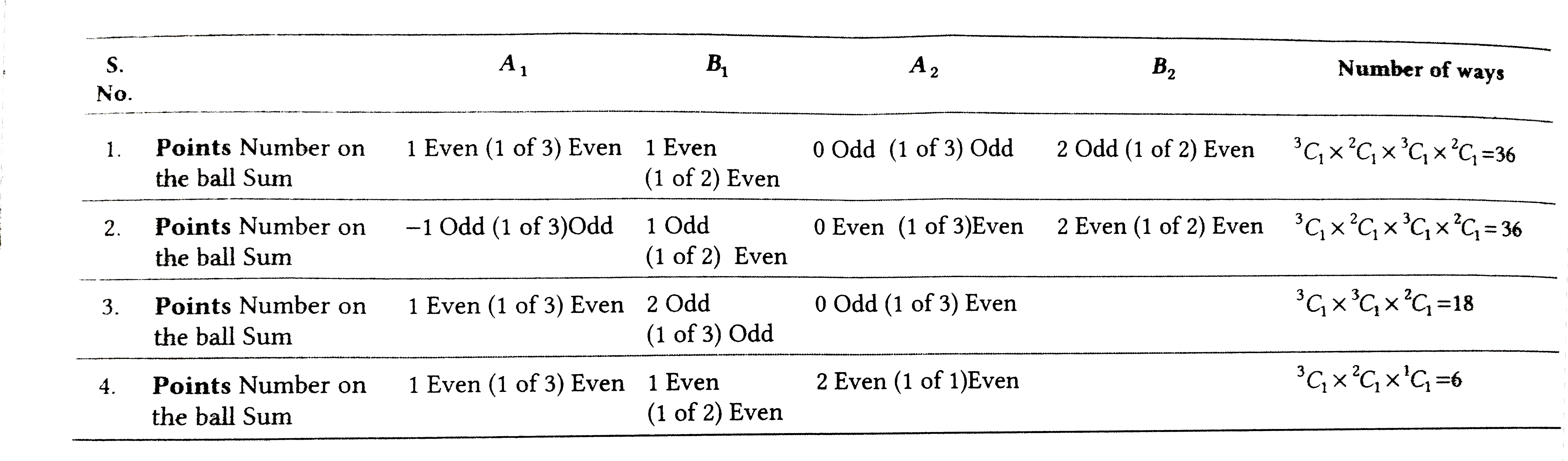
Denoting `A_(1),B_(1),A_(2) and B_2` for their taking out the ball, a chart is made to denote the winner.

`therefore`Total number of ways in which the game can be won when A starts the game =36+36+18+6=96.
Promotional Banner

Similar Questions

Explore conceptually related problems

An urn contains 10 black and 5 white balls. Two balls are drawn from the urn one after the other without replacement. What is the probability that both drawn balls are black ?

A box contains 3 green and 5 white balls. Three balls are drawn from it one after the other with replacement. Find probability distribution of the number of green balls.

A bag contains 5 black and 6 red balls. Determine the number of ways in which 2 black and 3 red balls can be selected.

A bag contains a white and b black balls. Two players, A and B alternately draw a ball from the bag, replacing the ball each time after the draw till one of them draws a white ball and wins the game. A begins the game. If the probability of A winning the game is three times that of B , then find the ratio a : b

A box contains 1 red and 3 identical white balls. Two balls are draw at random in succession without replacement. Write the sample space for this experiment.

A bag contains 5 red and 3 blue balls. If 3 balls are drawn at random without replacement the probability of getting exactly one red ball is ……..

A bag contains 5 red balls and some blue balls. If the probability of drawing a blue ball is double that of a red ball, determine the number of blue balls in the bag.

There are 6 red and 8 green balls in a bag. 5 balls are drawn at random and placed in a red box. The remaining balls are placed in a green box. What is the probability that the number of red balls in the green box plus the number of green balls in the red box is not a prime number?

A box contains 15 green and 10 yellow balls. If 10 balls are randomly drawn, one-by-one, with replacement, then the variance of the number of green balls drawn is :

