Home
Class 12
MATHS
Consider all possible permutations of th...

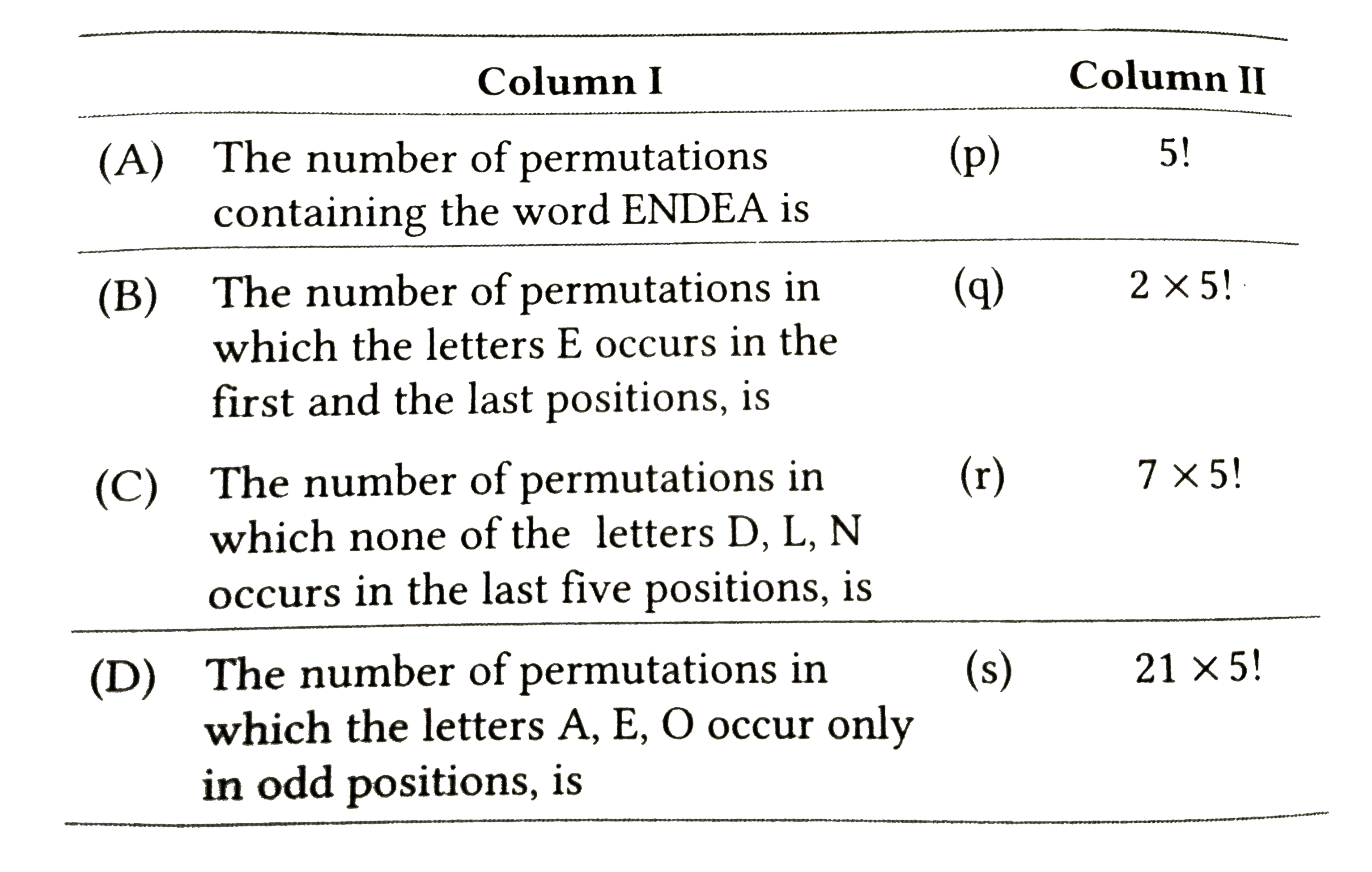
Consider all possible permutations of the letters of the word ENDEANOEL. Match the statements/ expressions in column I with the statement/expressions in

Text Solution

Verified by Experts

The correct Answer is:

A, B, C, D

`(A)to(p),(B)to(s),(C)to(q),(D)to(q)`
(A) ENDEA, N,O,E,L are five different letters, then perrmutations=5!.
(B) if E is in the first and last position, then permutations
`=(7!)/(2!)=(7xx6xx5!)/(2)=21xx5!`
(C) for first four letters`=(4!)/(2!)=4xx3=12` and for last five
letters`=(5!)/(3!)=(5!)/(6)`, then permutations `=12xx(4!)/(2!)=12`, then permutations `=(5!)/(3!)xx12=(5!)/(6)xx12=2xx5!`
Promotional Banner

Similar Questions

Explore conceptually related problems

The number of other permutations of the letters of the word SIMPLETON taken all at a time is :

Match the statements in bb"Column I" with those in bb"Column II" .

Column I gives a list of possible set of parameters measured in some expermients. The varitions of the parameters in the form of graphs ar shown in Column II. Match the set of parameters given Column I with the graph given in Column II. Indicate your answer by darking the appropriate bubbles of the 4 xx 4 matrix given in the ORS.

If the different permutations of all the letter of the word EXAMINATION are listed as in a dictionary, how many words are there in this list before the first word starting with E ?

In each situation of column-I, a system involving two bodies is given. All strings and pulleys are light and friction is absent everywhere. Initially each body of every system is at rest. Consider the system in all situation of column I from rest till any collision occurs. Then match the statements in column - I with the corresponding results in column - II

Some physical quanties are given in Column I and some possible SI units in which these quantities may be expressed are given in Column II. Match the physical quantities in Column I with the units in Column II. {:(,"Column I",,,"Column II"),((A),GM_(e)M_(s),,(p),("volt")("coulomb")("metre")),(,G-"universal gravitational constant",,,),(,M_(e)-"mass of the earth," M_(s)- "mass of the sun",,,),((B),(3RT)/(M),,(q),("kilogram")("metre")^(3)("second")^(-2)),(,R-"universal gas constant,",,,),(,T- "absolute temperature, M- molar mass",,,),((C),F^(2)/(q^(2)B^(2)),,(r),("metre")^(2)("second")^(-2)),(,F-"force,"q-"charge," B- "magnetic field",,,),((D),(GM_(e))/R_(e),,(s),("farad")("volt")^(2)(kg)^(-1)),(,G- "universal gravitational constant,",,,),(,M_(e)- "mass of the earth," R_(e)- "radius of the earth.",,,):}

In the shown expermiental setup to study photoelectric effect, two conducting electrodes are enclosed in an evacuated glass-tube as shown. A parallel beam of monochromatic light, falls on photosensitive electrodes. The emf of battery shwon is high enough such that all photoelectron ejected from left electrode will reach the right electrode. Under initial conditions photoelectrons are emitted. AS changes are made in each situation of column-I, Match the statements in column-I with results in column-II. {:(,"Column I",,"Column II"),((A),"If frequency of incident light is increased keeping its intensity constant",(p),"magnitude of stopping potential"),((B),"If frequency of incident light is increased and its intensity is decreased",(q),"current through circuit may stop"),((C),"If work function of photo sensitive electrode is increased",(r),"maximum kinetic energy of ejected photoelectrons will increase"),((D),"If intensity of incident light is increased keeping its frequency constant",(s),"saturation current will increase"):}

Column I contains rational algebraic expressions and Column II contains possible integers which lie in their range. Match the entries of Column I with one or more entries of the elements of Column II.

Column I contain rational algebraic expressions and ColumnII contains possible integers which lie in their range. Match the entries of Column I with one or more entries of the elements of Column II.

A copper rod (initially at room temperature 20^(@)C ) of non-uniform cross section is placed between a steam chamber at 100^(@)C and ice-water chamber at 0^(@)C . A and B are cross sections are as shown in figure. Then match the statements in column -I with results in columns-II using comparing only between cross section A and B . (The mathematical expressions in column-I have usual meaning in heat transfer). {:(,"Column-I",,"Column-II"),((A),"initially rate of heat flow" ((dQ)/(dt))"will be ",(p),"Maximum at section" A),((B),"At steady state rate of heat flow" ((dQ)/(dt)) "will be ",(q),"Maximum at section" B),((C),"At steady state temperature gradient" |((dT)/(dx))| "will be " ,(r),"Minimum at section B"), ((D), "At steady state rate of change of temperature"((dT)/(dt)) " at a certain point will be",(s),"Same for all section"):}
