A
B
C
D
Text Solution
Verified by Experts
The correct Answer is:



Similar Questions
Explore conceptually related problems
Recommended Questions
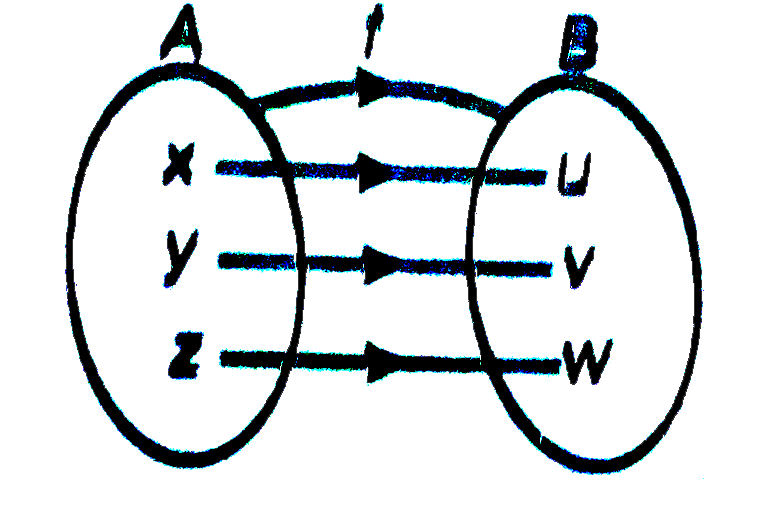
- Let A = {x, y, z), B = {u, v, w} and f : A rarr B be defined by f(x) =...
Text Solution
|
- Let A={a ,\ b ,\ c} , B={u\ v ,\ w} and let f and g be two functions f...
Text Solution
|
- If quad f(x)=((x-a)(x-b))/(x) and ((f(z))/((z-x)(z-y))+((f(y))/((y-z)(...
Text Solution
|
- Let A={x,y,z}=B={u,v,w) and f:A to B be defined by f (x)=u, f(y)=v, f(...
Text Solution
|
- Let f(x) be defined on R such that f(1)=2,f(2)=8 and f(u+v)=f(u)+kuv-2...
Text Solution
|
- A, Z, B, Y, C, X, D, W, E, V, F, U, G, ?
Text Solution
|
- माना A = {a, b,c} , B = { u , v , w} और f : A to B , g : B to A क्रमशः...
Text Solution
|
- यदि f(x)=log(e)x जहाँ xgt0, तो सिद्ध कीजिए - f((u)/(v))=f(u)-f(v).
Text Solution
|
- यदि f(x)=log(e)x,(xgt0), तो सिद्ध कीजिए । f(uvw)=f(u)+f(v)+f(w).
Text Solution
|