Home
Class 12
MATHS
If a, b, c be the vectors represented by...

If a, b, c be the vectors represented by the sides of a triangle taken in order, then a+b+c=0

Text Solution

Verified by Experts
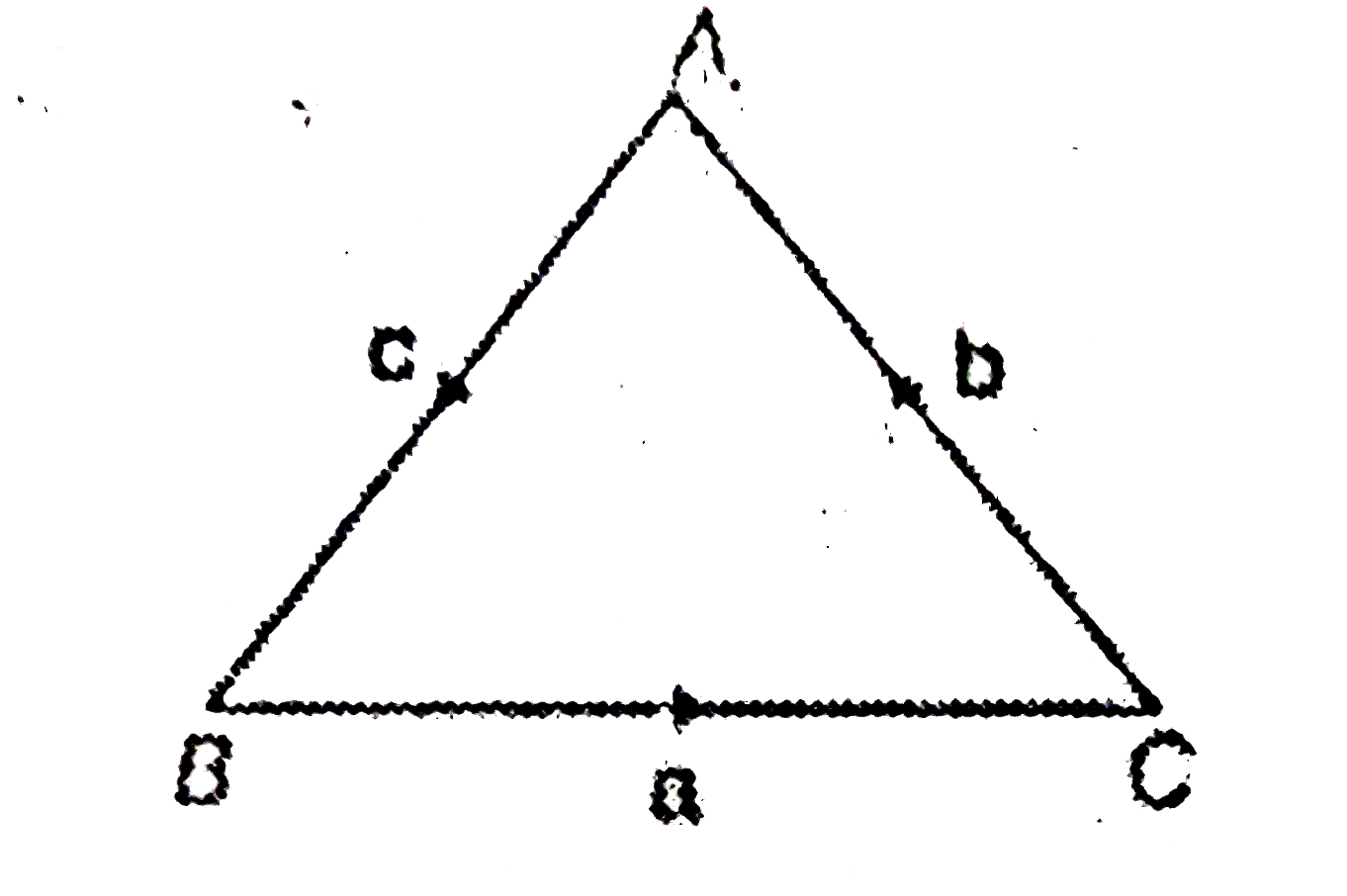
Let ABC be a triangle such that
BC=a,CA=b and AB=c

Then, a+b+c=BC+CA+AB `(becauseBC+CA=BA)`
`=-AB+AB`
a+b+c=0 Hence proved.
Promotional Banner

Similar Questions

Explore conceptually related problems

Assertion: The minimum number of vectors of unequal magnitude required to produce zero resultant is three. Reason: Three vectors of unequal magnitude which can be represented by the three sides of a triangle taken in order, produce zero resultant.

If vec(a) and vec(b) are the vectors determined by two adjacent sides of a regular hexagonn ABCDEF. What are the vectors determined by the other sides taken in order ?

If a,b,and c are the side of a triangle and A,B and C are the angles opposite to a,b,and c respectively, then Delta=|{:(a^(2),bsinA,CsinA),(bsinA,1,cosA),(CsinA,cos A,1):}| is independent of

Statement 1: If vec u a n d vec v are unit vectors inclined at an angle alphaa n d vec x is a unit vector bisecting the angle between them, then vec x=( vec u+ vec v)//(2sin(alpha//2)dot Statement 2: If "Delta"A B C is an isosceles triangle with A B=A C=1, then the vector representing the bisector of angel A is given by vec A D=( vec A B+ vec A C)//2.

Forces proportional to AB, BC & 2 CA act along the sides of triangle ABC in order, their resultant represented in magnitude and direction as:

If a, b, c are the side of a right triangle where c is the hypotenuse, prove that the radius of the circle which touches all the side of the triangle is given by r= (a+b-c)/2 .

If a,b and c are the position vectors of the vertices A,B and C of the DeltaABC , then the centroid of DeltaABC is

If g, h, k denotes the side of a pedal triangle, then prove that (g)/(a^(2))+ (h)/(b^(2))+ (k)/(c^(2))=(a^(2)+b^(2) +c^(2))/(2 abc)

Let a,b,c be the sides of a triangle. No two of them are equal and lambda in R If the roots of the equation x^2+2(a+b+c)x+3lambda(ab+bc+ca)=0 are real, then

If vec xa n d vec y are two non-collinear vectors and a, b, and c represent the sides of a A B C satisfying (a-b) vec x+(b-c) vec y+(c-a)( vec x X vec y)=0, then A B C is (where vec x X vec y is perpendicular to the plane of xa n dy ) a. an acute-angled triangle b. an obtuse-angled triangle c. a right-angled triangle d. a scalene triangle

