Home
Class 12
MATHS
If O is the circumcentre and O' the orth...

If O is the circumcentre and O' the orthocenter of `DeltaABC` prove that
(i) SA+SB+SC=3SG, where S is any point in the plane of `DeltaABC`.
(ii) OA+OB+OC=OO'
Where, AP is diameter of the circumcircle.

Text Solution

Verified by Experts
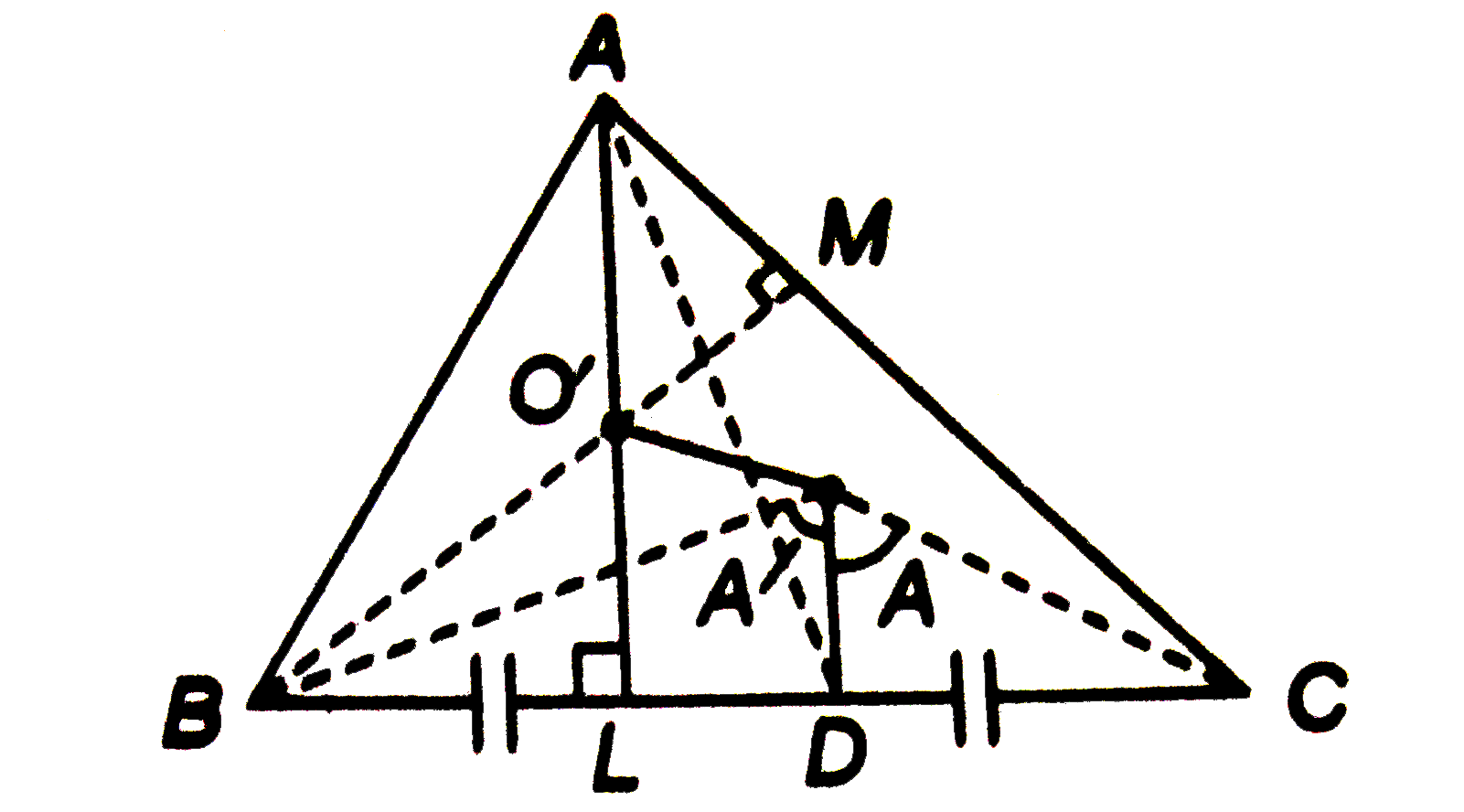
Let G be the centroid of `DeltaABC`, first we shall show that circumcentre O, orthocenter O' and centroid G are collinear and O'G=2OG.

Let AL and BM be perpendiculars on the sides BC and CA, respectively. Let AD be the median and OD be the perpendicular from O on side BC. iff R is the circumradius of circumcircle of `DeltaABC`, then OB=OC=R.
In `DeltaOBD,` we have OD=R cosA . . . (i)
In `DeltaABM,AM=AB cos A=c cosA` . . . (ii)
form `DeltaAO'M,AO'=AMsec(90^(@)-C)`
=c cos A cosec C
`=(c)/(sinC)*cosA=2RcosA " "(because(a)/(sinA)=(b)/(sinB)=(c)/(sinC)=2R)`
`AO'=2(OD)` . . . (iii)
Now, `DeltaAGO' and DeltaOGD` are similar.
`therefore(OG)/(O*G)=(GD)/(GA)=(OD)/(AO')=(1)/(2)` [using Eq. (iii)]
`implies 2OG=O'G`
(i) We have, `SA+SB+SC=SA+(SB+SC)`
`=SA+2SD` (`because` D is the mid-point of BC)
`=(1+2)+SG=8SG`.
(ii) On replacing S by O in Eq. (i), we get
`OA+OB+OC=3OG`
`=2OG+OG=GO'+OG`
`=OG+GO'+O O'`.
Promotional Banner

Similar Questions

Explore conceptually related problems

Let O, O' and G be the circumcentre, orthocentre and centroid of a Delta ABC and S be any point in the plane of the triangle. Statement -1: vec(O'A) + vec(O'B) + vec(O'C)=2vec(O'O) Statement -2: vec(SA) + vec(SB) + vec(SC) = 3 vec(SG)

if D,E and F are the mid-points of the sides BC,CA and AB respectively of the DeltaABC and O be any points, then prove that OA+OB+OC=OD+OE+OF

A student performs an experiment to determine how the range of a ball depends on the velocity with which it is projected. The "range" is the distance between the points where the ball lends and from where it was projected, assuming it lands at the same height from which it was projected. It each trial, the student uses the same baseball, and launches it at the same angle. Table shows the experimental results. |{:("Trail","Launch speed" (m//s),"Range"(m)),(1,10,8),(2,20,31.8),(3,30,70.7),(4,40,122.5):}| Based on this data, the student then hypothesizes that the range, R, depends on the initial speed v_(0) according to the following equation : R=Cv_(0)^(n) , where C is a constant and n is another constant. The student speculates that the constant C depends on :- (i) The angle at which the ball was launched (ii) The ball's mass (iii) The ball's diameter If we neglect air resistance, then C actually depends on :-

Consider a thin lens placed between a source (S) and an observer (O) (see figure) . Let the thicknes of the lens very as w(b) = w_0 - (b^2)/(alpha) , where b is the verticle distance from the pole. w_0 is constant. Using Fermat.s principle i.e. the time of transit for a ray between the source and observer is an extremum, find the condition that all paraxial rays starting from the source will converage at a point O on the axis. Find the focal length. (ii) A gravitational lens may be assumed to have a varying width of the from w(b) = k_1 "ln" ((k_2)/(b)) b_("min") lt b lt b_("max") = k_1 "ln" ((k_2)/(b_"min")) b lt b_("min") Show that an observe will see an image of a point object as a right about the center of the lens with and angular radius beta=sqrt(((n-1)k_1(u)/(v))/(u+v))

O is any point inside a rectangle ABCD (see the given figure). Prove that OB^(2)+OD^(2)= OA^(2)+OC^(2) .

Let vec(OA)=vec(a),vec(OB)=10vec(a)+2vec(b) and vec(OC)=vec(b) where O is origin. Let P denotes the area of the quadrilateral OABC and q denote the area of the parallelogram with OA and OC as adjacent side. Prove that P = 6q.

In a tetrahedron OABC, if OA=hat(i), OB=hat(i)+hat(j) and OC=hat(i)+2hat(j)+hat(k) ,if shortest distance between egdes OA and BC is m, then sqrt(2)m is equal to …(where O is the origin).

In the given figure, O is a point in the interior of a DeltaABC, OD bot BC, OE bot AC" and "OF bot AB . Show that : OA^(2)+OB^(2)+OC^(2)-OD^(2)-OE^(2)-OF^(2)= AF^(2)+BD^(2)+CE^(2) .

On the xy plane where O is the origin, given points, A(1, 0), B(0, 1) and C(1, 1) . Let P, Q, and R be moving points on the line OA, OB, OC respectively such that overline(OP)=45t overline((OA)),overline(OQ)=60t overline((OB)),overline(OR)=(1-t) overline((OC)) with t>0. If the three points P,Q and R are collinear then the value of t is equal to

