Home
Class 12
MATHS
If D ,Ea n dF are three points on the si...

If `D ,Ea n dF` are three points on the sides `B C ,C Aa n dA B ,` respectively, of a triangle `A B C` such that AD,BE and CF are concurrent, then show that `(B D)/(C D),(C E)/(A E),(A F)/(B F)=-1`

Text Solution

Verified by Experts
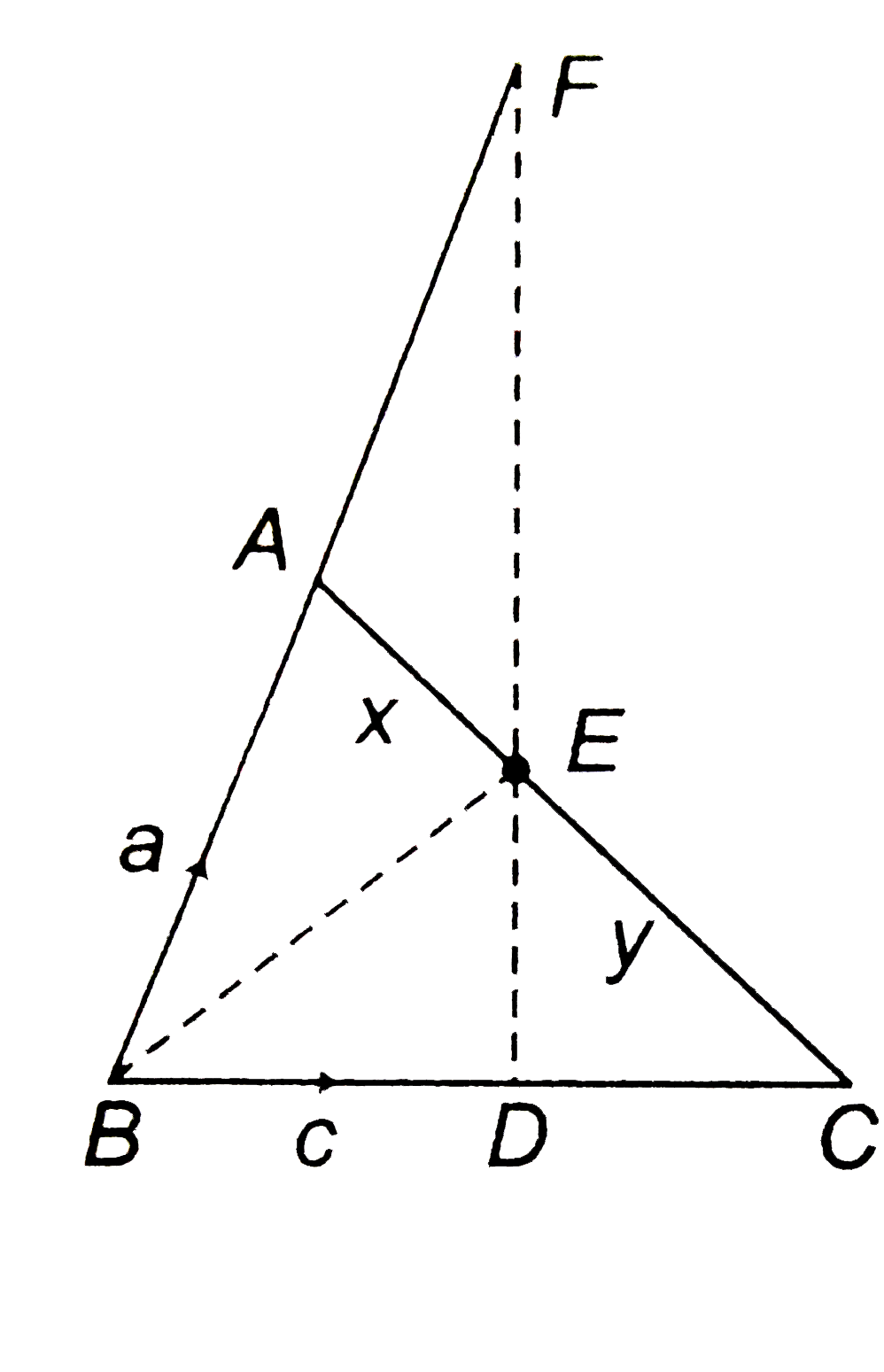
Here, D, E and F be the points on the sides BC,CA and AB respectively of `DeltaABC`. Such that points D,E and F are collinear, be shawn as the adjoining figuece.
Let B as the origin, BA=a and BC=c
The, BF=ka and BD=lc

where, k and l are scalars.
`therefore(BD)/(BC)=l and (BF)/(BA)=k`
`impliesBC:BD=1:l`
`implies(BC)/(BD)-1=(1)/(l)-1implies(DC)/(BD)=(1-l)/(l)`
`implies(BD)/(DC)=(l)/(1-l) and (BA)/(BF)=(1)/(k)`
`implies1-(BA)/(BF)=1-(1)/(k)implies (AF)/(BF)=(k-1)/(k)`
Now, let E divide the line AC in the ratio of x:y
so, that `BE=(xc+ya)/(x+y)=(x*(BD)/(l)+y*(BF)/(k))/(x+y)`
`implies BE-(x)/(l(x+y))BD-(y)/(k(x+y))BF=0`
Since, D,E and F are collinear.
Sum of coefficient must be zero.
hence, `1-(x)/(l(x+y))-(y)/(k(x+y))=0`
`implies(x+y)-(x)/(l)-(y)/(k)=0impliex+y=(x)/(l)+(y)/(k)`
`implies x(1-(1)/(l))=y((1)/(k)-1)impliesx((l-1)/(l))=y((1-k)/(k))`
`implies (l)/(l-1)*(y)/(x)*(k-1)/(k)=1`
`implies(BD)/(DC)*(CE)/(AE)*(AF)/(BF)=1` [using Eqs. (i), (ii) and (iii)].
Promotional Banner

Similar Questions

Explore conceptually related problems

If the vectors vec a , vec b ,a n d vec c form the sides B C ,C Aa n dA B , respectively, of triangle A B C ,t h e n

A,B,C and D have position vectors a,b,c and d, respectively, such that a-b=2(d-c). Then,

From the given figures identify the A,B,C,D,E and F

If vec a , vec b , vec c , vec d are the position vector of point A , B , C and D , respectively referred to the same origin O such that no three of these point are collinear and vec a + vec c = vec b + vec d , than quadrilateral A B C D is a ;

In an acute triangle A B C if sides a , b are constants and the base angles Aa n dB vary, then show that (d A)/(sqrt(a^2-b^2sin^2A))=(d B)/(sqrt(b^2-a^2sin^2B))

If in a triangle A B C , the side c and the angle C remain constant, while the remaining elements are changed slightly, using differentials show that (d a)/(cosA)+(d b)/(cosB)=0

Statement 1: if three points P ,Qa n dR have position vectors vec a , vec b ,a n d vec c , respectively, and 2 vec a+3 vec b-5 vec c=0, then the points P ,Q ,a n dR must be collinear. Statement 2: If for three points A ,B ,a n dC , vec A B=lambda vec A C , then points A ,B ,a n dC must be collinear.

If a,b,c,d,e,f are in A.P. then d-b= ……

In a right triangle with legs a and b and hypotenuse c, angles A,B and C are opposite to the sides a,b and c respectively, then e^(lnb-lna) is equal to-

