Home
Class 12
MATHS
Let OABCD be a pentagon in which the sid...

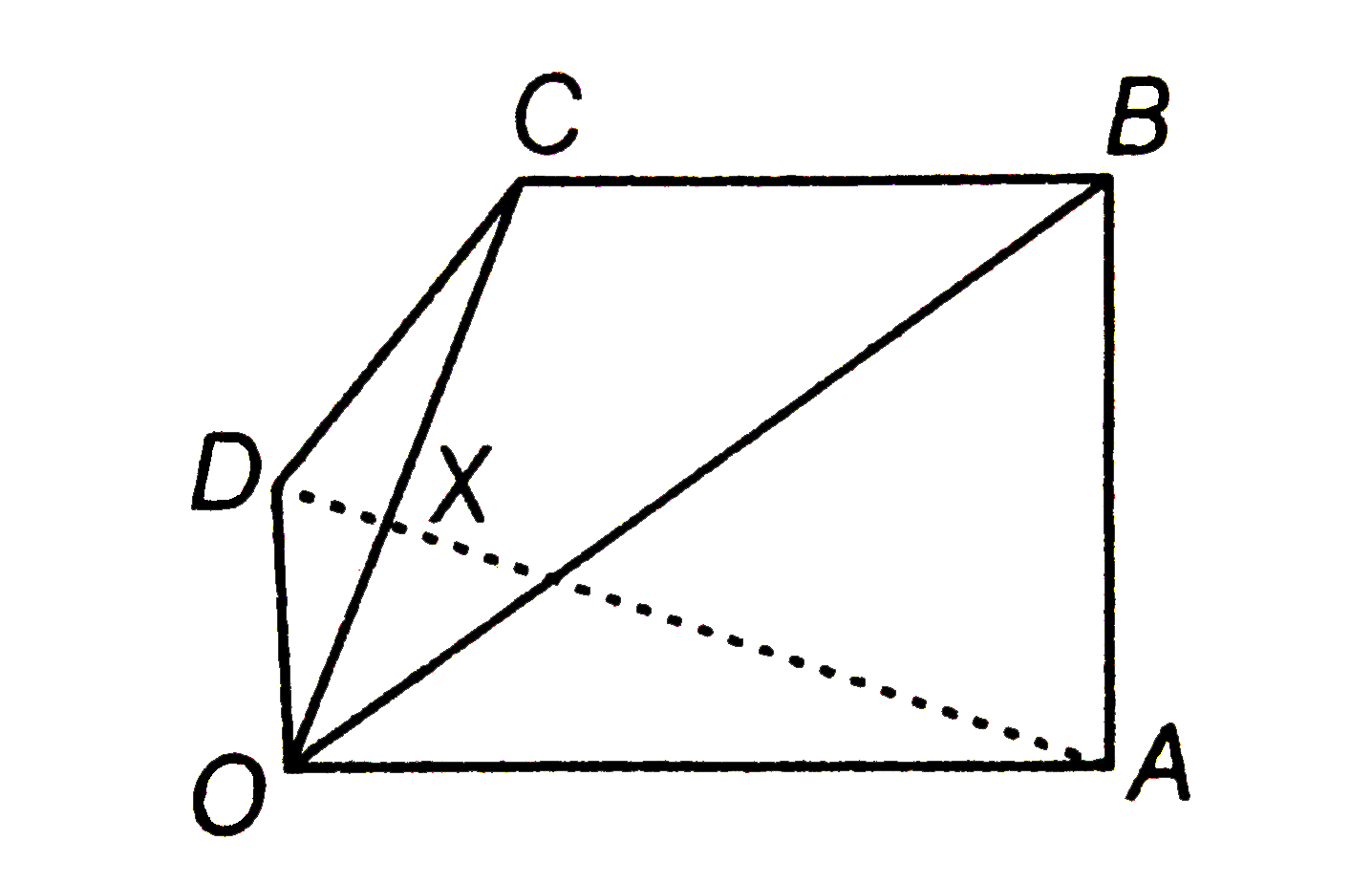
Let OABCD be a pentagon in which the sides OA and CB are parallel and the sides OD and AB are parallel. Also, OA:CB=2:1 and OD:AB=1:3.

Q. The ratio `(OX)/(XC)` is

Text Solution

Verified by Experts

The correct Answer is:
`2:5`

Let O be the origin of reference.
Let the position vectors of A,B,C and D be a,b,c and d,
respectively.
then, `OA:CB=2:1`
`implies (OA)/(CB)=(2)/(1)implies OA+2CB`

`implies OA=2CB`
`implies a=2(b-c)` . . . (i)
and `OD:AB=1:3`
`implies (OD)/(AB)=(1)/(3) implies 3OD=AB`
`implies 3OD=AB`
`implies 3d=(b-a)=b-2(b-c)` [using eq. (i)]
`implies 3d=-b+2c` . . . (ii)
Let OX:XC=`lamda:1 and AX:XD=mu:1`
Now, X divides OC in the ratio `lamda:1`. therefore,
PV of `X=(lamdac)/(lamda+1)` . . . (iii)
X also divides AD in the ratio `mu:1`
PV of X`=(mud+a)/(mu+1)`
from eqs. (iii) and (iv), we get
`(lamdac)/(lamda+1)=(mud+a)/(mu+1)`
`implies ((lamda)/(lamda+1))c=((mu)/(mu+1))d+((1)/(mu+1))a`
`implies((lamda)/(lamda+1))c=((mu)/(mu+1))((-b+2c)/(3))+((1)/(mu+1))2(b-c)`
[using eqs. (i) and (iv)]
`implies((lamda)/(lamda+1))c=((2)/(mu+1)-(mu)/(3(mu+1)))b+((2mu)/(3(mu+1))-(2)/(mu+1))c`
`implies ((lamda)/(lamda+1))c=((6-mu)/(3(mu+1)))b+((2mu-6)/(3(mu+1)))c`
`implies ((6-mu)/(3(mu+1)))b+((2mu-6)/(3(mu+1))-(lamda)/(lamda+1))c=0`
`implies (6-mu)/(3(mu+1))=0 and (2mu-6)/(3(mu+1))-(lamda)/(lamda+1)=0`
(since, b and c are non-collinear)
`implies mu=6 and lamda=(2)/(5)`
Hence, `OX:XC=2:5`
Promotional Banner

Similar Questions

Explore conceptually related problems

Let OABCD be a pentagon in which the sides OA and CB are parallel and the sides OD and AB are parallel as shown in figure. Also, OA:CB=2:1 and OD:AB=1:3. if the diagonals OC and AD meet at x, find OX:OC.

Let ABCD be a trapezium ,in which AB is parallel to CD, AB =11 ,BC=4,CD=6 and DA=3. the distance between AB and CD is

In a right trianlge ABC right angled at C, P and Q are the points on the sides CA and CB respectively which divide these sides in the ratio 2 : 1. Prove that 9(AQ^(2)+BP^(2))= 13AB^(2) .

In the triangle OAB , M is the midpoint of AB, C is a point on OM, such that 2 OC = CM . X is a point on the side OB such that OX = 2XB. The line XC is produced to meet OA in Y. Then (OY)/(YA)=

D and E are points on the sides CA and CB respectively of a DeltaABC right angled at C. Prove that AE^(2)+BD^(2)= AB^(2)+DE^(2) .

In the given figure, the line segment XY is parallel to side AC of DeltaABC and it divides the Deltainto two parts of equal areas. Find the ratio (AX)/(AB) .

If E, F G and H are respectively the midpoints of the sides AB, BC, CD and AD of a parallelogram ABCD, show that ar(EFGH) =1/2 ar (ABCD) .

In the adjacent figure the sides AB and AC of Delta ABC are produced to points E and D respectively. If bisectors BO and CO of angleCBE and angleBCD respectively meet at point O, then prove that angleBOC = 90^(@)-(1)/(2) angleBAC .

In a right triangle ABC right angled at C, P and Q are points on sides AC and CB respectively which divide these sides in the ratio of 2 : 1. Prove that (i) 9 AQ^(2) = 9AC^(2) + 4BC^(2) (ii) 9BP^(2) = 9BC^(2) + 4AC^(2) (iii) 9 (AQ^(2) + BP^(2)) = 13 AB^(2)

A line passes through the points A(2,-3) and B(6,3) . Find the slopes of the lines which are , (i) parallel to AB (ii) perpendicular to AB

