Home
Class 12
MATHS
A square is drawn by joining mid point o...

A square is drawn by joining mid point of the sides of a square. Another square is drawn inside the second square in the same way and the process is continued infinitely. If the side of the first square is 16 cm, then what is the sum of the areas of all the squares ?

Text Solution

Verified by Experts
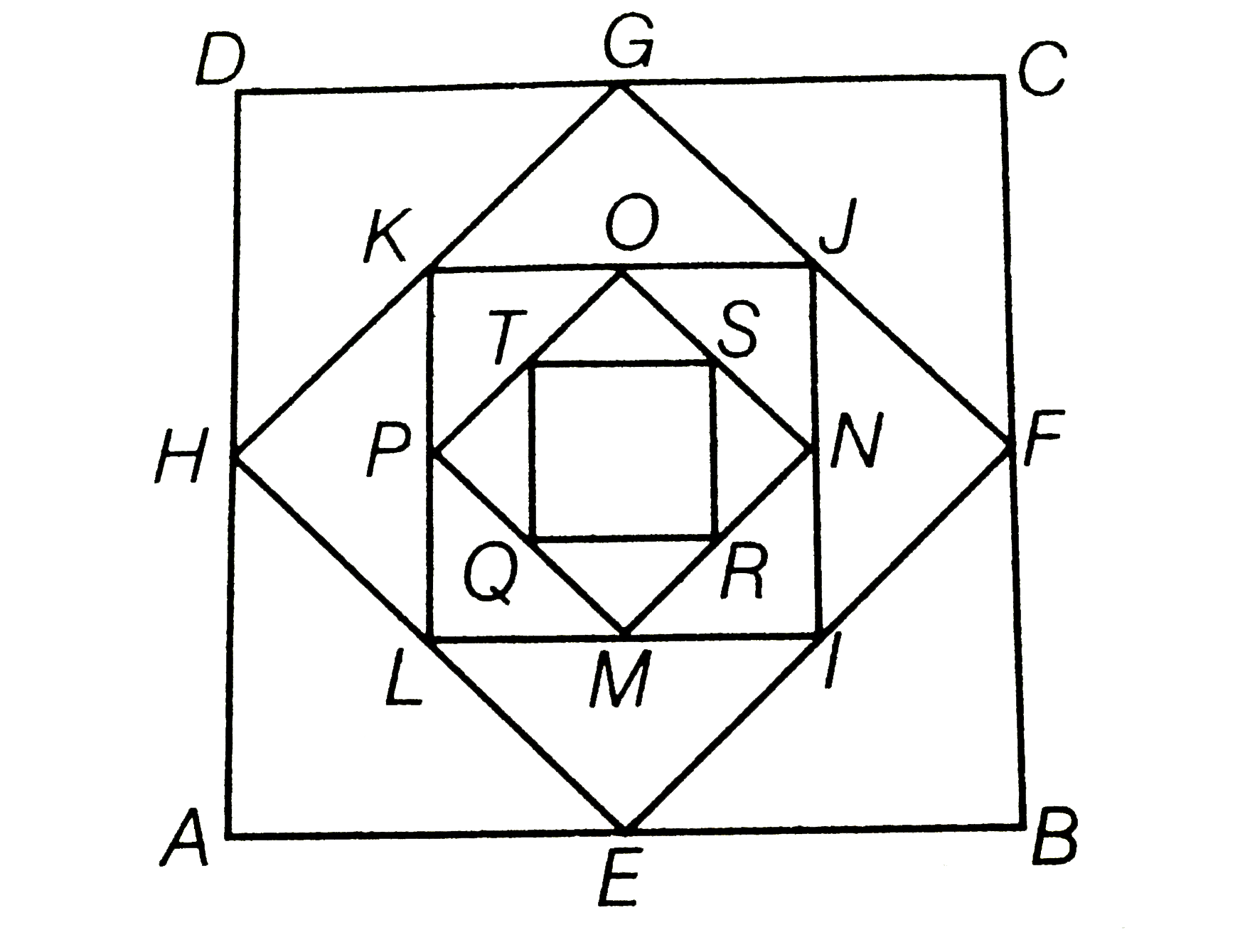
Let a be the side lengh of square, than
`AB=BC=CD=DA=a`
`therefore` E,F,G,H are the mid-points of AB,BC,CD and DA, respectively.
`therefore EF=FG=GH=HE=(a)/(sqrt(2))`
and I,J,K,L are the mid-points of EF,FG,GH and HE, respectively.
`therefore IJ=JK=KL=LI=(a)/(2)`
Similarly, `MN=NO=OP=PM=(a)/(2sqrt(2))` and `QR=RS=ST=TQ=(a)/(4),"....."`
S=Sum of areas =`ABCD+EFGH+IJKL+MNOP+QRST+"..."`
`a^(2)+((a)/(sqrt2))^(2)+((a)/(sqrt2))^(2)+((a)/(2sqrt2))^(2)+"...."`
`=a^(2)(1+(1)/(2)+(1)/(4)+(1)/(8)+"...")`
`=a^(2)((1)/(1-(1)/(2)))=2a^(2)=2(16)^(2) " " [therefore a=16" cm "]`
`=512sq " cm "`
.
Promotional Banner

Similar Questions

Explore conceptually related problems

If the sum of first n terms of an AP is cn^(2) , then the sum of squares of these n terms is

The side of a given square is 10cm. The mid points of its sides are joined to form a new square. Again the mid poind of the sides of this new square are joined to form another square. This process is continued indefinitely. Find the sum of the area.

If one side of a squre be represented by the vectors 3hati+4hatj+5hatk , then the area of the square is

Prove that the sum of the squares of the sides of a rhombus is equal to the sum of the squares of its diagonals.

Prove that the sum of the squares of the diagonals of a parallelogram is equal to the sum of the squares of its sides.

A point charge + mu c is a distance 5 cm directly above the centre of a square of side 10 cm as what is the magnitude of the electric flux through the square

State whether each of the following statements is true or false : The side of a square is 10 cm, then its diagonal is 10 sqrt(3) cm.

If the diagonal of a square is 'a' units, what is the diagonal of the square, whose are is doubel that of the first square?

The sum of the perimeter of a circle and square is k, where k is some constant. Prove that the sum of their areas is least when the side of square is double the radius of the circle.

One side of an equilateral triangle is 24 cm. The midpoints of its sides are joined to form another triangle whose midpoints are in turn joined to form still another triangle this process continues indefinitely. The sum of the perimeters of all the triangles is

