Home
Class 12
MATHS
ABC is a right angled triangle in which ...

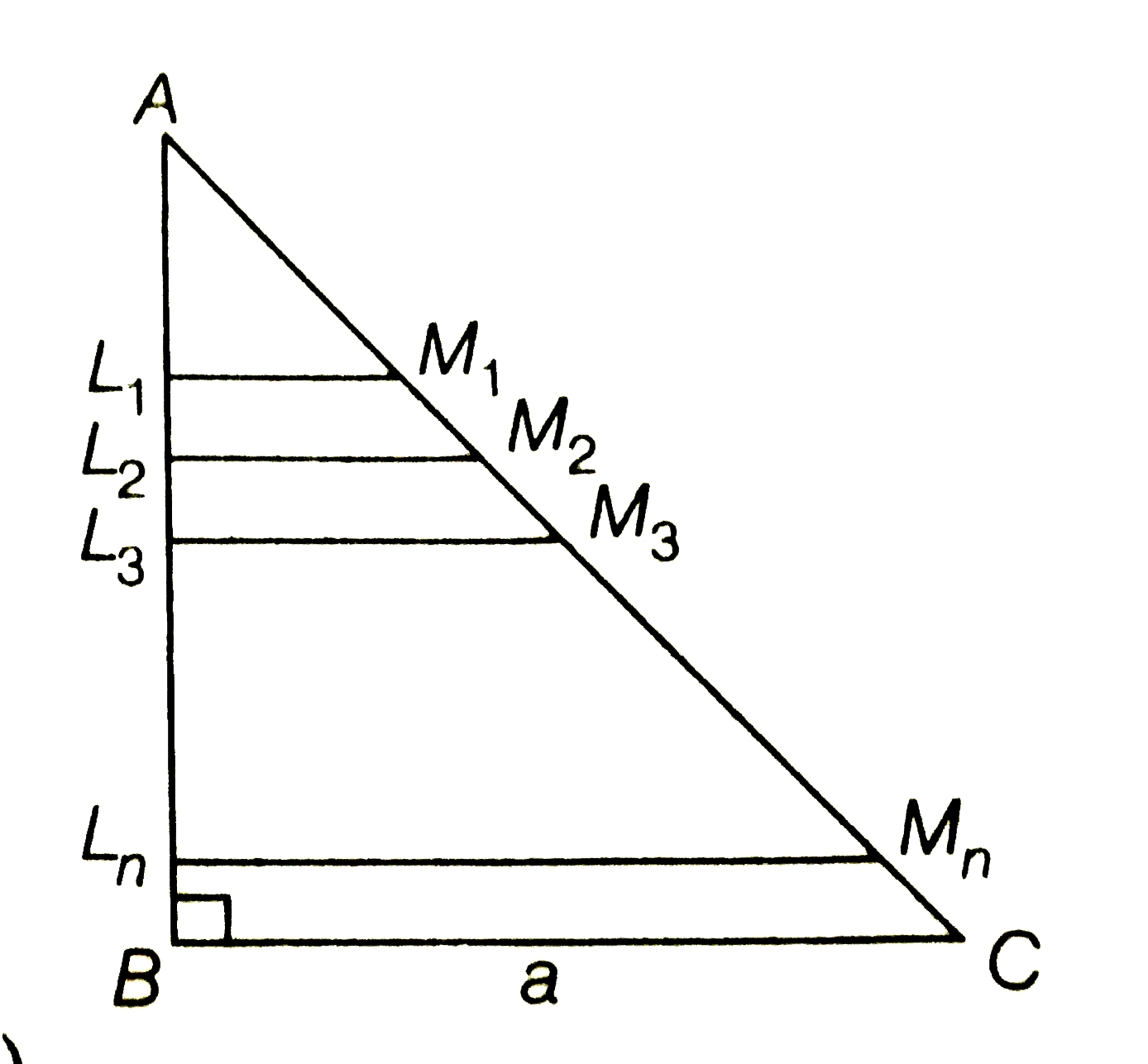
ABC is a right angled triangle in which `/_B=90^(@)` and BC=a. If n points `L_(1),L_(2),"…….",L_(n)` on AB are such that AB is divided in `n+1` equal parts and `L_(1)M_(1),L_(2)M_(2),"......,"L_(n)M_(n)` are line segments parallel to BC and `M_(1),M_(2),M_(3),"......,"M_(n)` are on AC, the sum of the lenghts of `L_(1)M_(1),L_(2)M_(2),"......,"L_(n)M_(n)` is

A

`(n(n+1))/((2)`

B

`(a(n-1))/(2)`

C

`(an)/(2)`

D

Impossible to find from the given data

Text Solution

Verified by Experts

The correct Answer is:
C

`:. (AL_(1))/(AB)=(L_(1)M_(1))/(BC) implies L_(1)M_(1)=(a)/(n+1)`
Similarly, `L_(2)M_(2)=(2a)/(n+1)`
`L_(3)M_(3)=(3a)/(n+1)`
`vdots " " vdots " " vdots " "`
`L_(n)M_(n)=(na)/(n+1)`
`L_(1)M_(1)+L_(2)M_(2)+"…."+L_(n)M_(n)`
`=(a)/((n+1))(1+2+3+"....."+n)`
`=(a)/((n+1))*(n(n+1))/(2)=(na)/(2)`
Promotional Banner

Similar Questions

Explore conceptually related problems

What is indicated by n, l and m_(l) ?

If m is the AM of two distinct real numbers l and n (l,ngt1) and G_(1),G_(2)" and "G_(3) are three geometric means between l and n, then G_(1)^(4)+2G_(2)^(4)+G_(3)^(4) equals

State the value of n, l, m_(l) and m_(s) for 4f.

In Delta ABC , point M on AB and point N on AC are such that AM = (1)/(4)AC and AN =(1)/(4)AC . Prove that MN =(1)/(4) BC

If the line lx + my = 1 is a tangent to the circle x^(2) + y^(2) = a^(2) , then the point (l,m) lies on a circle.

Three perfect gases at absolute temperature T_(1), T_(2) and T_(3) are mixed. The masses f molecules are m_(1), m_(2) and m_(3) and the number of molecules are n_(1), n_(2) and n_(3) respectively. Assuming no loss of energy, the final temperature of the mixture is

How many orbitals are there if n= 3, l =2, m_(l) = + 2?

Statement I: If a=2hati+hatk,b=3hatj+4hatk and c=lamda a+mub are coplanar, then c=4a-b . Statement II: A set vector a_(1),a_(2),a_(3), . . ,a_(n) is said to be linearly independent, if every relation of the form l_(1)a_(1)+l_(2)a_(2)+l_(3)a_(3)+ . . .+l_(n)a_(n)=0 implies that l_(1)=l_(2)=l_(3)= . . .=l_(n)=0 (scalar).

What is shape of the orbital with (i) n = 2 and l = 0 , (ii) n = 2 and l = 1?

If r_(1),r_(2) and r_(3) are the position vectors of three collinear points and scalars l and m exists such that r_(3)=lr_(1)+mr_(2) , then show that l+m=1.

