PQ and PR are two infinite rays. QAR is an arc. Point lying in the shaded region excluding the boundary satisfies.
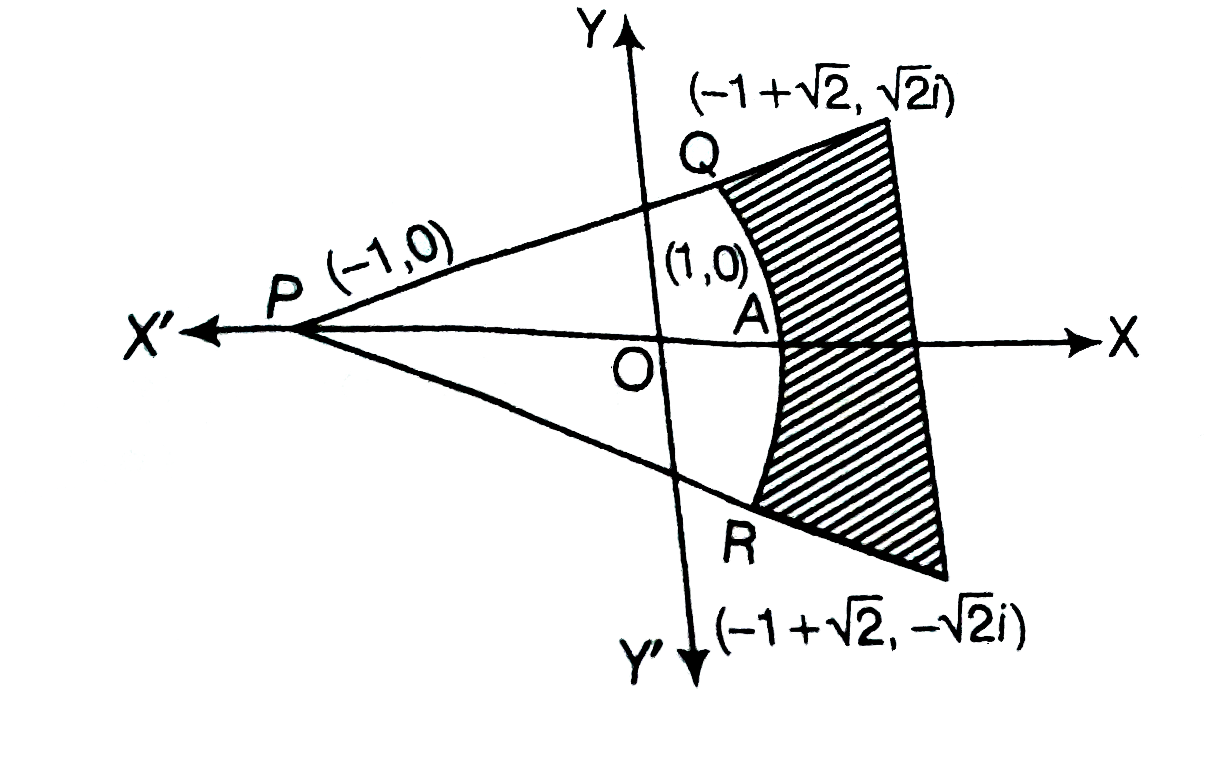
PQ and PR are two infinite rays. QAR is an arc. Point lying in the shaded region excluding the boundary satisfies.
A
`abs(z-1) ge 2 , abs(arg(z-1)) lt (pi)/(4)`
B
`abs(z-1) ge 2 , abs(arg(z-1)) lt (pi)/(2)`
C
`abs(z+1) ge 2 , abs(arg(z+1)) lt (pi)/(4)`
D
`abs(z+1) ge 2 , abs(arg(z+1)) lt (pi)/(3)`
Text Solution
Verified by Experts
The correct Answer is:
C



Similar Questions
Explore conceptually related problems
A corner point of a feasible region is a point in the region which is the ……….. of two boundary lines.
Through a point P (-2,0), tangerts PQ and PR are drawn to the parabola y^2 = 8x. Two circles each passing through the focus of the parabola and one touching at Q and other at R are drawn. Which of the following point(s) with respect to the triangle PQR lie(s) on the radical axis of the two circles?
Thin films, including soap bubbles and oil show patterns of alternative dark and bright regions resulting from interference among the reflected light waves. If two waves are in phase, their crests and troughs will coincide. The interference will be constructive and the amplitude of resultant wave will be greater then either of constituent waves. If the two wave are not of phase by half a wavelength (180^(@)) , the crests of one wave will coincide width the troughs of the other wave. The interference will be destructive and the amplitude of the resultant wave will be less than that of either constiuent wave. 1. When incident light I, reaches the surface at point a, some of the light is reflected as ray R_(a) and some is refracted following the path ab to the back of the film. 2. At point b, some of the light is refracted out of the film and part is reflected back through the film along path bc. At point c, some of the light is reflected back into the film and part is reflected out of the film as ray R_(c) . R_(a) and R_(c) are parallel. However, R_(c) has traveled the extra distance within the film of abc. If the angle of incidence is small, then abc is approximately twice the film's thickness . If R_(a) and R_(c) are in phase, they will undergo constructive interference and the region ac will be bright. If R_(a) and R_(c) are out of phase, they will undergo destructive interference and the region ac will be dark. I. Refraction at an interface never changes the phase of the wave. II. For reflection at the interfere between two media 1 and 2, if n_(1) gt n_(2) , the reflected wave will change phase. If n_(1) lt n_(2) , the reflected wave will not undergo a phase change. For reference, n_(air) = 1.00 . III. If the waves are in phase after reflection at all intensities, then the effects of path length in the film are: Constrictive interference occurs when 2 t = m lambda // n, m = 0, 1,2,3 ,... Destructive interference occurs when 2 t = (m + (1)/(2)) (lambda)/(n) , m = 0, 1, 2, 3 ,... If the waves are 180^(@) out of the phase after reflection at all interference, then the effects of path length in the film area: Constructive interference occurs when 2 t = (m + (1)/(2)) (lambda)/(n), m = 0, 1, 2, 3 ,... Destructive interference occurs when 2 t = (m lambda)/(n) , m = 0, 1, 2, 3 ,... 72. A film with index of refraction 1.50 coats a glass lens with index of refraction 1.80. What is the minimum thickness of the thin film that will strongly reflect light with wavelength 600 nm?
Thin films, including soap bubbles and oil show patterns of alternative dark and bright regions resulting from interference among the reflected ligth waves. If two waves are in phase, their crests and troughs will coincide. The interference will be cosntructive and the amlitude of resultant wave will be greater then either of constituent waves. If the two wave are not of phase by half a wavelength (180^(@)) , the crests of one wave will coincide width the troughs of the other wave. The interference will be destructive and the ampliutde of the resultant wave will be less than that of either consituent wave. 1. When incident light I, reaches the surface at point a, some of the ligth is reflected as ray R_(a) and some is refracted following the path ab to the back of the film. 2. At point b, some of the light is refracted out of the film and part is reflected back through the film along path bc. At point c, some of the light is reflected back into the film and part is reflected out of the film as ray R_(c) . R_(a) and R_(c) are parallel. However, R_(c) has travelled the extra distance within the film fo abc. If the angle of incidence is small, then abc is approxmately twice the film's thickness . If R_(a) and R_(c) are in phase, they will undergo constructive interference and the region ac will be bright. If R_(a) and R_(c) are out of phase, they will undergo destructive interference and the region ac will be dark. I. Refraction at an interface never changes the phase of the wave. II. For reflection at the interfere between two media 1 and 2, if n_(1) gt n_(2) , the reflected wave will change phase. If n_(1) lt n_(2) , the reflected wave will not undergo a phase change. For reference, n_(air) = 1.00 . III. If the waves are in phase after reflection at all intensities, then the effects of path length in the film are: Constrictive interference occurs when 2 t = m lambda // n, m = 0, 1,2,3 ,... Destrcutive interference occurs when 2 t = (m + (1)/(2)) (lambda)/(n) , m = 0, 1, 2, 3 ,... If the waves are 180^(@) out of the phase after reflection at all interference, then the effects of path length in the film ara: Constructive interference occurs when 2 t = (m + (1)/(2)) (lambda)/(n), m = 0, 1, 2, 3 ,... Destructive interference occurs when 2 t = (m lambda)/(n) , m = 0, 1, 2, 3 ,... A soap film of thickness t is surrounded by air and is illuminated at near normal incidence by monochromatic light wavelength lambda in the film. With respect to the wavelength of the monochromatic ligth in the film, what film thickness will produce maximum consturctive interference
Thin films, including soap bubbles and oil show patterns of alternative dark and bright regions resulting from interference among the reflected ligth waves. If two waves are in phase, their crests and troughs will coincide. The interference will be cosntructive and the amlitude of resultant wave will be greater then either of constituent waves. If the two wave are not of phase by half a wavelength (180^(@)) , the crests of one wave will coincide width the troughs of the other wave. The interference will be destructive and the ampliutde of the resultant wave will be less than that of either consituent wave. 1. When incident light I, reaches the surface at point a, some of the ligth is reflected as ray R_(a) and some is refracted following the path ab to the back of the film. 2. At point b, some of the light is refracted out of the film and part is reflected back through the film along path bc. At point c, some of the light is reflected back into the film and part is reflected out of the film as ray R_(c) . R_(a) and R_(c) are parallel. However, R_(c) has travelled the extra distance within the film fo abc. If the angle of incidence is small, then abc is approxmately twice the film's thickness . If R_(a) and R_(c) are in phase, they will undergo constructive interference and the region ac will be bright. If R_(a) and R_(c) are out of phase, they will undergo destructive interference and the region ac will be dark. I. Refraction at an interface never changes the phase of the wave. II. For reflection at the interfere between two media 1 and 2, if n_(1) gt n_(2) , the reflected wave will change phase. If n_(1) lt n_(2) , the reflected wave will not undergo a phase change. For reference, n_(air) = 1.00 . III. If the waves are in phase after reflection at all intensities, then the effects of path length in the film are: Constrictive interference occurs when 2 t = m lambda // n, m = 0, 1,2,3 ,... Destrcutive interference occurs when 2 t = (m + (1)/(2)) (lambda)/(n) , m = 0, 1, 2, 3 ,... If the waves are 180^(@) out of the phase after reflection at all interference, then the effects of path length in the film ara: Constructive interference occurs when 2 t = (m + (1)/(2)) (lambda)/(n), m = 0, 1, 2, 3 ,... Destructive interference occurs when 2 t = (m lambda)/(n) , m = 0, 1, 2, 3 ,... A thin film with index of refraction 1.33 coats a glass lens with index of refraction 1.50. Which of the following choices is the smallest film thickness that will not reflect light with wavelength 640 nm?
Which of the following statements are true and which are false ? Give reasons for your answers : (i) Only one line can pass through a single point. (ii) There are an infinite number of lines which pass through two distinct points. (iii) A terminated line can be produced indefinitely on both the sides. (iv) If two circles are equal, then their radii are equal. (v) In the given figure, if AB = PQ and PQ = XY, then AB = XY.
Thin films, including soap bubbles and oil slicks, show patterns of alternating dark and bright regions resulting from interference among the reflected light waves. If two waves are in phase their crest and troughs will coincide. The interference will be constructive and the aplitude of the resultant wave will be greater than the amplitude of either constituent wave. if the two waves are out of phase, the crests of one wave will coincide with the troughs of the other wave. The interference will be destructive and the amplitude of the resultant wave will be less than that of either constituent wave. at the interface between two transparent media some light is reflected and some light is refracted. * When incident light, reaches the surface at point a, some of the light is reflected as ray R_(a) and and some is refracted following the path ab to the back of the film. *At point b some of the light is refracted out of the film and part is reflected back refracted out of the fiml as ray R_(c) . R_(a) and R_(c) are parallel. However, R_(c) has travelled the extra distance within the film of abc. if the angle of incidence is small then abc is approximately twice the film's thickness. if R_(a) and R_(c) are in phase they will undergo constructive interference and the region ac will be bright if R_(a) and R_(c) are out of phase, they will undergo destructive interference. * Refraction at an interface never changes the phase of the wave. * For reflection at the interface between two media 1 and 2, if n_(1)ltn_(2) the reflected wave will change phase by pi . if n_(1)gtn_(2) the reflected wave will not undergo a phase change. for reference n_(air)=1.00 * if the waves are in phase after refection at all interfaces, then the effects of path length in the film are Constructive interference occur when (n= refractive index) 2t=mlamda//n" "m=0,1,2,3... .. Destructive interference occurs when 2t=(m+1//2)lamda//n" "m=0,1,2,3... Q. A 600 nm light is perpendicularly incident on a soap film suspended in air. The film is 1.00 mum thick with n=1.35. Which statement most accurately describes the interference of the light reflected by the two surfaces of the film?
Thin films, including soap bubbles and oil slicks, show patterns of alternating dark and bright regions resulting from interference among the reflected light waves. If two waves are in phase their crest and troughs will coincide. The interference will be constructive and the aplitude of the resultant wave will be greater than the amplitude of either constituent wave. if the two waves are out of phase, the crests of one wave will coincide with the troughs of the other wave. The interference will be destructive and the amplitude of the resultant wave will be less than that of either constituent wave. at the interface between two transparent media some light is reflected and some light is refracted. * When incident light, reaches the surface at point a, some of the light is reflected as ray R_(a) and and some is refracted following the path ab to the back of the film. *At point b some of the light is refracted out of the film and part is reflected back refracted out of the fiml as ray R_(c) . R_(a) and R_(c) are parallel. However, R_(c) has travelled the extra distance within the film of abc. if the angle of incidence is small then abc is approximately twice the film's thickness. if R_(a) and R_(c) are in phase they will undergo constructive interference and the region ac will be bright if R_(a) and R_(c) are out of phase, they will undergo destructive interference. * Refraction at an interface never changes the phase of the wave. * For reflection at the interface between two media 1 and 2, if n_(1)ltn_(2) the reflected wave will change phase by pi . if n_(1)gtn_(2) the reflected wave will not undergo a phase change. for reference n_(air)=1.00 * if the waves are in phase after refection at all interfaces, then the effects of path length in the film are Constructive interference occur when (n= refractive index) 2t=mlamda//n" "m=0,1,2,3... .. Destructive interference occurs when 2t=(m+1//2)lamda//n" "m=0,1,2,3... Q. The average human eye sees colors with wavelengths between 430 nm to 680 nm. For what visible wavelength will a 350 nm thick n=1.35 soap film produce maximum destructive interference?
The method of electrical images is used to solve the electrostatic problems, where charge distribution is not specified completely. The method consists of replacement of given charge distribution by a simplified charge distribution or a signal point charge or a number of point charges [rovided the original boundary conditions are still satisfied. For example consider a system consider a system containing a point charge q placed at a distance d of form an infinite conducting plane. The boundary conditions are : (i) Potential is zero at infinity (ii) Potential is zero at each point on the conducting plane If we replaced the conducting plane by a point charge (-q) placed at a distance 'd' opposite to conducting plane. The charge (-q) is called the electrical image. Now system consists of two charge +q an -q at seperation 2d . If charge +q moves to a distance 'y' from the boundary of conducting plane (now absent), the electrical image -q also moves to the same 'y' from the boundary of conducting plane, so that the new distance between +q and -q is 2y The force between point charge +q and earthed conducting plane is
The method of electrical images is used to solve the electrostatic problems, where charge distribution is not specified completely. The method consists of replacement of given charge distribution by a simplified charge distribution or a signal point charge or a number of point charges [rovided the original boundary conditions are still satisfied. For example consider a system consider a system containing a point charge q placed at a distance d of form an infinite conducting plane. The boundary conditions are : (i) Potential is zero at infinity (ii) Potential is zero at each point on the conducting plane If we replaced the conducting plane by a point charge (-q) placed at a distance 'd' opposite to conducting plane. The charge (-q) is called the electrical image. Now system consists of two charge +q an -q at seperation 2d . If charge +q moves to a distance 'y' from the boundary of conducting plane (now absent), the electrical image -q also moves to the same 'y' from the boundary of conducting plane, so that the new distance between +q and -q is 2y The potential energy of system of charge +q placed at a distance d from the earthed conducting plane is
Recommended Questions
- PQ and PR are two infinite rays. QAR is an arc. Point lying in the sha...
Text Solution
|
- How many lines of symmetry does the above figure have ? <img src="http...
Text Solution
|
- Which of the following are correct chain isomers of butane ? (i) <img ...
Text Solution
|
- Determine the point of symmetry of a regular hexagon. <img src="htt...
Text Solution
|
- Dtermine the images of the following figure about the given line : ...
Text Solution
|
- Find the area of the shaded region, given that the radius of each circ...
Text Solution
|
- Match the following Column A to Column B
Text Solution
|
- Match the following Column A to Column B
Text Solution
|
- Match the following Column A to Column B
Text Solution
|