Home
Class 12
CHEMISTRY
The magnitude ( but not the sign ) of th...

The magnitude `(` but not the sign `)` of the standard reduction potentials of two metals `X` and `Y` are `:`
`Y^(2)+2e^(-) rarr Y |E_(1)^(c-)|=0.34V`
`X^(2)+2e^(-) rarr X |E_(2)^(c-)|=0.25V`
When the two half cells of `X` and `Y `are connected to construct a cell, eletrons flow from `X` to `Y`. When `X` is connected to a standard hydrogen electrode `(SHE)`,electrons flow from `X` to `SHE`.
If standard emf `(E^(c-))` of a half cell `Y^(2)|Y^(o+)` is `0.15V`, the standard emf of the half cell `Y^(o+)|Y` will be

A

`0.19V`

B

`0.53V`

C

`0.49V`

D

`0.64V`

Text Solution

Verified by Experts

The correct Answer is:
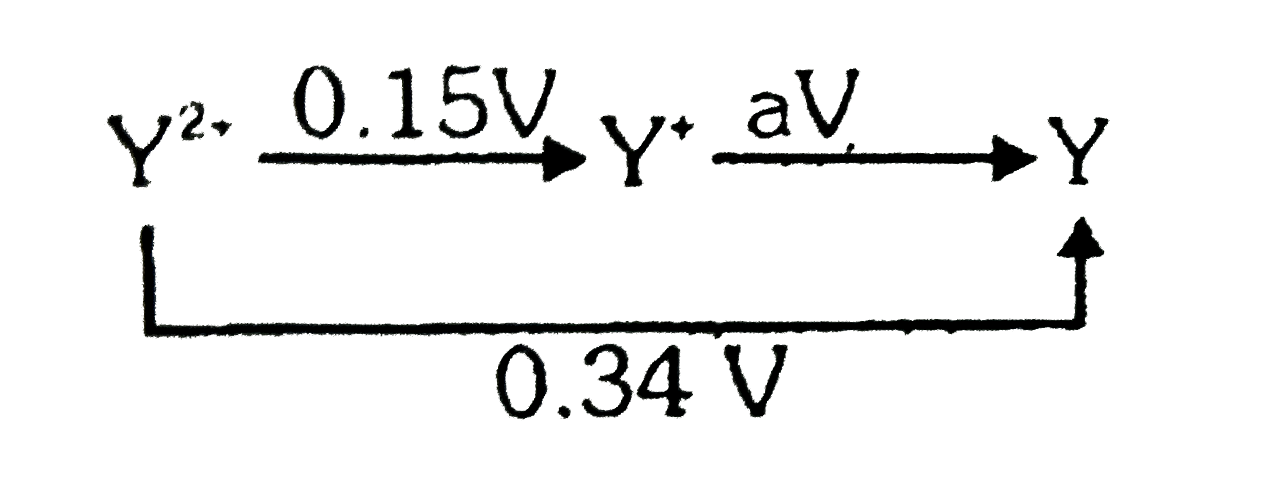
B

When connected, electron flow from `X` to `Y` means,
`E_(Y^(2+)//Y)^(@) gt E_(X^(2+)//X)^(@)`
and when `X` is connected to `SHF`, e flow from `X` to `SHE` means.
`E_(X^(2+)//X)^(@)`

So, `0.34 xx2 = 0.15 xx 1 +a xx 1`
`rArr a = 0.68 - 0.15 = 0.53 V`
Promotional Banner

Similar Questions

Explore conceptually related problems

The magnitude ( but not the sign ) of the standard reduction potentials of two metals X and Y are : Y^(2)+2e^(-) rarr Y |E_(1)^(c-)|=0.34V X^(2)+2e^(-) rarr X |E_(2)^(c-)|=0.25V When the two half cells of X and Y are connected to construct a cell, eletrons flow from X to Y . When X is connected to a standard hydrogen electrode (SHE) ,electrons flow from X to SHE . If a half call X|X^(2)(0.1M) is connected to another half cell Y|Y^(2+)(1.0M) by means of a salt bridge and an external circuit at 25^(@)C , the cell voltage would be

The standard reduction potential for Zn^(2+)//Zn, Ni^(2+)//Ni and Fe^(2+)//Fe are -0.76, -0.23 and -0.44V respectively. The reaction X + Y^(2) rarr X^(2+) + Y will be spontaneous when:

(dy)/(dx) + 3y = e^(-2x)

The tangent to the curve y=e^(2x) at the point (0, 1) meets X-axis at :

Given, standard electrode potentials, {:(Fe^(3+)+3e^(-) rarr Fe,,,E^(@) = -0.036 " volt"),(Fe^(2+)+2e^(-)rarr Fe,,,E^(@) = - 0.440 " volt"):} The standard electrode potential E^(@) for Fe^(3+) + e^(-) rarr Fe^(2+) is :

Two probability distributions of the discrete random variables X and Y are given below. Prove that E(Y^(2)) = 2E(X) .

The binding energy of nucei X and Y are E_(1) and E_(2) , respectively. Two atoms of X fuse to give one atom of Y and an energy Q is released. Then,

