Home
Class 12
CHEMISTRY
An organic compound A has molecular form...

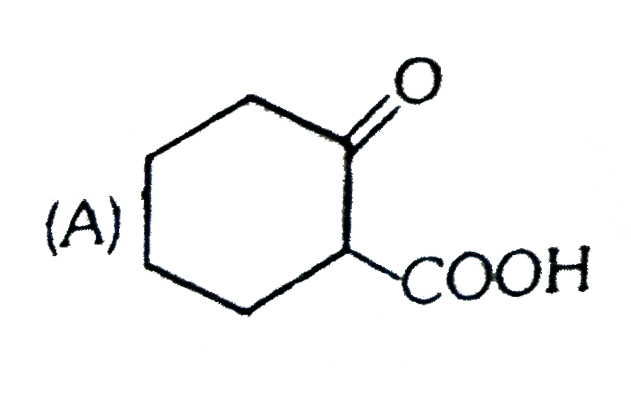
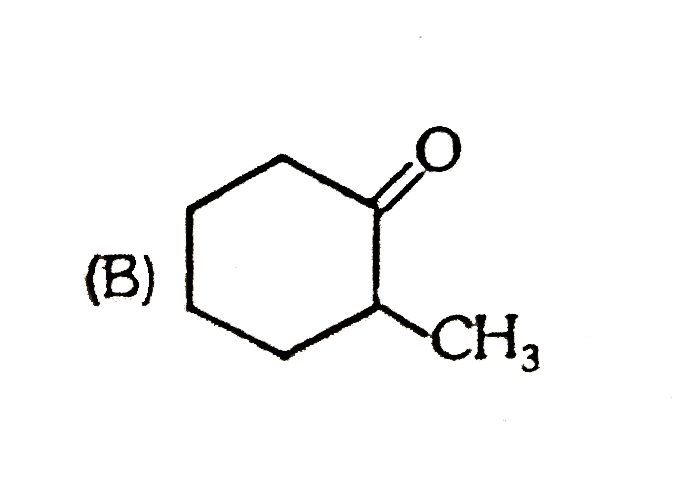
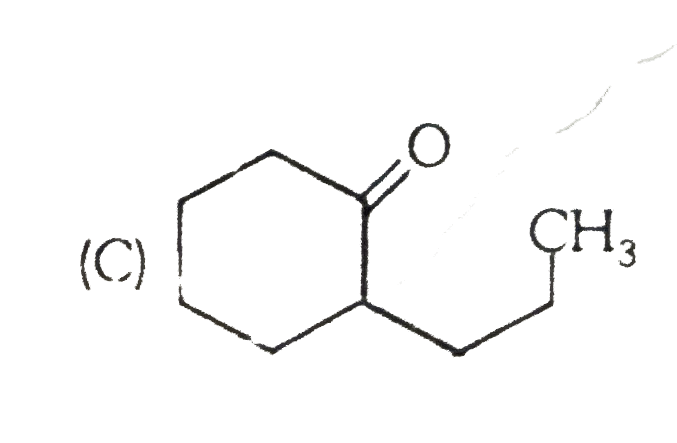
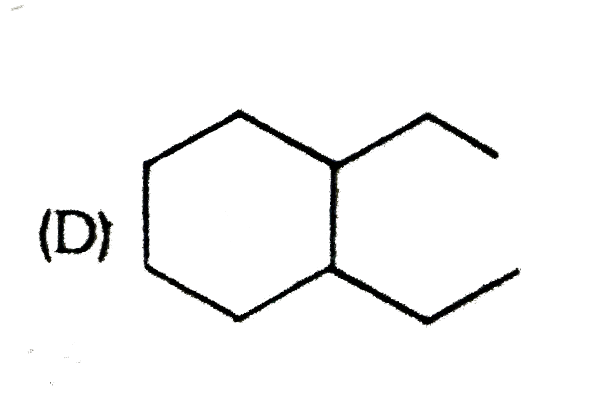
An organic compound A has molecular formula `C_(10)H_(17)Br` and it is non-resolvable. A does not decolourise brown colour of bromine water solution. A on treatement with `(CH_(3))_(2 COK//(CH_(3))_(3)COH` yields `B` as majot product. B on treatment with `H_(2)//Pt` yields `(C_(10)H_(16))` which on treatment with `CI_(2)//hv` yields three monochloro derivative. Also B on boiling with acidic permanganate solution yields `C(C_(10)H_(16)O_(3))C`. on heating with sodalime yields `D(C_(9)H_(16)O).D` on reducing with `LiAIH_(4)` followed by heating product with concentrated `H_(2)SO_(4)` yields `E(C_(9)H_(16))` as major product. E on treatment with ozone followed by work-up with `Zn-H_(2)O` yields 6-Ketononanal.
Compound B is:

A

B

C

D

Text Solution

Verified by Experts

The correct Answer is:

C
Promotional Banner

Similar Questions

Explore conceptually related problems

An alkyl bromide A has molecular formula C_(8)H_(17)Br and four different structures can be drawn for it, all optically active. A on refluxing with ethanolic KOH solution yields only one elimination product B(C_(8)H_(16)) which it still enantiomeric. B on treatment with H_(2)//Pt yields C(C_(8)H_(18)) which does not rotate the plane polarized light, B on ozonolysis followed by work-up with H_(2)O_(2) yields D(C_(7)H_(14)O) as one product which it still resolvable. Deduce structures of A to D.

Following reaction: (CH_(3))_(3)C-Br +H_(2)O rarr (CH_(3))_(3)C-OH +HBr is an example of -

An optically active compound A (assume dextrorotatory) has the molecular formula C_(7)H_(11)Br . A reacts with hydrogen bromide, in the absence of peroxides to yield isomeric products, B and C, with the molecular formula C_(7)H_(12)Br_(2) . Compound B is optically active, C is not. Treating B with 1 mol of potassium butoxide yields (+)-A . Treating C with 1 mol of potassium tert-butoxide yields (+-)-A . Treating A with potassium tert-butoxide yields D(C_(7)H_(10)) . Subjecting 1 mol of D to ozonolysis followed by treatment with zinc and acetic acid yields 2 moles of formaldehyde and 1 mole of 1,3-cyclopentanedione. The optically active compound 'A' is

An optically active compound A (assume dextrorotatory) has the molecular formula C_(7)H_(11)Br . A reacts with hydrogen bromide, in the absence of peroxides to yield isomeric products, B and C, with the molecular formula C_(7)H_(12)Br_(2) . Compound B is optically active, C is not. Treating B with 1 mol of potassium butoxide yields (+)-A . Treating C with 1 mol of potassium tert-butoxide yields (+-)-A . Treating A with potassium tert-butoxide yields D(C_(7)H_(10)) . Subjecting 1 mol of D to ozonolysis followed by treatement with zinc and acetic acid yields 2 moles of formaldehyde and 1 mole of 1,3-cyclopentanedione. The compound 'B' is:
