Home
Class 12
CHEMISTRY
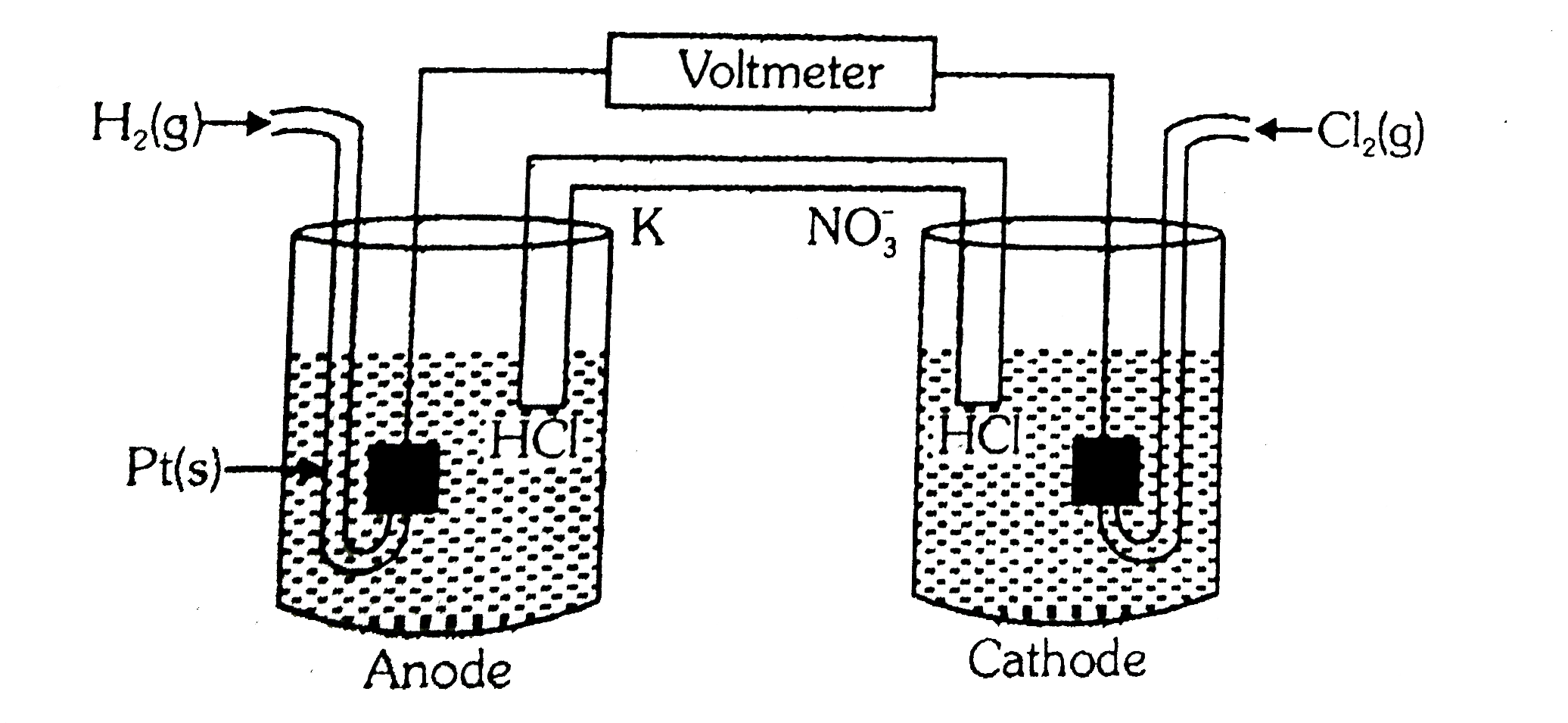
Consider the following Galvanic cell:- ...

Consider the following Galvanic cell:-

By what value the cell voltage when concentration of ions in anodic and cathodic compartments both increased by factor of 10 at 298K:

A

`+0.0591`

B

`-0.0591`

C

`-0.1182`

D

0

Text Solution

Verified by Experts

The correct Answer is:

C

`{:("Anode":, H_(2) rarr 2H^(+) +2e^(-)),("Cathode":,CI_(2)+2e^(-) rarr 2CI^(-)):}`
`E = E^(@) - 0.0591 log [H^(+)] [CI^(-)]`
on increasing concentration by 10 E wil increase by a factor of `-0.0591log 100 =- 0.0591 xx 2`
`=- 0.1182 V`
Promotional Banner

Similar Questions

Explore conceptually related problems

Consider a Galvenic cell, Zn(s) |Zn^(2+) (0.1M) ||Cu^(2+) (0.1M)|Cu(s) by what factor, the electrolyte in anodic half cell should be diluted to increase the emf by 9 mili volt at 298K .

Which one of the following will increase the voltage of the cell ? (T = 298 K) Sn+ 2Ag^+ rarr Sn^(2+) +2 Ag .

Accidentally chewing on a stray fragmet of aluminium foil can causes a sharp tooth path if the aluminium comes in contact with an amalgam filing. The filing, an alloy of silver, tin and mercury, acts as the cathode of a tiny galvanic cell, the aluminium behaves as the anode, and salivas serves as the electrolyte. when the aluminium and the filling come in contact, and electric current passage from the aluminium to the filling which is sensed by a nerve in the tooth. Aluminium is oxidized at the anode, and O_(2) gas is reduced to water at the cathode. E_(AI^(3+)//AI)^(@) =- 1.66 E_(O_(2)H^(+)//H_(2)O)6^(@) = 1.23 V The standard reduction potential of the reaction, H_(2)O +e^(-) rarr (1)/(2)H_(2)+OH^(-) at 298K is:

Accidentally chewing on a stray fragmet of aluminium foil can causes a sharp tooth path if the aluminium comes in contact with an amalgam filing. The filing, an alloy of silver, tin and mercury, acts as the cathode of a tiny galvanic cell, the aluminium behaves as the anode, and salivas serves as the electrolyte. when the aluminium and teh filling come in contact, and electric current passage from the aluminium to the filling which is sensed by a nerve in the tooth. Aluminium is oxidized at the anode, and O_(2) gas is reduced to water at the cathode. E_(AI^(3+)//AI)^(@) =- 1.66 E_(O_(2)H^(+)//H_(2)O)6^(@) = 1.23 V Net reaction taking place when amalgam is in contact with aluminium foil:

Accidentally chewing on a stray fragmet of aluminium foil can causes a sharp tooth path if the aluminium comes in contact with an amalgam filing. The filing, an alloy of silver, tin and mercury, acts as the cathode of a tiny galvanic cell, the aluminium behaves as the anode, and salivas serves as the electrolyte. when the aluminium and the filling come in contact, and electric current passage from the aluminium to the filling which is sensed by a nerve in the tooth. Aluminium is oxidized at the anode, and O_(2) gas is reduced to water at the cathode. E_(AI^(3+)//AI)^(@) =- 1.66 E_(O_(2)H^(+)//H_(2)O)6^(@) = 1.23 V Standard E.M.F experienced by the person with dental filing is:

When the electric current is passed through a cell having an electrolyte, the positive ions move towards cathode and negative ions toqards the anode. If the cathode is pulled out of the solution .

Light coming from a discharge tube filled with hydrogen falls on the cathode for the photoelectric cell. The work function of the surface of cathode is 4eV . Which one of the following values of the anode voltage (in volts) with respect to the cathode will likely to make the photo current zero?
