Home
Class 12
CHEMISTRY
The equivalent conductance of NaCl at co...

The equivalent conductance of NaCl at concentration C and at infinite dilution are `lambda_(C)` and `lambda_(oo)`, respectively. The correct relationship between `lambda_(C)` and `lambda_(oo)` is given as (where, the constant B is positive)

A

`lambda_(C) = lambda_(oo) -(B) sqrt(C)`

B

`lambda_(C) = lambda_(oo) +(B) sqrt(C)`

C

`lambda_(C) = lambda_(oo) +(B)C`

D

`lambda_(C) = lambda_(oo) -(B)C`

Text Solution

Verified by Experts

The correct Answer is:
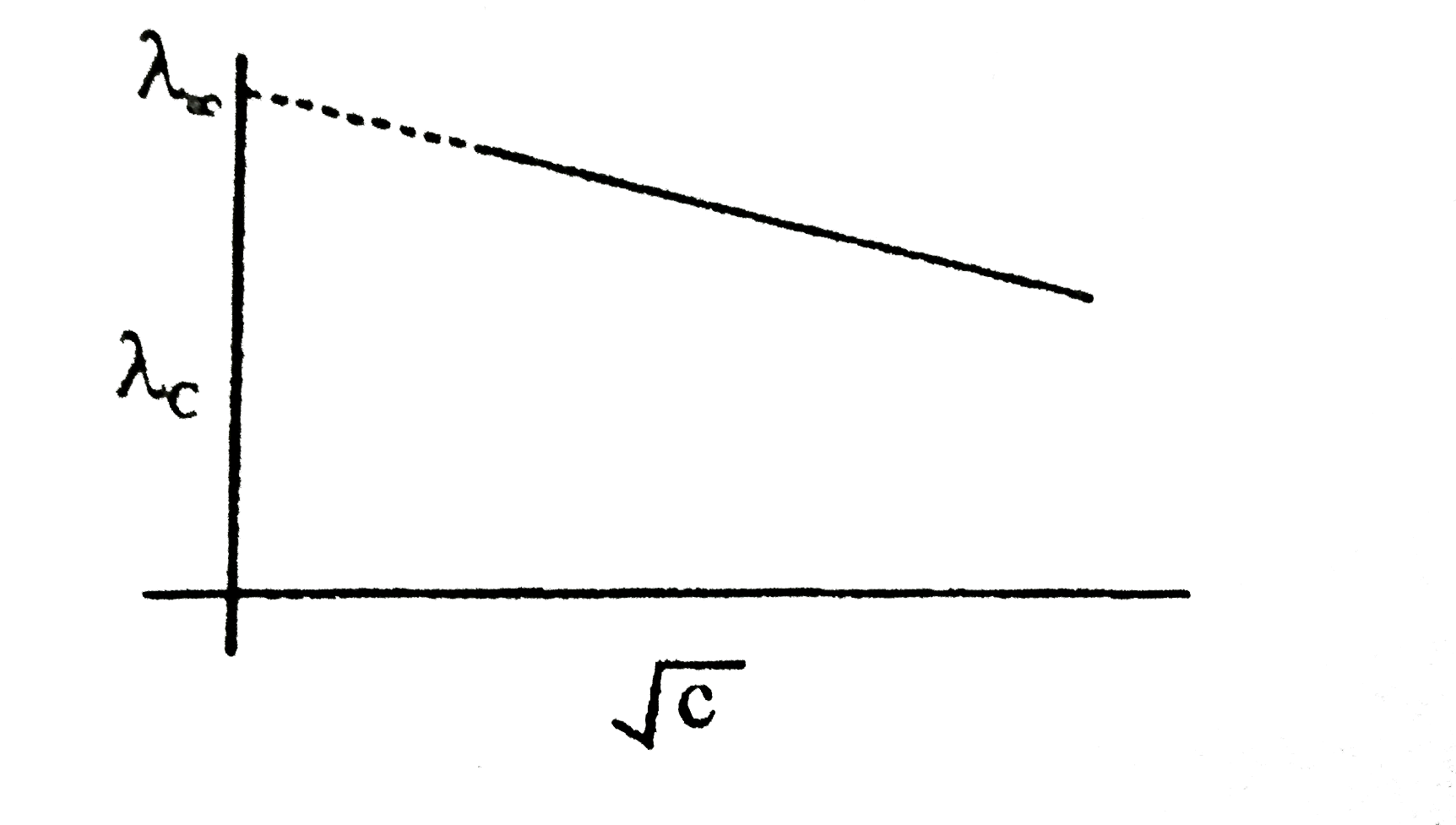
A


`lambda_(C) = lambda_(oo) - B sqrt(C)`, Debye-Huckle equation
Promotional Banner

Similar Questions

Explore conceptually related problems

The equivalenet conductivites of acetic acid at 298K at the concentration of 0.1M and 0.001M are 5.20 and 49.2S cm^(2) eq^(-1) respectively. Calculate the degree of dissociation of acetic acid at the these concentrations. Given that, lambda^(prop) (H^(+)) and lambda^(prop) (CH_(3)COO^(-)) are 349.8 and 40.9 ohm^(-1) cm^(2) mol^(-1) respectively.

The given two fixed rings of radius R lie in XY plane as shown in the figure. Linear charge density of the rings A and B varies as per the relation lambda=lambda_(0)sintheta and lambda=lambda_(0)costheta respectively where theta is measured from +x axis. Distance between the centre of the two rings is r gt gt R

The molar conductivities Lambda_(NaOAc)^@ and Lambda_(HCI)^@ at infinite dilution is watter at 25^@C are 91.0 and 426.2 S cm^@ // mol respectively. To calculate Lambda_(HOAc,)^2 the additional value required is:

Two particles A and B of de-Broglie wavelength lambda_(1) and lambda_(2) combine to form a particle C.The process conserves momentum .Find the de-Broglie wavelength of the particle C.(The motion is one -dimensional).

Given the equivalent conductance of sodium butyrate sodium chloride and hydrogen chloride as 83,127 and 426 mho cm^(2) at 25^(@)C respectively the equivalent conductance of butyric acid at infinite dilution.

The equivalent conductivity of CH_(3)COOH at 25^(@)C is "80 ohm"^(-1) cm^(2) eq^(-1) and at infinite dilution 400" ohm"^(-1)" cm"^(2) eq^(-1) . The degree of dissociation of CH_(3)COOH is ...............

Let A,B,C,D,E represent vertices of a regular pentangon ABCDE. Given the position vector of these vertices be a,a+b,b, lamda a and lamdab respectively. Q. AD divides EC in the ratio

