Home
Class 12
CHEMISTRY
{:(Column-I,Column-II),((a)"Acetone" +CH...

`{:(Column-I,Column-II),((a)"Acetone" +CHCI_(3),(p)DeltaS gt 0),((b)"Ethanol +water",(q)DeltaH gt 0),((c)C_(2)H_(5)Br+C_(2)H_(5)I,(r)DeltaH lt 0),((d)"Acetone+Benzne",(s)"Maximum boiling azetropes"),(,(t)"Minimum boiling azeotropes"):}`

Text Solution

Verified by Experts

The correct Answer is:
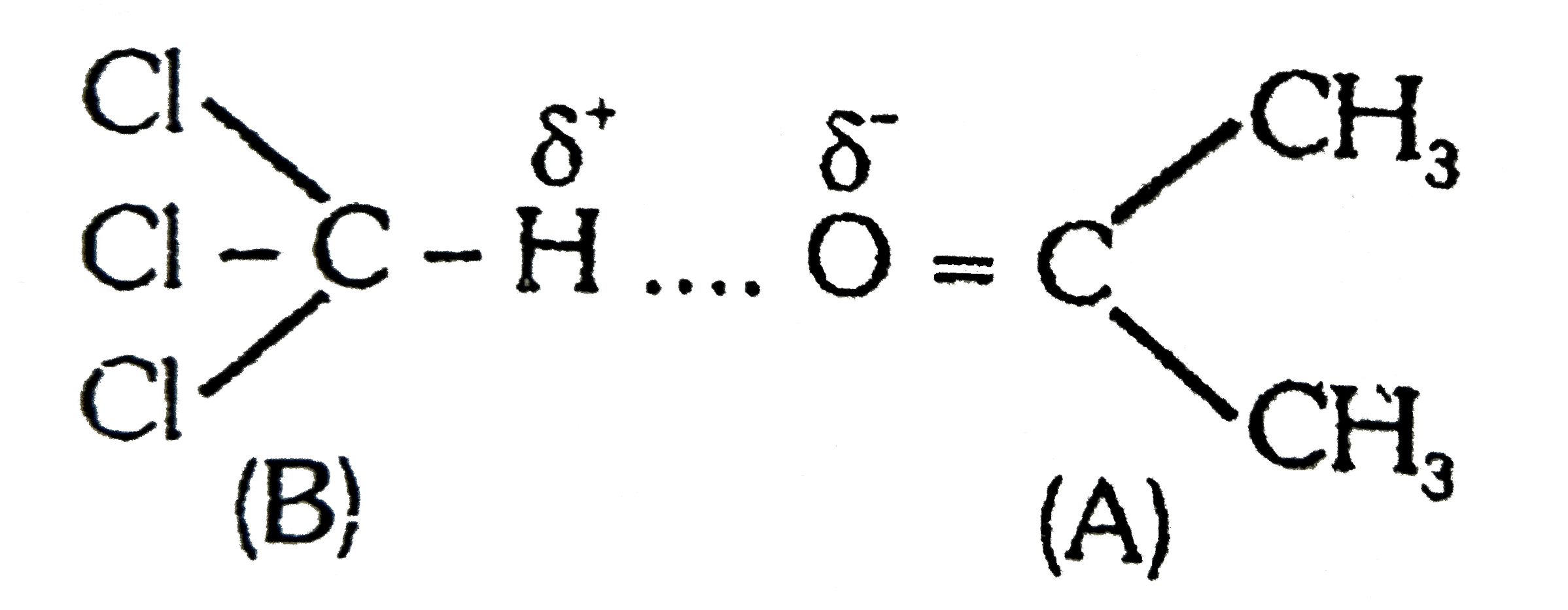
`(a) rarr p,r,s; (b) rarr p,q,t; (c) rarr p;(d) rarr p,q,t`


On mixing entropy (disroder) always increase (P) `F_(A-A) & F_(B-B) =` Dipole - Dipole `lt F_(A)-B` [H-Bond]
`:.` Negative deviation from ideal solution
`DeltaH_(miax) lt 0 (r)`
Those solutions which exihibt negative deviation form maximum boiling axeotrope(s)
Promotional Banner

Similar Questions

Explore conceptually related problems

For the given process :- {:("Column-I","Column-II"),((A)Process " "JtoK,(P) Wgt0),((B)Process" "KtoL ,(q) Wlt0),((C)Process " "LtoM,(r)Qgt0),((D)Process" "MtoJ,(s)Qlt0):}

{:(Column-I,Column-II),((A)"Electrolytic cell",(p)-DeltaG^(@)),((B)nFE_(cell)^(0),(q)"Concentration cell"),((C)E_(cell)=(0.059)/(n)log.(C_("cathode"))/(C_("anode")),(r)96500 "Coulombs"),((D)"Diffusion of ions",(s)"Device converting electrical energy into chemical energy"),((E)1"Farday",(u)"Salt bridge"):}

Match the following: {:(,"Column-I",,"Column-II"),((A),"Isobaric process",(p),"No heat exchange"),((B),"Isothermal process ",(q),"Constant pressure"),((C),"Isoentropy process",(r),"Constant internal energy"),((D),"Isochoric process",(s),"Work done is zero"):}

If net force on a system of particles is zero. Then {:(,"Column I",,"Column II",),((A),"Acceleration of centre of mass",(p),"Constant",),((B),"Velocity of centre of mass",(q),"Zero",),((C ),"Momentum of centre of mass",(r ),"May br zero",),((D),"Velocity of an individual particle of the system",(s),"May be constant",):}

Three rods of equal length of same material are joined to form an equivalent triangle ABC as shown figure. Area of cross-section of rod AB is S of rod BC is 2S and that of AC is S , then {:(,"Column-I",,"Column-II"),((A),"Temperature of junction" B,(p),"Greater than" 50^(@)C),((B),"Heat current in" AB,(q),"Less than" 50^(@)C),((C),"Heat current in BC",(r),"Is equal to current in BC"),(,,(s),"Is " 2/3 "times heat current in AC"),(,,(t),"None"):}

{:(,"Column I",,"Column II"),((A),"Dimensional variable",(p),pi),((B),"Dimensionless variable",(q),"Force"),((C),"Dimensional constant",(r),"Angle"),((D),"Dimensionless constant",(s),"Gravitational constant"):}

In y = Asinomegat + Asin(omegat + (2pi)/(3)) |{:(,"Column-I",,"Column-II"),((A),"Motion",(p),"is periodic but no SHM"),((B),"Amplitude",(q),"is SHM"),((C),"Initial phase",(r),A),((D),"Maximum velocity",(s),pi//3),(,,(t),omegaA//2),(,,(u),"None"):}|

Three liquids A, B and C having same specific heat and mass m , 2 m and 3 m have temperature 20^(@)C , 40^(@)C and 60^(@)C respectively. Temperature of the mixture when: {:(,"Column-I",,"Column-II"),((A),"A and B are mixed",(p),33^(@)C),((B),"A and C are mixed",(q),52^(@)C),((C),"B and C are mixed",(r),50^(@)C),((D),"A,B and C all three are mixed",(s),46^(@)C),(,,(t),"None"):}

Match the items of column I to those of column I: {:(Column-I, Column-II),((A)"Cell constant",(p) E_("cathode")^(0)+E_("anode")^(0)),((B)Anode,(q)l//A),((C)"Conductance",(r)"Mass of product by 1 coulomb of electricity"),((D)"Electrochemical equivalent",(s)("Resistance")^(-1)),((E)E_(cell)^(0),(u)"Involve oxidation"):}

{:(,"Column I",,,"Column II"),((A),"Moment of inertia",,(p),"newton"//"metre"^(2)),((B),"Surface tension",,(q),"kg"//("metre-sec")),((C),"Angular acceleration",,(r),"kg-metre"^(2)),((D),"Coefficient of viscosity",,(s),"newton"//"metre"),((E),"Modulus of elasticity",,(t),"radian"//"sec"^(2)):}

