Home
Class 11
PHYSICS
A cubical block of side a and density rh...


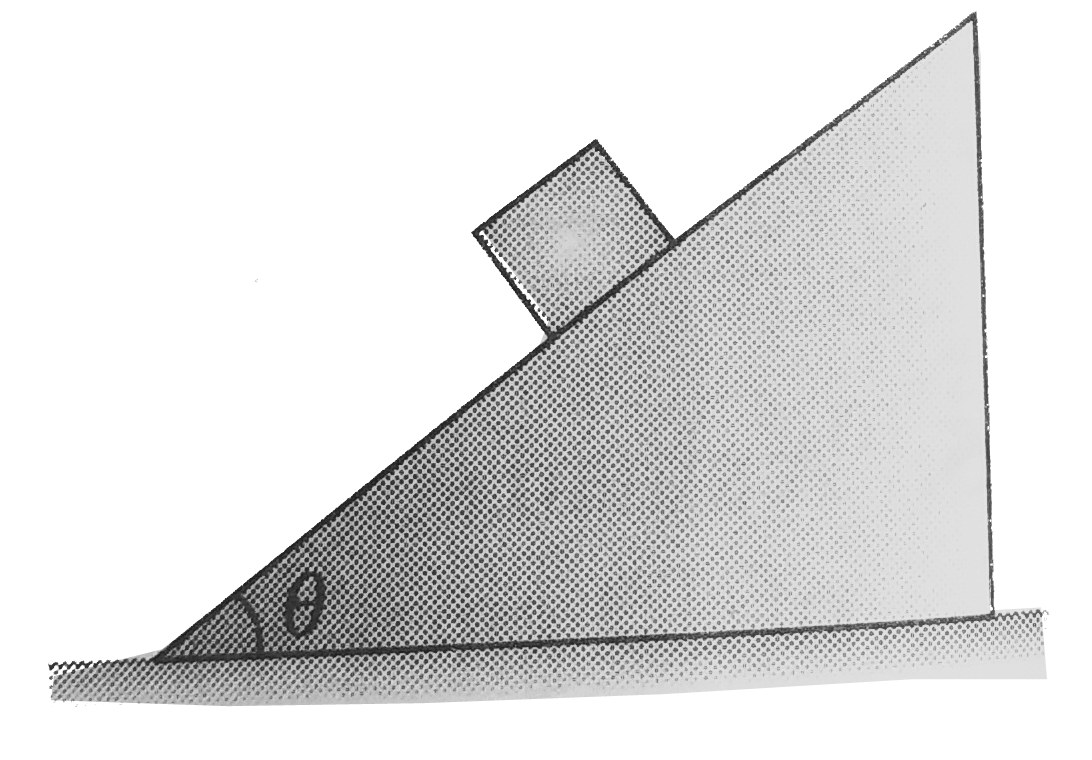
A cubical block of side `a` and density `rho` slides over a fixed inclined plane with constant velocity `v`. There is a thin film of viscous fluid of thickness `t` between the plane and the block. Then the coefficient of viscosity of the thin film will be: (Acceleration due to gravity is g)

A

`(rhoa"gt"sintheta)/(v)`

B

`(rho"gt"costheta)/(v)`

C

`(v)/(rho"gt"sintheta)`

D

none of these

Text Solution

Verified by Experts

The correct Answer is:

A
Promotional Banner

Topper's Solved these Questions

  • ELASTICITY, SURFACE TENSION AND FLUID MECHANICS

    ALLEN |Exercise Exercise 3 (Assertion & Reason)|32 Videos
  • ELASTICITY, SURFACE TENSION AND FLUID MECHANICS

    ALLEN |Exercise Exercise 3 (Comprehension based questions)|23 Videos
  • ELASTICITY, SURFACE TENSION AND FLUID MECHANICS

    ALLEN |Exercise Exercise 1 (Fluid Statics)|40 Videos
  • CENTRE OF MASS

    ALLEN |Exercise EXERCISE-V B|19 Videos
  • ERROR AND MEASUREMENT

    ALLEN |Exercise Part-2(Exercise-2)(B)|22 Videos

Similar Questions

Explore conceptually related problems

A cubical block (of sie 2m) of mass 20 kg slides on inclined plane lubricated with the oil of viscosity eta=10^(-1) poise with constant velocity of 10 m/s find out the thickness of layer of liquid ( g=10m//s^(2) )

A block of mass m1 = 1 kg another mass m2 = 2 kg, are placed together (see figure) on an inclined plane with angle of inclination theta . Various values of theta are given in List I. The coefficient of friction between the block m_(1) and the plane is always zero. The coefficient of static and dynamic friction between the block m_(2) and the plane are equal to mu = 0.3 . In List II expressions for the friction on block m_(2) are given. Match the correct expression of the friction in List II with the angles given in List I, and choose the correct option. The acceleration due to gravity is denoted by g [Useful information : tan (5.5^(@)) ~~ 0.1, tan (11.5^(@)) ~~ 0.2 , tan (16.5^(@))~~ 0.3 ].

Two blocks of masses 2kg and M are at rest on an inclined plane and are separated by a distance of 6.0m as shown. The coefficient of friction between each block and the inclined plane is 0.25 . The 2kg block is given a velocity of 10.0m//s up the inclined plane. It collides with M, comes back and has a velocity of 1.0m//s when it reaches its initial position. The other block M after the collision moves 0.5m up and comes to rest. Calculate the coefficient of restitution between the blocks and the mass of the block M. [Take sintheta=tantheta=0.05 and g=10m//s^2 ]

A metal block of area 0.10m^(2) is connected to a 0.010kg mass via a string that passes over an ideal pulley (considered massless and frictionless) as in figure . A liquid with a film thickness of 0.30mm is placed between the block and the right with a constant speed of 0.085ms^(-1) . Find the coefficient of viscosity of the liquid.

A metal block of base area 0.2m^(2) is connected to a 0.02 kg mass via a string that passes over an ideal pulley as shown in figure.A liquid film of thickness 0.6 mm is placed between the block moves to the right with a constant speed of 0.17 m/s The coefficient of viscosity of liquid is .......

When an object moves through a fluid, as when a ball falls through air or a glass sphere falls through water te fluid exerts a viscous foce F on the object this force tends to slow the object for a small sphere of radius r moving is given by stoke's law, F_(w)=6pietarv . in this formula eta in the coefficient of viscosity of the fluid which is the proportionality constant that determines how much tangential force is required to move a fluid layer at a constant speed v, when the layer has an area A and is located a perpendicular distance z from and immobile surface. the magnitude of the force is given by F=etaAv//z . For a viscous fluid to move from location 2 to location 1 along 2 must exceed that at location 1, poiseuilles's law given the volumes flow rate Q that results from such a pressure difference P_(2)-P_(1) . The flow rate of expressed by the formula Q=(piR^(4)(P_(2)-P_(1)))/(8etaL) poiseuille's law remains valid as long as the fluid flow is laminar. For a sfficiently high speed however the flow becomes turbulent flow is laminar as long as the reynolds number is less than approximately 2000. This number is given by the formula R_(e)=(2overline(v)rhoR)/(eta) In which overline(v) is the average speed rho is the density eta is the coefficient of viscosity of the fluid and R is the radius of the pipe. Take the density of water to be rho=1000kg//m^(3) Q. Blood vessel is 0.10 m in length and has a radius of 1.5xx10^(-2) m blood flows at rate of 10^(-7)m^(3)//s through this vessel. The pressure difference that must be maintained in this flow between the two ends of the vessel is 20 Pa what is the viscosity sufficient of blood?

When an object moves through a fluid, as when a ball falls through air or a glass sphere falls through water te fluid exerts a viscous foce F on the object this force tends to slow the object for a small sphere of radius r moving is given by stoke's law, F_(w)=6pietarv . in this formula eta in the coefficient of viscosity of the fluid which is the proportionality constant that determines how much tangential force is required to move a fluid layer at a constant speed v, when the layer has an area A and is located a perpendicular distance z from and immobile surface. the magnitude of the force is given by F=etaAv//z . For a viscous fluid to move from location 2 to location 1 along 2 must exceed that at location 1, poiseuilles's law given the volumes flow rate Q that results from such a pressure difference P_(2)-P_(1) . The flow rate of expressed by the formula Q=(piR^(4)(P_(2)-P_(1)))/(8etaL) poiseuille's law remains valid as long as the fluid flow is laminar. For a sfficiently high speed however the flow becomes turbulent flow is laminar as long as the reynolds number is less than approximately 2000. This number is given by the formula R_(e)=(2overline(v)rhoR)/(eta) In which overline(v) is the average speed rho is the density eta is the coefficient of viscosity of the fluid and R is the radius of the pipe. Take the density of water to be rho=1000kg//m^(3) Q. If the sphere in previous question has mass of 1xx10^(-5)kg what is its terminal velocity when falling through water? (eta=1xx10^(-3)Pa-s)

A block of mass m is being pulled up the rough incline , inclined at angle theta with horizontal by an agent delivering constant power P. The coefficient of friction between block & incline is mu . Then during the upward motion along the inclined plane , maximum velocity of the block will be :

Two blocks of masses m_(1)=1 kg and m_(2)=2 kg are connected by a string and side down a plane inclined at an angle theta=45^(@) with the horizontal. The coefficient of sliding friction between m_(1) and plane is mu_(1)=0.4, and that between m_(2) and plane is mu_(2)=0.2. Calculate the common acceleration of the two blocks and the tension in the string.

ALLEN -ELASTICITY, SURFACE TENSION AND FLUID MECHANICS-Exercise 2 (One or more than one correct answer)
  1. Water coming out of the mouth of a tap and falling vertically in strea...

    Text Solution

    |

  2. There are two identical small holes on the opposite sides of a tank co...

    Text Solution

    |

  3. A U-tube of uniform cross section (see figure) is partially filled wit...

    Text Solution

    |

  4. A homogeneous solid cylinder of length L(LltH/2), cross-sectional area...

    Text Solution

    |

  5. A mercury manometer is connected as shown in the figure. The differenc...

    Text Solution

    |

  6. An open pan P filled with water of density (rhow) is placed on a verti...

    Text Solution

    |

  7. A small ball is left in a viscous liquid form very much height correct...

    Text Solution

    |

  8. A cubical block of side a and density rho slides over a fixed inclined...

    Text Solution

    |

  9. A space 2.5cm wide between two large plane surfaces is filled with oil...

    Text Solution

    |

  10. A large drop of oil whose density is less than that of water, floats ...

    Text Solution

    |

  11. If the terminal speed of a sphere of gold (density =19.5kg//m^3) is 0....

    Text Solution

    |

  12. A spherical ball is dropped in a long column of viscous liquid. Which ...

    Text Solution

    |

  13. A small sphere of mass m is dropped from a aheight After it has fallen...

    Text Solution

    |

  14. The wires A and B shown in Fig. are made of the same material and have...

    Text Solution

    |

  15. When a capillary tube is dipped in a liquid, the liquid rises to a hei...

    Text Solution

    |

  16. A massless conical flask filled with a liquid is kepth on t a table in...

    Text Solution

    |

  17. The vessel shown in the figure has a two sections of areas of cross-se...

    Text Solution

    |

  18. A liquid flows through a horizontal tube. The velocities of the liquid...

    Text Solution

    |

  19. A vertical U-tube contains a liquid. The total length of the liquid co...

    Text Solution

    |

  20. A cup filled with water has a hole in the side, through which the liqu...

    Text Solution

    |
