Home
Class 11
PHYSICS
Two wires of diameter 0.25 cm, one made ...

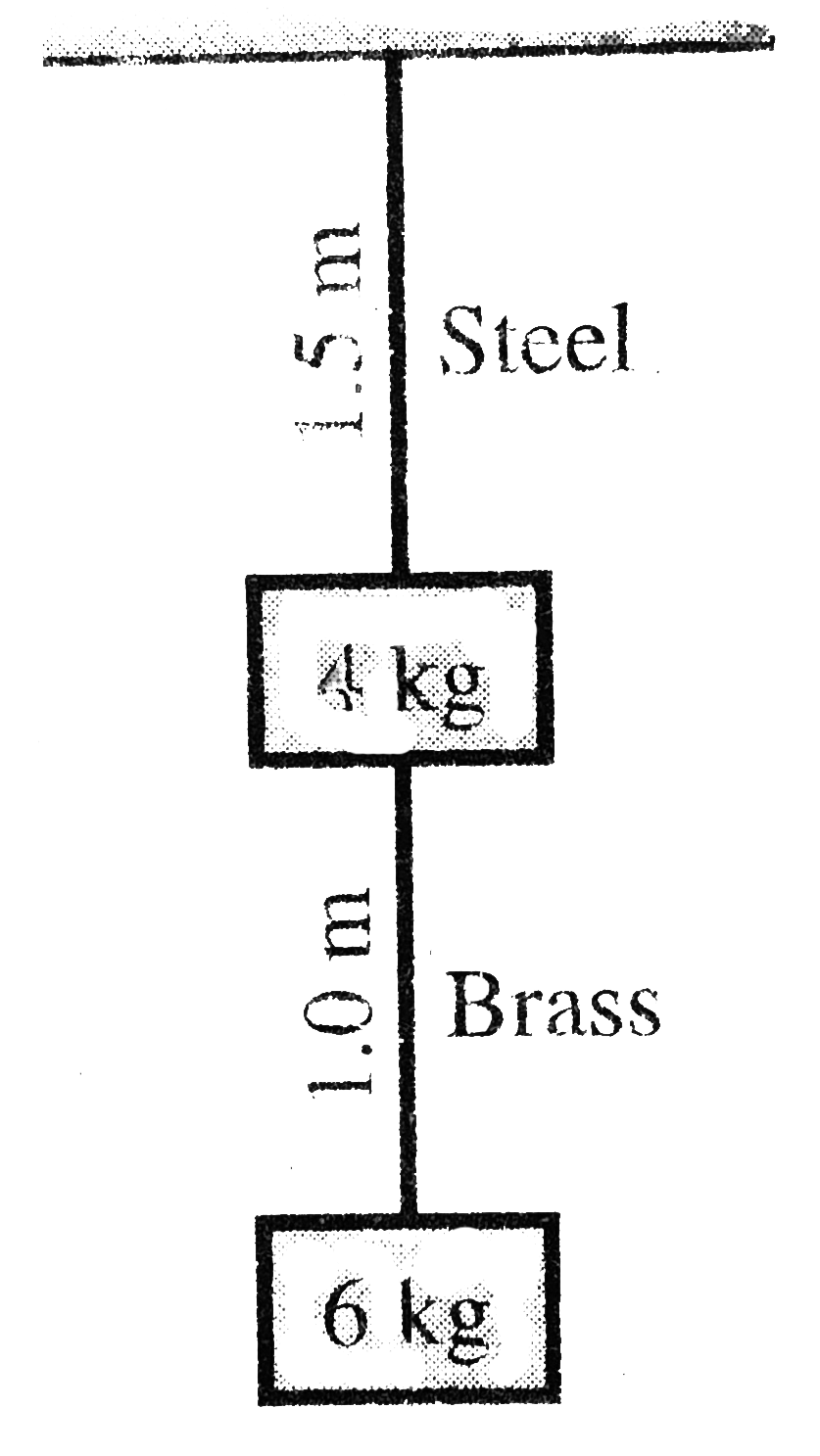
Two wires of diameter `0.25 cm`, one made of steel and other made of brass, are loaded as shown in the figure. The unloaded length of the steel wire is `1.5 m` and that of brass is `1.0 m`. Young's modulus of steel is `2.0 xx 10^(11)`Pa and that of brass is `1.0 xx 10^(11)` Pa. Compute the ratio of elongations of steel and brass wires. `(/_\l_("steel"))/(/_\l_("brass"))=?`

Text Solution

Verified by Experts

The correct Answer is:

steel wire `1.49xx10^(-4)m,` brass wire `1.31xx10^(-4)m`
Promotional Banner

Topper's Solved these Questions

  • ELASTICITY, SURFACE TENSION AND FLUID MECHANICS

    ALLEN |Exercise Exercise 4 A (Surface Tension)|5 Videos
  • ELASTICITY, SURFACE TENSION AND FLUID MECHANICS

    ALLEN |Exercise Exercise 4 A (Fluid Statics)|13 Videos
  • ELASTICITY, SURFACE TENSION AND FLUID MECHANICS

    ALLEN |Exercise Exercise 3 (Comprehension based questions)|23 Videos
  • CENTRE OF MASS

    ALLEN |Exercise EXERCISE-V B|19 Videos
  • ERROR AND MEASUREMENT

    ALLEN |Exercise Part-2(Exercise-2)(B)|22 Videos

Similar Questions

Explore conceptually related problems

Two wires of diameter 0.25 cm, one made of steel and the other made of brass are loaded as shown in figure. The unloaded length of steel wire is 1.5 m and that of brass wire is 1.0 m. Compute the elongations of the steel and the brass wires.

The area of cross-section of a wire of length 1.1 meter is 1mm^(2) . It is loaded with 1 kg. if young's modulus of copper is 1.1xx10^(11)N//m^(2) then the increase in length will be (if g=10m//s^(2) )-

Length and cross sectional area of a wire are 5 m and 2.5 mm^(2). Calculate work required to be done to increase its length by 1 mm. Young's modulus of material of wire =2 xx 10 ^(11) Nm ^(-2)

The diameter of a brass rod is 4 mm and Young's modulus of brass is 9 xx 10 ^(9) Nm ^(-2), What will be the force required to stretch by 0.1% of its length ?

A steel wire of 4.0 m in length is stretched through 2.00 mm. The cross-sectional area of the wire is 2.0mm^(2) if young's modulus of steel is 2.0xx10^(11)N//m^(2) find (i) the energy density of wire (ii) the elastic potential energy stored in the wire.

A steal wire of cross-section area 3xx10^(-6) m^(2) can withstand a maximum strain of 10^(-3) .Young's modulus of steel is 2xx10^(11) Nm^(-2) .The maximum mass this wire can hold is

Two identical steel cubes (masses 50 g , side 1 cm ) collide head -on face to face with a space of 10 cm/s each . Find the maximum compression of each .Young's modulus for steel = Y = 2xx10^(11) N//m^(2)

Speed of transwerse wave of a straight wire having mass 6.0g length 60cm and area of cross- section 1.0 mm^(2) is 90 m/s. If the Young's modulus of wire is 1.6 xx 10^(11) Nm^(-2) , the extension of wire over its natural length is

If the ratio of lengths, radii and Young's moduli of steel and brass wires in the figure are a, b and c respectively then the corresponding ratio of increase in their lengths is

A brass rod of cross-sectional area 1cm^(2) and length 0.2 m is compressed lengthwise by a weight of 5 kg. if young's modulus of elasticity of brass is 1xx10^(11)N//m^(2) and g=10m//sec^(2) then increase in the energy of the rod will be
