Home
Class 11
PHYSICS
Two U-tube manometers are connected to a...

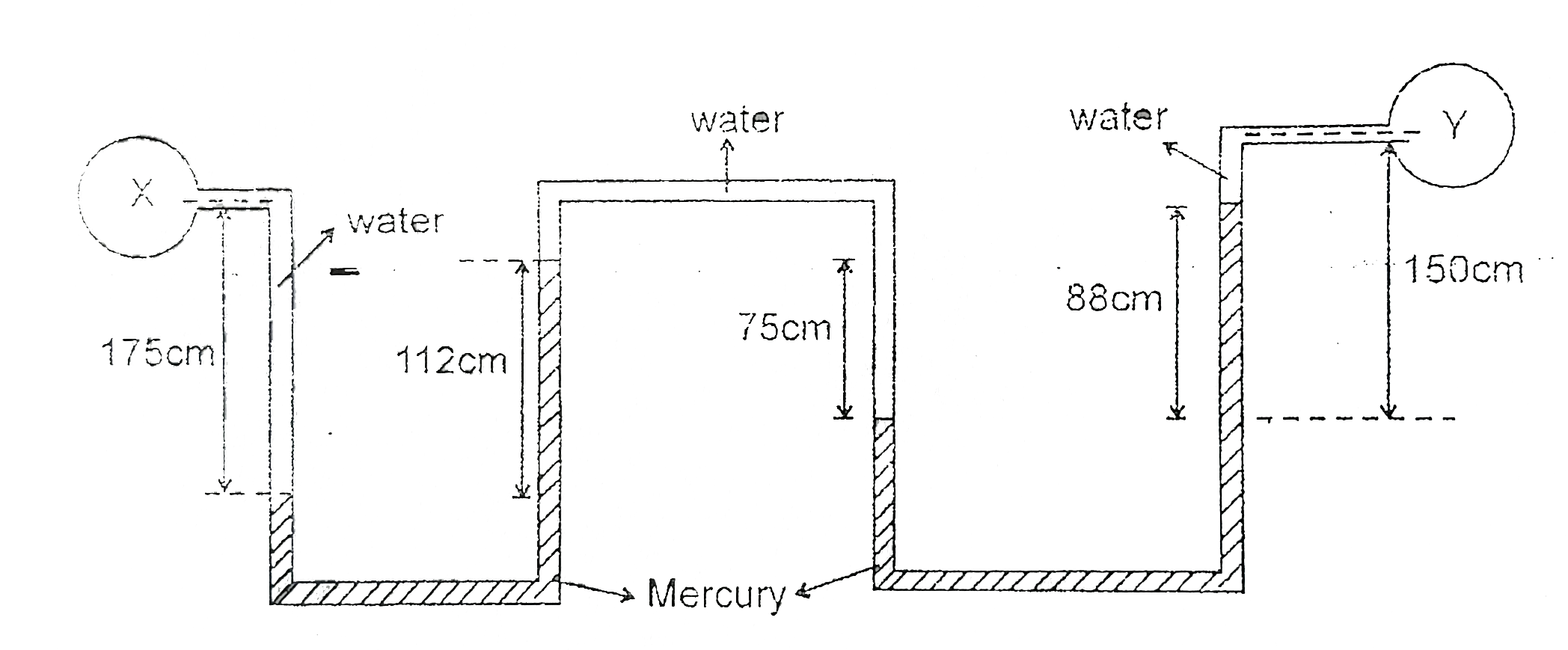
Two `U-`tube manometers are connected to a same tube as shown in figure. Datermine difference of pressure between `X` and `Y`. Take specific gravity of mercury as `13.6. (g = 10 m//s^(2), rho_(Hg) = 13600 kg//m^(3))`

Text Solution

Verified by Experts

The correct Answer is:

`248kN//m^(2)`
Promotional Banner

Topper's Solved these Questions

  • ELASTICITY, SURFACE TENSION AND FLUID MECHANICS

    ALLEN |Exercise Exercise 4 A (Fuild Dynamics)|7 Videos
  • ELASTICITY, SURFACE TENSION AND FLUID MECHANICS

    ALLEN |Exercise Exercise 4 A (Viscosity)|3 Videos
  • ELASTICITY, SURFACE TENSION AND FLUID MECHANICS

    ALLEN |Exercise Exercise 4 A (Surface Tension)|5 Videos
  • CENTRE OF MASS

    ALLEN |Exercise EXERCISE-V B|19 Videos
  • ERROR AND MEASUREMENT

    ALLEN |Exercise Part-2(Exercise-2)(B)|22 Videos

Similar Questions

Explore conceptually related problems

A block of mass 1 kg falls freely on a spring form a height of 20 cm as shown in figure . Find the compression in the spring if its force constant is 10^(3) N/m . ( Take g = 10.0 m//s^(2) )

In the previous problem , if 15.0 cm of water and spirit each are further poured into the respective arms of the tube , what is the difference in the levels of mercury in the two arms ? (Specific gravity of mercury =13.6)

The heart of a man pumps 5 litre of blood through the arteries per minute at a pressure of 150 mm of mercury.If the density of mercury be 13.6 xx10^(3) kg//m^(3)and g = 10 m//s^(2) then the power of heart in watt is :

Two bodies performing S.H.M. have same amplitude and frequency. Their phases at a certain instant are as shown in the figure. The phase difference between them is

An aeroplane of mass 3xx10^(4)kg and total wing area of 120 m^(2) is in a level flight at some height the difference in pressure between the upper and lower surfaces of its wings in kilo pascal is (g=10m//s^(2))

Two vertical cylinders are connected by a small tube at the bottom. It contains a gas at constant temperature . Initially the pistons are located at the same height. The diameters of the two cylinders are different . Outside the cylinder the space is vaccum . Gravitational acceleration is h , h_(0) = 20cm , m_(1) = 2kg "and" m_(2) =1kg . The pistons are initially in equilibrium. If the masses of the piston are interchanged find the separation between the two pistons when they are again in equilibrium. Assume constant temperature .

A non-viscous liquid of constant density 1000kg//m^3 flows in a streamline motion along a tube of variable cross section. The tube is kept inclined in the vertical plane as shown in Figure. The area of cross section of the tube two point P and Q at heights of 2 metres and 5 metres are respectively 4xx10^-3m^2 and 8xx10^-3m^2 . The velocity of the liquid at point P is 1m//s . Find the work done per unit volume by the pressure and the gravity forces as the fluid flows from point P to Q.

A large cylinderical tank of cross-sectional area 1m^(2) is filled with water . It has a small hole at a height of 1 m from the bottom. A movable piston of mass 5 kg is fitted on the top of the tank such that it can slide in the tank freely. A load of 45 kg is applied on the top of water by piston, as shown in figure. The value of v when piston is 7 m above the bottom is (g=10m//s^(2) ) (a). sqrt(120)m//s (b). 10m//s (c). 1m//s (d). 11m//s

Three masses of 1 kg, 6 kg and 3 kg are connected to each other with threads and are placed on a table as shown in figure. What is the accelration with which the system is moving? Take g=10ms^(-2) :

The fricition coefficient between the table and block shown in fig. is 0.2 find the acceleration of the system (Take g=10 m//s^(2) )
