Home
Class 11
PHYSICS
When a vertical capillary of length l wi...

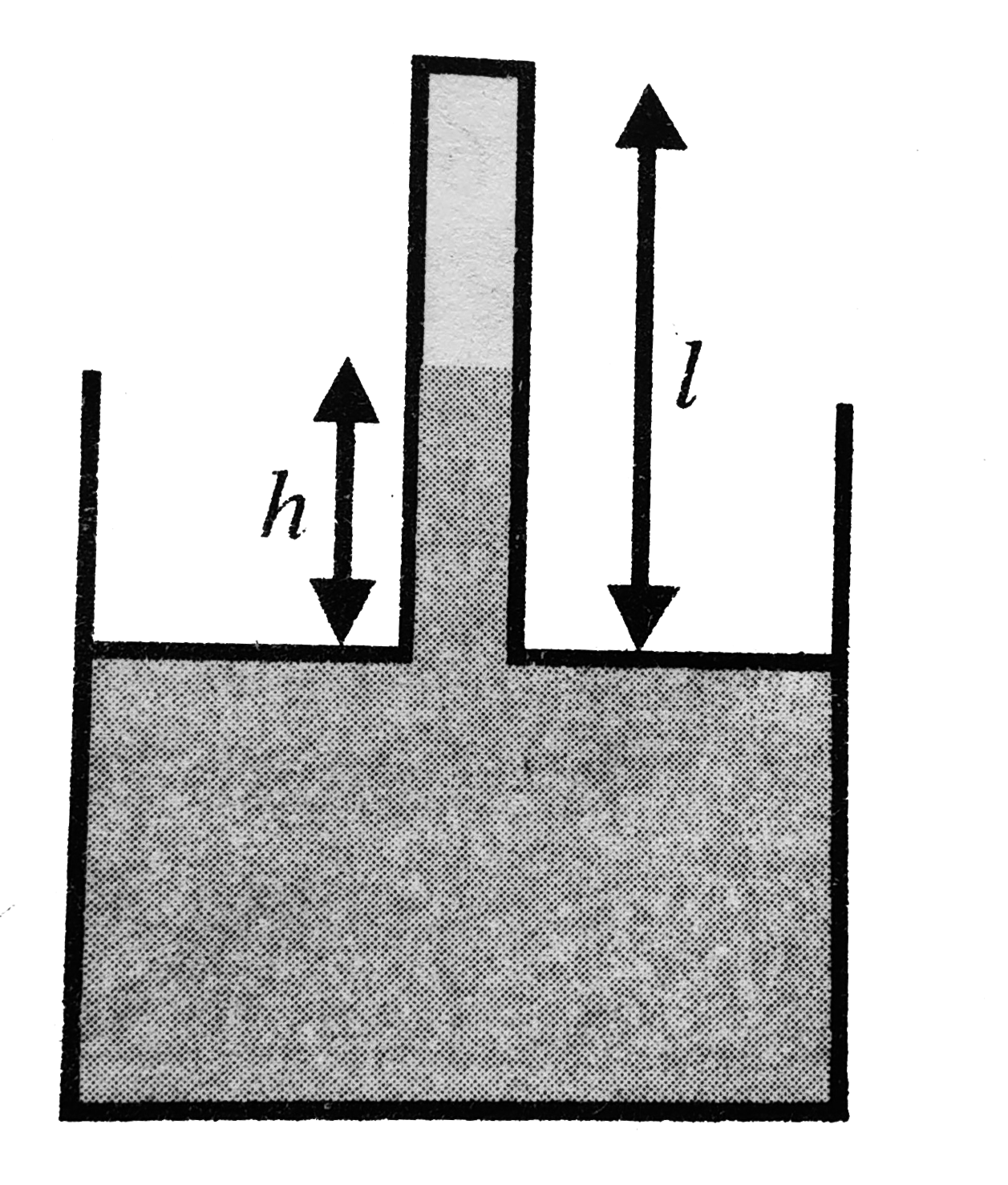
When a vertical capillary of length `l` with a sealed upper end was brought in contact with the surface of a liquid, the level of this liquid rose to the height `h`. The liquid density is `rho`, the inside diameter the capillary is `d`, the contact angle is `theta`, the atmospheric pressure is `rho_(0)`. Find the surface tension of the liquid. (Temperature in this process remains constant.)

Text Solution

Verified by Experts

The correct Answer is:

`[rhogh+(P_(o)h)/(l-h)](d)/(4costheta)`
Promotional Banner

Topper's Solved these Questions

  • ELASTICITY, SURFACE TENSION AND FLUID MECHANICS

    ALLEN |Exercise Exercise 5 A (Previous year Questions)|29 Videos
  • ELASTICITY, SURFACE TENSION AND FLUID MECHANICS

    ALLEN |Exercise Exercise 5 B (MCQ)|13 Videos
  • ELASTICITY, SURFACE TENSION AND FLUID MECHANICS

    ALLEN |Exercise Exercise 4 A (Viscosity)|3 Videos
  • CENTRE OF MASS

    ALLEN |Exercise EXERCISE-V B|19 Videos
  • ERROR AND MEASUREMENT

    ALLEN |Exercise Part-2(Exercise-2)(B)|22 Videos

Similar Questions

Explore conceptually related problems

A U tube is rotated about one of it's limbs with an angular velocity omega . Find the difference in height H of the liquid (density rho ) level, where diameter of the tube dlt lt L .

A small spherical monoatomic ideal gas bubble (gamma= (5)/(3)) is trapped inside a liquid of density rho_(l) (see figure) . Assume that the bubble does not exchange any heat with the liquid. The bubble contains n moles of gas. The temperature of the gas when the bubble is at the bottom is T_(0) , the height of the liquid is H and the atmospheric pressure is P_(0) (Neglect surface tension). When the gas bubble is at a height y from the bottom , its temperature is :-

When a capillary tube is dipped in a liquid, the liquid rises to a height h in the tube. The free liquid surface inside the tube is hemispherical in shape. The tube is now pushed down so that the height of the tube outside the liquid is less than h . Then

A small spherical monoatomic ideal gas bubble (gamma=5//3) is trapped inside a liquid of density rho (see figure). Assume that the bubble does not exchange any heat with the liquid. The bubble contains n moles of gas. The temperature of the gas when the bubble is at the bottom is T_0 , the height of the liquid is H and the atmospheric pressure P_0 (Neglect surface tension). The buoyancy force acting on the gas bubble is (Assume R is the universal gas constant)

A small spherical monoatomic ideal gas bubble (gamma=5//3) is trapped inside a liquid of density rho (see figure). Assume that the bubble does not exchange any heat with the liquid. The bubble contains n moles of gas. The temperature of the gas when the bubble is at the bottom is T_0 , the height of the liquid is H and the atmospheric pressure P_0 (Neglect surface tension). As the bubble moves upwards, besides the buoyancy force the following forces are acting on it

The vessel shown in the figure has a two sections of areas of cross-section A_1 and A_2 . A liquid of density rho fills both th sections, up to a height h in each Neglect atmospheric pressure. Choose the wrong option. .

A capillary of the shape as shown is dipped in a liquid. Contact angle between the liquid and the capillary is 0^@ and effect of liquid inside the mexiscus is to be neglected. T is surface tension of the liquid, r is radius of the meniscus, g is acceleration due to gravity and rho is density of the liquid then height h in equilibrium is:

Statement-1: The angle of contact of a liquid decrease with increase in temeperature Statement-2: With increase in temperature the surface tension of liquid increase.

A ball of density rho_(0) falls from rest from a point P onto the surface of a liquid of density rho in the time T. It enters the liquid, stops, moves up, and returns to P in a total time 3 T. neglect viscosity, surface tension and splashing find the ratio of (rho)/(rho_(0))

A homogeneous solid cylinder of length L(LltH/2), cross-sectional area A/5 is immersed such that it floats with its axis vertical at the liquid-liquid interface with length L/4 in the denser liquid as shown in the figure. The lower density liquid is open to atmosphere having pressure P_0 . Then density D of solid is given by
