Home
Class 11
PHYSICS
A bottle has an opening of radius a and ...

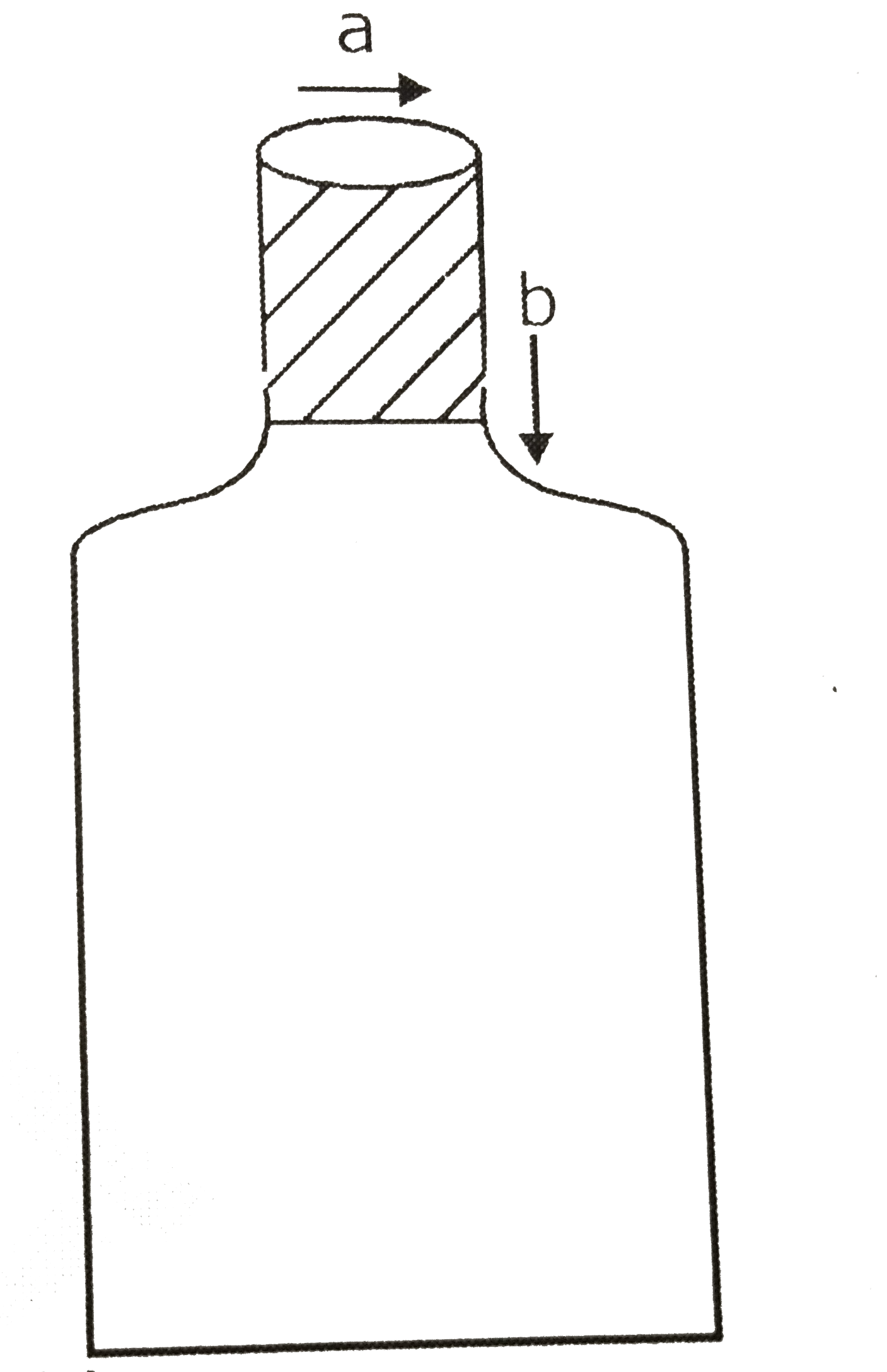
A bottle has an opening of radius a and length b. A cork of length b and radius `(a+Delta A)` is compressed to fit into the opening completely (See figure). If the bulk modulus of cork is B and frictional coefficient between the bottle and cork is  then the force needed to push the cork into the bottle is :

A

`(2pimuBb)Deltaa`

B

`(pimuBb)Deltaa`

C

`(4pimuBb)Deltaa`

D

`(pimuBb)a`

Text Solution

Verified by Experts

The correct Answer is:

C
Promotional Banner

Topper's Solved these Questions

  • ELASTICITY, SURFACE TENSION AND FLUID MECHANICS

    ALLEN |Exercise Exercise 5 B (MCQ)|13 Videos
  • ELASTICITY, SURFACE TENSION AND FLUID MECHANICS

    ALLEN |Exercise Exercise 5 B (Multiple correct answers)|2 Videos
  • ELASTICITY, SURFACE TENSION AND FLUID MECHANICS

    ALLEN |Exercise Exercise 4 B (Bran storming Subjective Exercise)|11 Videos
  • CENTRE OF MASS

    ALLEN |Exercise EXERCISE-V B|19 Videos
  • ERROR AND MEASUREMENT

    ALLEN |Exercise Part-2(Exercise-2)(B)|22 Videos

Similar Questions

Explore conceptually related problems

The neck and bottom of a bottle are 3 cm and 15 cm in radius respectively. If the cork is pressed with a force 12 N in the neck of the bottle, then force exerted on the bottom of the bottle is :-

A magnetic field vecB=B_0 sin (omegat)hatk covers a large region where a wire AB slides smoothly over two parallel conductors separated by a distance d as in figure. The wires are in the xy-plane. The wire AB (of length d) has resistance R and the parallel wires have negligible resistance. If AB is moving with velocity v, what is the current in the circuit. What is the force needed to keep the wire moving at constant velocity ?

A bob of mass m is attached at one end of a string of length l other end of the string is fixed at point O . Bob is rotating in a circular path of radius l in horizontal plane about O with constant speed v , as shown in the figure. The average force exterted by string on the bob during its :- (A) half revolution will be (mv^(2))/(pil) (B) half revolution will be (2mv^(2))/(pil) (C) one fourth revolution will be (sqrt2mv^(2))/(pil) (D) one revolution will be zero Select correct alternative :-

A block of mass 1 kg is pushed up a surface inclined to horizontal at an angle of 30^(@) by a force of 10 N parallel to the inclined surface (figure) . The coefficient of friction between block and the incline is 0.1 .If the block is pushed up by 10 m along teh inclined calculate (a) work done against gravity (b) work done against force of friction (c ) increases in potential energy (d) increases in kinetic energy (e) work done by applied force

A car is moving along a banked road laid out as a circle of radius r . (a) What should be the banking angle theta so that the car travelling at speed v needs no frictional force from tyres to negotiate the turn ? (b) The coefficient of friction between tyres and road are mu_(s) = 0.9 and mu_(k) = 0.8 . At what maximum speed can a car enter the curve without sliding toward the top edge of the banked turn ?

Figure shows a metal rod PQ resting on the smooth rails AB and positioned between the poles of a permanent magnet. The rails, the rod, and the magnetic field are in three mutual perpendicular directions. A galvanometer G connects the rails through a switch K. Length of the rod =15 cm, B =0.50 T, resistance of the closed loop containing the rod 9.0 m Omega . Assume the field to be uniform. (a) Suppose K is open and the rod is moved with a speed of 12 "cm s"^(-1) in the direction shown. Give the polarity and magnitude of the induced emf. (b) Is there an excess charge built up at the ends of the rods when K is open ? What if K is closed ? (c) With K open and the rod moving uniformly, there is no net force on the electrons in the rod PQ even though they do experience magnetic force due to the motion of the rod. Explain. (d) What is the retarding force on the rod when K is closed ? How much power is required (by an external agent) to keep the rod moving at the same speed (= 12 cm s^(-1) ) when K is closed ? How much power is required when K is open? (f)How much power is dissipated as heat in the closed circuit ? What is the source of this power ? (g) What is the induced emf in the moving rod if the magnetic field is parallel to the rails instead of being perpendicular ?

Two identical balls A and B each of mass 0.1 kg are attached to two identical mass less is springs. The spring-mass system is constrained to move inside a right smooth pipe bent in the form of a circle as shown in figure . The pipe is fixed in a horizontal plane. The center of the balls can move in a circle of radius 0.06 m . Each spring has a natural length of 0.06 pi m and force constant 0.1 N//m . Initially, both the balls are displaced by an angle theta = pi//6 radians with respect to diameter PQ of the circle and released from rest. a. Calculate the frequency of oscillation of the ball B. b. What is the total energy of the system ? c. Find the speed of the ball A when A and B are at the two ends of the diameter PQ.

Consider a thin lens placed between a source (S) and an observer (O) (see figure) . Let the thicknes of the lens very as w(b) = w_0 - (b^2)/(alpha) , where b is the verticle distance from the pole. w_0 is constant. Using Fermat.s principle i.e. the time of transit for a ray between the source and observer is an extremum, find the condition that all paraxial rays starting from the source will converage at a point O on the axis. Find the focal length. (ii) A gravitational lens may be assumed to have a varying width of the from w(b) = k_1 "ln" ((k_2)/(b)) b_("min") lt b lt b_("max") = k_1 "ln" ((k_2)/(b_"min")) b lt b_("min") Show that an observe will see an image of a point object as a right about the center of the lens with and angular radius beta=sqrt(((n-1)k_1(u)/(v))/(u+v))

(a) A steel wire of mass u per unit length with a circular cross section has a radius of 0.1 cm. The wire is of length 10 m when measured lying horizontal and hangs from a hook on the wall. A mass of 25 kg is hung from the free end of the wire. Assuming the wire to be uniform an lateral strains lt lt longitudinal strains find the extension in the length of the wire. The density of steel is 7860 kgm ^(-3) and Young's modulus =2 xx 10 ^(11) Nm ^(-2) (b) If the yield strength of steel is 2.5 xx 10 ^(8) Nm ^(-2), what is the maximum weight that can be hung at the lower end of the wire ?

A structural steel rod has a radius of 10 mm and a length of 1.0 m. A 100 KN force stretches it along its length. Calculate a stress, (b) elongation and (c) strain on the rod. Young's modulus of structural steel is 2.0xx 10 ^(11) Nm^(-2).

ALLEN -ELASTICITY, SURFACE TENSION AND FLUID MECHANICS-Exercise 5 A (Previous year Questions)
  1. A spherical solild of volume V is made of a material of density rho(1)...

    Text Solution

    |

  2. A jar is filled with two non-mixing liquids 1 and 2 haivng densities r...

    Text Solution

    |

  3. A capillary tube (A) is dipped in water. Another identical tube (B) is...

    Text Solution

    |

  4. A spherical solid ball of volume V is made of a material of density rh...

    Text Solution

    |

  5. Two wires are made of the same material and have the same volume. Howe...

    Text Solution

    |

  6. A ball is made of a material of density rho where rho(oil)ltrholtrho(w...

    Text Solution

    |

  7. Water is flowing continuously from a tap having an internal diameter 8...

    Text Solution

    |

  8. Work done in increasing the size of a soap bubble from a radius of 3cm...

    Text Solution

    |

  9. Two mercury drops (each of radius r) merge to form a bigger drop. The ...

    Text Solution

    |

  10. if a ball of steel (density rho=7.8 g//cm^(3)) attains a terminal velo...

    Text Solution

    |

  11. A thin liquid film formed between a U-shaped wire and a light slider s...

    Text Solution

    |

  12. There is a circular tube in a vertical plane. Two liquids which do not...

    Text Solution

    |

  13. On heating water, bubbles being formed at the bottom of the vessel det...

    Text Solution

    |

  14. If it takes 5 minutes to fill a 15 litre bucket from a water tap diame...

    Text Solution

    |

  15. If two glass plates have water between them and are separated by very ...

    Text Solution

    |

  16. Consider a water jar of radius R that has water filled up to height H ...

    Text Solution

    |

  17. A uniformly tapering conical wire is mae from a material of young's mo...

    Text Solution

    |

  18. A simple pendulum made of bob of mass m and a metallic wire of neglig...

    Text Solution

    |

  19. Which of the following optiona correctly describes the variation of th...

    Text Solution

    |

  20. A bottle has an opening of radius a and length b. A cork of length b a...

    Text Solution

    |
