Home
Class 11
PHYSICS
A U tube is rotated about one of it's li...

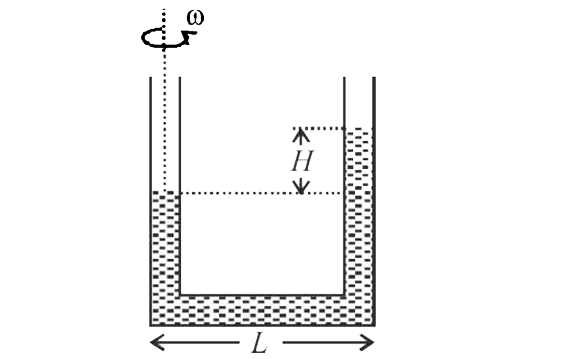
A U tube is rotated about one of it's limbs with an angular velocity `omega`. Find the difference in height H of the liquid (density `rho`) level, where diameter of the tube `dlt lt L`.

Text Solution

Verified by Experts

The correct Answer is:

`H=(omega^(2)L^(2))/(2g)`
Promotional Banner

Topper's Solved these Questions

  • ELASTICITY, SURFACE TENSION AND FLUID MECHANICS

    ALLEN |Exercise Exercise 5 B (Integer Type Questions)|3 Videos
  • ELASTICITY, SURFACE TENSION AND FLUID MECHANICS

    ALLEN |Exercise Exercise 5 B (Assertion Reason)|1 Videos
  • CENTRE OF MASS

    ALLEN |Exercise EXERCISE-V B|19 Videos
  • ERROR AND MEASUREMENT

    ALLEN |Exercise Part-2(Exercise-2)(B)|22 Videos

Similar Questions

Explore conceptually related problems

A liquid is kept in a cylindrical vessel which is being rotated about a vertical axis through the centre of the circular base .If the redius of the vessel is r and angular velocity of rotation is omega , then the difference in the heights of the liquid at the centre of the vessel and the edge is .....

When a vertical capillary of length l with a sealed upper end was brought in contact with the surface of a liquid, the level of this liquid rose to the height h . The liquid density is rho , the inside diameter the capillary is d , the contact angle is theta , the atmospheric pressure is rho_(0) . Find the surface tension of the liquid. (Temperature in this process remains constant.)

Diameters of the arms of a U tube are 10 mm and 1 mm . It is partially filled with water and it is held in a vertical plane . Find the difference in heights of water in both the arms . (Surface tension of water =70 dyne cm^(-1) angle of contact =0^(@).g=980cms^(-2))

A uniform rod of mass m and length l rotates in a horizontal plane with an angular velocity omega about a vertical axis passing through one end. The tension in the rod at a distance x from the axis is

A frame of reference that is accelerated with respect to an inertial frame of reference is called a non-inertial frame of reference. A coordinate system fixed on a circular disc rotating about a fixed axis with a constant angular velocity omega is an example of non=inertial frame of reference. The relationship between the force vecF_(rot) experienced by a particle of mass m moving on the rotating disc and the force vecF_(in) experienced by the particle in an inertial frame of reference is vecF_(rot)=vecF_(i n)+2m(vecv_(rot)xxvec omega)+m(vec omegaxx vec r)xxvec omega . where vecv_(rot) is the velocity of the particle in the rotating frame of reference and vecr is the position vector of the particle with respect to the centre of the disc. Now consider a smooth slot along a diameter fo a disc of radius R rotating counter-clockwise with a constant angular speed omega about its vertical axis through its center. We assign a coordinate system with the origin at the center of the disc, the x-axis along the slot, the y-axis perpendicular to the slot and the z-axis along the rotation axis (vecomega=omegahatk) . A small block of mass m is gently placed in the slot at vecr(R//2)hati at t=0 and is constrained to move only along the slot. The distance r of the block at time is

A frame of reference that is accelerated with respect to an inertial frame of reference is called a non-inertial frame of reference. A coordinate system fixed on a circular disc rotating about a fixed axis with a constant angular velocity omega is an example of non=inertial frame of reference. The relationship between the force vecF_(rot) experienced by a particle of mass m moving on the rotating disc and the force vecF_(in) experienced by the particle in an inertial frame of reference is vecF_(rot)=vecF_(i n)+2m(vecv_(rot)xxvec omega)+m(vec omegaxx vec r)xxvec omega . where vecv_(rot) is the velocity of the particle in the rotating frame of reference and vecr is the position vector of the particle with respect to the centre of the disc. Now consider a smooth slot along a diameter fo a disc of radius R rotating counter-clockwise with a constant angular speed omega about its vertical axis through its center. We assign a coordinate system with the origin at the center of the disc, the x-axis along the slot, the y-axis perpendicular to the slot and the z-axis along the rotation axis (vecomega=omegahatk) . A small block of mass m is gently placed in the slot at vecr(R//2)hati at t=0 and is constrained to move only along the slot. The distance r of the block at time is

Two narrow bores of diameters 3.00mm and 6.0mm are joined together to form a U-tube open at both ends. If the U-tube contains water, what is the difference in its levels in the two limbs of the tube? Surface tension of water at the temperature of the experiment is 7.3 times 10^-2 N m^-1 .Take the angle of contact to be zero and density to water to be 1.0 times 10^3 kg m^-3

Two narrow bores of diameters 3.0 mm and 6.0mm are joined together to form a U- tube open at both ends . If the U- tube contains water , what is the difference in its levels in the two limbs of the tube ? Surface tension of water at the temperature of the experiment is 7.3xx10^(-2)Nm^(-1) . Take the angle of contact to be zero and density of water to be 1.0xx10^(3)kgm^(-3)(g=9.8ms^(-2)) .

An L shaped glass tube is kept inside a bus that is moving with constant acceleration during the motion the level of the liquid in the left arm is at 12 cm whereas in the right arm it is at 8 cm when the orientation of the tube is as shown assuming that the diameter of the tube is much smaller than levels of the liquid and neglecting effect of surface tension, acceleration of the bus find the (g=10m//s^(2)) .

Consider a disc rotating in the horizontal plane with a constant angular speed omega about its centre O . The disc has a shaded region on one side of the diameter and an unshaded region on the other side as shown in the figure. When the disc is in the orientation as shown, two pebbles P and Q are simultaneously projected at an angle towards R. The velocity of projection is in the y-z plane and is same for both pebbles with respect to the disc. Assume that (i) they land back on the disc before the disc has completed (1)/(8) rotation, (ii) their range is less than half the disc radius, and (iii) w remains constant throughout. Then
