In the adjacent diagram, CP represents a wavefront and AO & BP, the corresponding two rays. Find the condition on `theta` for constructive interference at P between the ray BP and reflected ray OP.
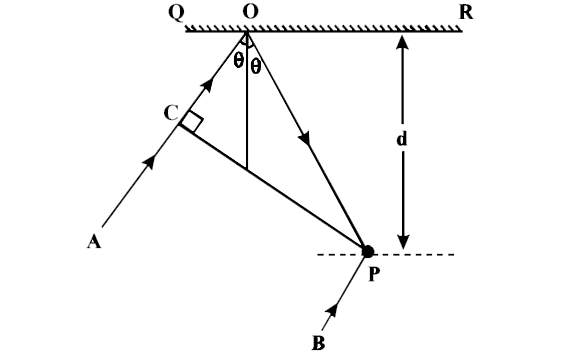
In the adjacent diagram, CP represents a wavefront and AO & BP, the corresponding two rays. Find the condition on `theta` for constructive interference at P between the ray BP and reflected ray OP.
A
`costheta=(3lamda)/(2d)`
B
`costheta=(lamda)/(4d)`
C
`sectheta-costheta=(lamda)/(d)`
D
`sectheta-costheta=(4lamda)/(d)`
Text Solution
Verified by Experts
The correct Answer is:
B
In `DeltaOPR,(PR)/(OP)=costhetaimpliesOP=(d)/(costheta)`
in `DeltaCOPcos2theta=(OC)/(OP)` ltbr. `impliesOC=OPcos2theta=(dcos2theta)/(costheta)`
So path difference `=CO+OP+(lamda)/(2)`
`=(dcos2theta)/(costheta)+(d)/(costheta)+(lamda)/(2)`
`=(d(2cos^(2)theta-1))/(costheta)+(d)/(costheta)+(lamda)/(2)=2dcostheta+(lamda)/(2)`
Now for constructive interference at P between B P and OP, path difference `=nlamda`
`implies2dcostheta+(lamda)/(2)=nlamdaimplies2dcostheta=(n-(1)/(2))lamda`
`impliescostheta=((2n-1)/(4d))lamda`:
For `n=1,costheta=(lamda)/(4d)`
in `DeltaCOPcos2theta=(OC)/(OP)` ltbr. `impliesOC=OPcos2theta=(dcos2theta)/(costheta)`
So path difference `=CO+OP+(lamda)/(2)`
`=(dcos2theta)/(costheta)+(d)/(costheta)+(lamda)/(2)`
`=(d(2cos^(2)theta-1))/(costheta)+(d)/(costheta)+(lamda)/(2)=2dcostheta+(lamda)/(2)`
Now for constructive interference at P between B P and OP, path difference `=nlamda`
`implies2dcostheta+(lamda)/(2)=nlamdaimplies2dcostheta=(n-(1)/(2))lamda`
`impliescostheta=((2n-1)/(4d))lamda`:
For `n=1,costheta=(lamda)/(4d)`



Topper's Solved these Questions
Similar Questions
Explore conceptually related problems
The graph, shown in the adjacent diagram, represents the variation of temperature (T) of two bodies, x and y having same surface area, with time (t) due to the emission of radiation. Find the correct relation between the emissivity and absorptivity power of the two bodies
Figure shows two coherent sources S_(1) and S_(2) which emit sound of wavelength lambda in phase. The separation between the sources is lambda. A circular wire of large radius is placed in such a way that S_(1)S_(2) lies in its plane and the middle point of S_(1)S_(2) is at the centre of the wire. Find the angular positions theta, on the wire for which constructive interference takes place.
Two plane mirrors, a source S of light, emitting monochromatic rays of wavelength lamda and a screen are arranged as shown in figure. If angle theta is very small, calculate fringe width of the interference pattern formed by reflected rays.
Consider a ray of light incident from air onto a slab of glass (refractive index n) of width d, at an angle theta . The phase difference between the ray reflected by the top surface of the glass and the bottom surface is
Thin films, including soap bubbles and oil slicks, show patterns of alternating dark and bright regions resulting from interference among the reflected light waves. If two waves are in phase their crest and troughs will coincide. The interference will be constructive and the aplitude of the resultant wave will be greater than the amplitude of either constituent wave. if the two waves are out of phase, the crests of one wave will coincide with the troughs of the other wave. The interference will be destructive and the amplitude of the resultant wave will be less than that of either constituent wave. at the interface between two transparent media some light is reflected and some light is refracted. * When incident light, reaches the surface at point a, some of the light is reflected as ray R_(a) and and some is refracted following the path ab to the back of the film. *At point b some of the light is refracted out of the film and part is reflected back refracted out of the fiml as ray R_(c) . R_(a) and R_(c) are parallel. However, R_(c) has travelled the extra distance within the film of abc. if the angle of incidence is small then abc is approximately twice the film's thickness. if R_(a) and R_(c) are in phase they will undergo constructive interference and the region ac will be bright if R_(a) and R_(c) are out of phase, they will undergo destructive interference. * Refraction at an interface never changes the phase of the wave. * For reflection at the interface between two media 1 and 2, if n_(1)ltn_(2) the reflected wave will change phase by pi . if n_(1)gtn_(2) the reflected wave will not undergo a phase change. for reference n_(air)=1.00 * if the waves are in phase after refection at all interfaces, then the effects of path length in the film are Constructive interference occur when (n= refractive index) 2t=mlamda//n" "m=0,1,2,3... .. Destructive interference occurs when 2t=(m+1//2)lamda//n" "m=0,1,2,3... Q. A 600 nm light is perpendicularly incident on a soap film suspended in air. The film is 1.00 mum thick with n=1.35. Which statement most accurately describes the interference of the light reflected by the two surfaces of the film?
Thin films, including soap bubbles and oil slicks, show patterns of alternating dark and bright regions resulting from interference among the reflected light waves. If two waves are in phase their crest and troughs will coincide. The interference will be constructive and the aplitude of the resultant wave will be greater than the amplitude of either constituent wave. if the two waves are out of phase, the crests of one wave will coincide with the troughs of the other wave. The interference will be destructive and the amplitude of the resultant wave will be less than that of either constituent wave. at the interface between two transparent media some light is reflected and some light is refracted. * When incident light, reaches the surface at point a, some of the light is reflected as ray R_(a) and and some is refracted following the path ab to the back of the film. *At point b some of the light is refracted out of the film and part is reflected back refracted out of the fiml as ray R_(c) . R_(a) and R_(c) are parallel. However, R_(c) has travelled the extra distance within the film of abc. if the angle of incidence is small then abc is approximately twice the film's thickness. if R_(a) and R_(c) are in phase they will undergo constructive interference and the region ac will be bright if R_(a) and R_(c) are out of phase, they will undergo destructive interference. * Refraction at an interface never changes the phase of the wave. * For reflection at the interface between two media 1 and 2, if n_(1)ltn_(2) the reflected wave will change phase by pi . if n_(1)gtn_(2) the reflected wave will not undergo a phase change. for reference n_(air)=1.00 * if the waves are in phase after refection at all interfaces, then the effects of path length in the film are Constructive interference occur when (n= refractive index) 2t=mlamda//n" "m=0,1,2,3... .. Destructive interference occurs when 2t=(m+1//2)lamda//n" "m=0,1,2,3... Q. The average human eye sees colors with wavelengths between 430 nm to 680 nm. For what visible wavelength will a 350 nm thick n=1.35 soap film produce maximum destructive interference?
Thin films, including soap bubbles and oil show patterns of alternative dark and bright regions resulting from interference among the reflected light waves. If two waves are in phase, their crests and troughs will coincide. The interference will be constructive and the amplitude of resultant wave will be greater then either of constituent waves. If the two wave are not of phase by half a wavelength (180^(@)) , the crests of one wave will coincide width the troughs of the other wave. The interference will be destructive and the amplitude of the resultant wave will be less than that of either constiuent wave. 1. When incident light I, reaches the surface at point a, some of the light is reflected as ray R_(a) and some is refracted following the path ab to the back of the film. 2. At point b, some of the light is refracted out of the film and part is reflected back through the film along path bc. At point c, some of the light is reflected back into the film and part is reflected out of the film as ray R_(c) . R_(a) and R_(c) are parallel. However, R_(c) has traveled the extra distance within the film of abc. If the angle of incidence is small, then abc is approximately twice the film's thickness . If R_(a) and R_(c) are in phase, they will undergo constructive interference and the region ac will be bright. If R_(a) and R_(c) are out of phase, they will undergo destructive interference and the region ac will be dark. I. Refraction at an interface never changes the phase of the wave. II. For reflection at the interfere between two media 1 and 2, if n_(1) gt n_(2) , the reflected wave will change phase. If n_(1) lt n_(2) , the reflected wave will not undergo a phase change. For reference, n_(air) = 1.00 . III. If the waves are in phase after reflection at all intensities, then the effects of path length in the film are: Constrictive interference occurs when 2 t = m lambda // n, m = 0, 1,2,3 ,... Destructive interference occurs when 2 t = (m + (1)/(2)) (lambda)/(n) , m = 0, 1, 2, 3 ,... If the waves are 180^(@) out of the phase after reflection at all interference, then the effects of path length in the film area: Constructive interference occurs when 2 t = (m + (1)/(2)) (lambda)/(n), m = 0, 1, 2, 3 ,... Destructive interference occurs when 2 t = (m lambda)/(n) , m = 0, 1, 2, 3 ,... 72. A film with index of refraction 1.50 coats a glass lens with index of refraction 1.80. What is the minimum thickness of the thin film that will strongly reflect light with wavelength 600 nm?
Thin films, including soap bubbles and oil show patterns of alternative dark and bright regions resulting from interference among the reflected ligth waves. If two waves are in phase, their crests and troughs will coincide. The interference will be cosntructive and the amlitude of resultant wave will be greater then either of constituent waves. If the two wave are not of phase by half a wavelength (180^(@)) , the crests of one wave will coincide width the troughs of the other wave. The interference will be destructive and the ampliutde of the resultant wave will be less than that of either consituent wave. 1. When incident light I, reaches the surface at point a, some of the ligth is reflected as ray R_(a) and some is refracted following the path ab to the back of the film. 2. At point b, some of the light is refracted out of the film and part is reflected back through the film along path bc. At point c, some of the light is reflected back into the film and part is reflected out of the film as ray R_(c) . R_(a) and R_(c) are parallel. However, R_(c) has travelled the extra distance within the film fo abc. If the angle of incidence is small, then abc is approxmately twice the film's thickness . If R_(a) and R_(c) are in phase, they will undergo constructive interference and the region ac will be bright. If R_(a) and R_(c) are out of phase, they will undergo destructive interference and the region ac will be dark. I. Refraction at an interface never changes the phase of the wave. II. For reflection at the interfere between two media 1 and 2, if n_(1) gt n_(2) , the reflected wave will change phase. If n_(1) lt n_(2) , the reflected wave will not undergo a phase change. For reference, n_(air) = 1.00 . III. If the waves are in phase after reflection at all intensities, then the effects of path length in the film are: Constrictive interference occurs when 2 t = m lambda // n, m = 0, 1,2,3 ,... Destrcutive interference occurs when 2 t = (m + (1)/(2)) (lambda)/(n) , m = 0, 1, 2, 3 ,... If the waves are 180^(@) out of the phase after reflection at all interference, then the effects of path length in the film ara: Constructive interference occurs when 2 t = (m + (1)/(2)) (lambda)/(n), m = 0, 1, 2, 3 ,... Destructive interference occurs when 2 t = (m lambda)/(n) , m = 0, 1, 2, 3 ,... A soap film of thickness t is surrounded by air and is illuminated at near normal incidence by monochromatic light wavelength lambda in the film. With respect to the wavelength of the monochromatic ligth in the film, what film thickness will produce maximum consturctive interference
Thin films, including soap bubbles and oil show patterns of alternative dark and bright regions resulting from interference among the reflected ligth waves. If two waves are in phase, their crests and troughs will coincide. The interference will be cosntructive and the amlitude of resultant wave will be greater then either of constituent waves. If the two wave are not of phase by half a wavelength (180^(@)) , the crests of one wave will coincide width the troughs of the other wave. The interference will be destructive and the ampliutde of the resultant wave will be less than that of either consituent wave. 1. When incident light I, reaches the surface at point a, some of the ligth is reflected as ray R_(a) and some is refracted following the path ab to the back of the film. 2. At point b, some of the light is refracted out of the film and part is reflected back through the film along path bc. At point c, some of the light is reflected back into the film and part is reflected out of the film as ray R_(c) . R_(a) and R_(c) are parallel. However, R_(c) has travelled the extra distance within the film fo abc. If the angle of incidence is small, then abc is approxmately twice the film's thickness . If R_(a) and R_(c) are in phase, they will undergo constructive interference and the region ac will be bright. If R_(a) and R_(c) are out of phase, they will undergo destructive interference and the region ac will be dark. I. Refraction at an interface never changes the phase of the wave. II. For reflection at the interfere between two media 1 and 2, if n_(1) gt n_(2) , the reflected wave will change phase. If n_(1) lt n_(2) , the reflected wave will not undergo a phase change. For reference, n_(air) = 1.00 . III. If the waves are in phase after reflection at all intensities, then the effects of path length in the film are: Constrictive interference occurs when 2 t = m lambda // n, m = 0, 1,2,3 ,... Destrcutive interference occurs when 2 t = (m + (1)/(2)) (lambda)/(n) , m = 0, 1, 2, 3 ,... If the waves are 180^(@) out of the phase after reflection at all interference, then the effects of path length in the film ara: Constructive interference occurs when 2 t = (m + (1)/(2)) (lambda)/(n), m = 0, 1, 2, 3 ,... Destructive interference occurs when 2 t = (m lambda)/(n) , m = 0, 1, 2, 3 ,... A thin film with index of refraction 1.33 coats a glass lens with index of refraction 1.50. Which of the following choices is the smallest film thickness that will not reflect light with wavelength 640 nm?
AB and CD are two slabs. The medium between the slabs has refractive index 2 . Find the minium angle of incidence of Q , so that the ray is totally reflected by both the slabs .
ALLEN -WAVE OPTICS-Exercise 5 B (Previous Years Questions)
- Two beams of ligth having intensities I and 4I interface to produce a ...
Text Solution
|
- In the ideal double-slit experiment, when a glass-plate(refractive ind...
Text Solution
|
- In the adjacent diagram, CP represents a wavefront and AO & BP, the co...
Text Solution
|
- In YDSE, bichromatic light of wavelengths 400 nm and 560 nm are used...
Text Solution
|
- In Young's double slit experiment intensity at a point is ((1)/(4)) of...
Text Solution
|
- In the Young's double slit experiment using a monochromatic light of w...
Text Solution
|
- In a Young's double slit experiment, the separation between the two sl...
Text Solution
|
- A light source, which emits two wavelength lamda(1)=400nm and lamda(2)...
Text Solution
|
- While conduction the Young's double slit experiment, a student replace...
Text Solution
|
- Fig. shows a surface XY separating two transparent media, medium 1 and...
Text Solution
|
- The figure shows a surface XY separating two transparent media, mediam...
Text Solution
|
- Fig. shows a surface XY separating two transparent media, medium 1 and...
Text Solution
|
- A coherent parallel beam of microwaves of wavelength lambda = 0.5 mm f...
Text Solution
|
- The young's double slit experiment is done in a medium of refractive i...
Text Solution
|
- A glass of refractive index 1.5 is coated with a thin layer of thickne...
Text Solution
|
- A vessel ABCD of 10 cm width has two small slits S(1) and S(2) sealed ...
Text Solution
|
- A point sources S emitting light of wavelength 600nm is placed at a ve...
Text Solution
|
- In a young's double slit experiment, two wavelength of 500 nm and 700 ...
Text Solution
|
- A Young's double slit interference arrangement with slits S(1) and S(2...
Text Solution
|