Home
Class 12
PHYSICS
The young's double slit experiment is do...

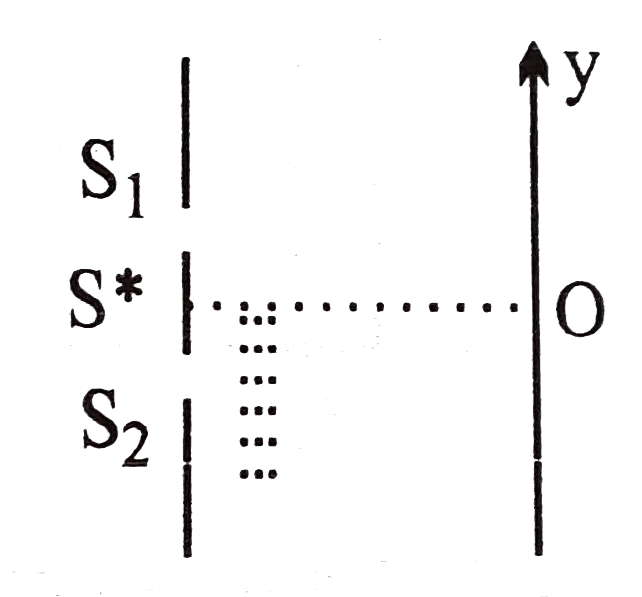
The young's double slit experiment is done in a medium of refractive index `4//3`.A light of `600nm`wavelength is falling on the slits having `0.45` mm separation .The lower slit `S_(2)` is covered by a thin glass sheet of thickness `10.4mu m` and refractive index`1.5`.the intereference pattern is observed ona screen placed `1.5m` from the slits are shown

(a) Find the location of the central maximum (bright fringe with zero path difference)on the y-axis.
(b) Find the light intensity at point `O`relative to the maximum fringe intensity.
(c )Now,if `600nm`light is replaced by white light of range 400 to700 nm find the wavelength of the light that from maxima exactly point `O`.[All wavelengths in this problem are for the given medium of refractive index `4//3` .Ignore dispersion]

Text Solution

Verified by Experts

The correct Answer is:
(i). 4.33m
(ii). `I=(3I_(max))/(4)`
(iii). 650nm;433.33 nm


(i) location of central maximum on y-axis let the central maximum be obtained at a distance y below point O. it will be below O because glass sheet covers the lower slit.
`Deltax_(1)=S_(1)P-S_(2)P=(yd)/(D)`
Due to glass sheet `Deltax_(2)=((mu_(g))/(mu_(m))-1)t`
For zero path difference `Deltax_(1)=Deltax_(2)`
`implies(yd)/(B)=((mu_(g))/(mu_(m))-1)timpliesy=((mu_(g))/(mu_(m))-1)(tD)/(d)`
`impliesy=((3//2)/(4//3)-1)((10.4xx10^(-6))/(0.45xx10^(-3)))(1.5)`
`y=4.33xx10^(-3)m=4.33mm`
(ii) Light intensity at O, `Deltax_(1)=0,Deltax_(2)=((mu_(g))/(mu_(m))-1)t`
`therefore` Net phase difference `=(2pi)/(y)Deltax_(2)`
`thereforephi=(2pi)/(6xx10^(-7))((3//2)/(4//3)-1)(10.4xx10^(6))=(13pi)/(3)`
`thereforeI(phi)=I_(max)cos^(2)((phi)/(2))` or `(I(phi))/(I_(max))=(3)/(4)=0.75`
(iii). Wavelength of light that form maxima O. if 600 nm light is replaced by 400 to 700 nm light
At `O,Deltax=((mu_(g))/(mu_(m))-1)t`
For maximum intensity at O, `Deltax=nlamda`
where `n=1,2,3`...
`thereforelamda=(Deltax)/(1),(Deltax)/(2),(Deltax)/(3)`
`Deltax=((3//2)/(4//3)-1)(10.4xx10^(-6)m)` or `Deltax=1300nm`
For maximum intensity at O,
`lamda=1300nm,(1300)/(2)nm,(1300)/(2)nm,(1300)/(4)nm`
`lamda=1300nm,650nm,433.33nm` ....
or `lamda=6.5xx10^(-7)m,4.33xx10^(-7)m`
Promotional Banner

Topper's Solved these Questions

  • WAVE OPTICS

    ALLEN |Exercise Exercise 2 (Previous Year Questions)|7 Videos
  • WAVE OPTICS

    ALLEN |Exercise Exercise 5 A (Previous Years Questions)|17 Videos
  • UNIT & DIMENSIONS, BASIC MATHS AND VECTOR

    ALLEN |Exercise Exercise (J-A)|7 Videos

Similar Questions

Explore conceptually related problems

Describe Young's double slit experiment.

In Young's double slit experiment if monochromatic light is replaced by white light

In a Young double slit experiment, the width of the source slit is increased then……

A thin glass plate of thickness t and refractive index mu is inserted between screen and one of the slits in a young's experiment. If the intensity at the centre of the screen is I, what was the intensity at the same point prior to the introduction of the sheet.

In a Young's double slit experiment, the separation between the slits is 0.15 mm. In the experiment, a source of light of wavelength 589 nm is used and the interference pattern is observed on a screen kept 1.5 m away. The separation between the successive bright fringes on the screen is

Consider a Young's double slit experiment as shown in figure. What should be the slit separation d in terms of wavelength such that the first minima occurs directly in front of the slit (S_(1)) ?

Red light of wavelength 6500 Å from a distant source falls on a slit 0.50 mm wide. Calculate the distance between first two dark bands on each side of central bright band in the diffraction pattern observed on a screen placed 1.8 m from the slit.

In Young's double slit experiment intensity at a point is ((1)/(4)) of the maximum intersity. Angular position of this point is

A double slit experiment is performed with light of wavelength 500 nm. A thin film of thickness 2mum and refractive index 1.5 is introduced in the path of the upper beam. The location of the central maximum will ......

ALLEN -WAVE OPTICS-Exercise 5 B (Previous Years Questions)
  1. Two beams of ligth having intensities I and 4I interface to produce a ...

    Text Solution

    |

  2. In the ideal double-slit experiment, when a glass-plate(refractive ind...

    Text Solution

    |

  3. In the adjacent diagram, CP represents a wavefront and AO & BP, the co...

    Text Solution

    |

  4. In YDSE, bichromatic light of wavelengths 400 nm and 560 nm are used...

    Text Solution

    |

  5. In Young's double slit experiment intensity at a point is ((1)/(4)) of...

    Text Solution

    |

  6. In the Young's double slit experiment using a monochromatic light of w...

    Text Solution

    |

  7. In a Young's double slit experiment, the separation between the two sl...

    Text Solution

    |

  8. A light source, which emits two wavelength lamda(1)=400nm and lamda(2)...

    Text Solution

    |

  9. While conduction the Young's double slit experiment, a student replace...

    Text Solution

    |

  10. Fig. shows a surface XY separating two transparent media, medium 1 and...

    Text Solution

    |

  11. The figure shows a surface XY separating two transparent media, mediam...

    Text Solution

    |

  12. Fig. shows a surface XY separating two transparent media, medium 1 and...

    Text Solution

    |

  13. A coherent parallel beam of microwaves of wavelength lambda = 0.5 mm f...

    Text Solution

    |

  14. The young's double slit experiment is done in a medium of refractive i...

    Text Solution

    |

  15. A glass of refractive index 1.5 is coated with a thin layer of thickne...

    Text Solution

    |

  16. A vessel ABCD of 10 cm width has two small slits S(1) and S(2) sealed ...

    Text Solution

    |

  17. A point sources S emitting light of wavelength 600nm is placed at a ve...

    Text Solution

    |

  18. In a young's double slit experiment, two wavelength of 500 nm and 700 ...

    Text Solution

    |

  19. A Young's double slit interference arrangement with slits S(1) and S(2...

    Text Solution

    |

