Home
Class 11
PHYSICS
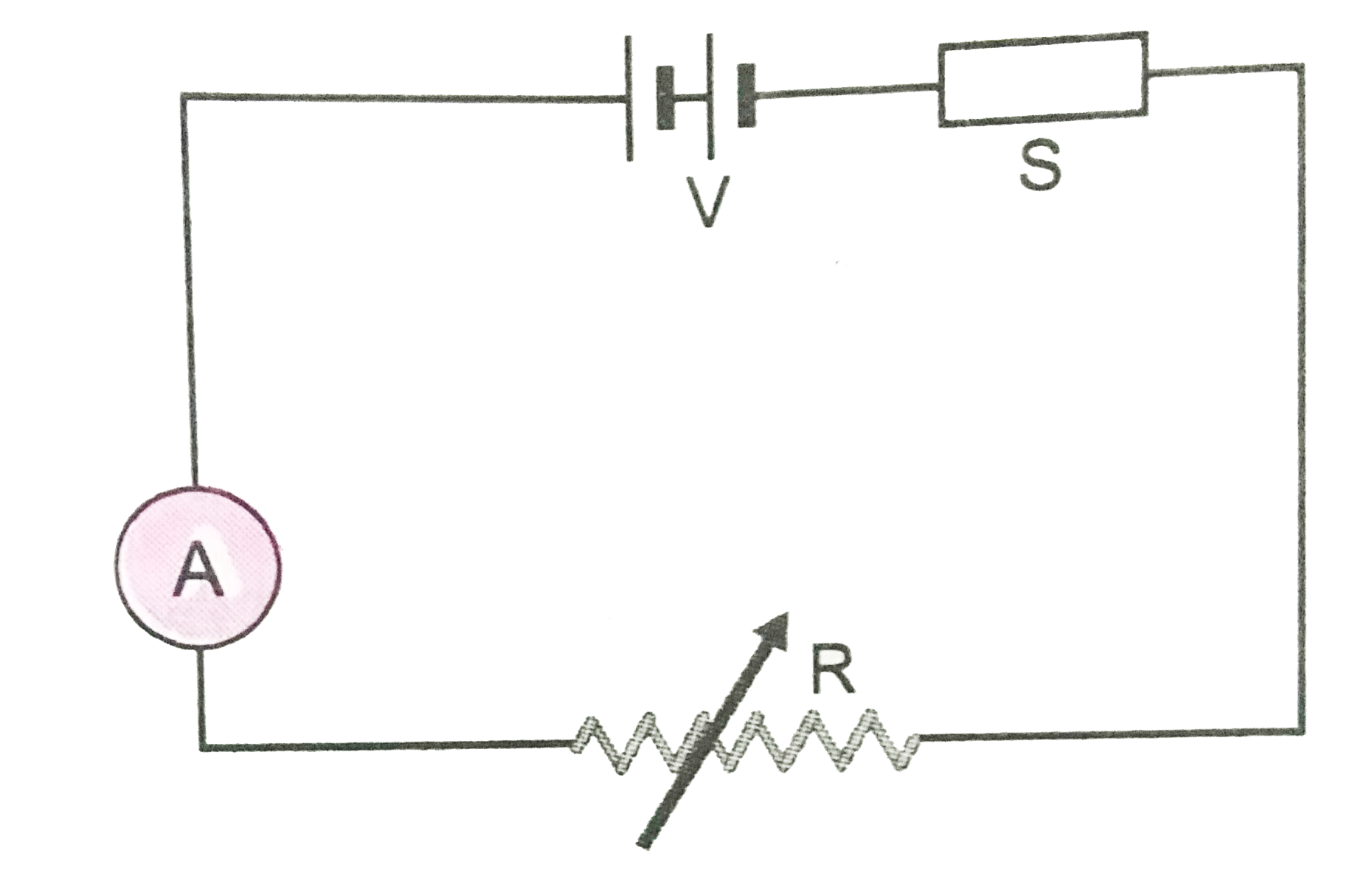
The diagram Fig.12 shown a piece of pure...

The diagram Fig.12 shown a piece of pure semiconductor S in series with a variable resistor R, and a source of constant voltage V. Would you increase or decrease the value of R to keep the reading of ammeter constant, when semi-conductor S is heated? Give reason.

Text Solution

Verified by Experts

Value of R should be increased with the increase in temperature of semiconductor as circuit resistance decreases and current tends to increase.
Promotional Banner

Topper's Solved these Questions

  • SEMICONDUCTORS

    ALLEN |Exercise Part-3(Exercise-1)|84 Videos
  • SEMICONDUCTORS

    ALLEN |Exercise Part-3(Exercise-2)|49 Videos
  • PHYSICAL WORLD, UNITS AND DIMENSIONS & ERRORS IN MEASUREMENT

    ALLEN |Exercise EXERCISE-IV|7 Videos
  • WAVES AND OSCILLATIONS

    ALLEN |Exercise Part-1(Exercise-05)[B]|42 Videos

Similar Questions

Explore conceptually related problems

A parallel plate capacitor with circular plates of radius 0.8 m has a capacitance of 1 nF. At t = 0, it is connected for charging in series with a resistor R = 1 M Omega across a 4V battery. Calculate the magnetic field at a point P, halfway between the centre and the perpendicular of the plates after t=10^(-3)s . (The charge on the capacitor at time t is q (t) = CV [1 - exp (-t//tau) ], where the time constant tau is equal to CR.)

A parallel plate capacitor with circular plates of radius 1 m has a capacitance of 1 nF. At t = 0, it is connected for charging in series with a resistor R = 1 M Onega across a 2V battery. Calculate the magnetic field at a point P, halfway between the centre and the periphery of the plates, after t=10^(-3)s . (The charge on the capacitor at time t is q (t) = CV [1 - exp (-t//tau) ], where the time constant tau is equal to CR.)

An accelration produces a narrow beam of protons, each having an initial speed of v_(0) . The beam is directed towards an initially uncharges distant metal sphere of radius R and centered at point O. The initial path of the beam is parallel to the axis of the sphere at a distance of (R//2) from the axis, as indicated in the diagram. The protons in the beam that collide with the sphere will cause it to becomes charged. The subsequentpotential field at the accelerator due to the sphere can be neglected. The angular momentum of a particle is defined in a similar way to the moment of a force. It is defined as the moment of its linear momentum, linear replacing the force. We may assume the angular momentum of a proton about point O to be conserved. Assume the mass of the proton as m_(P) and the charge on it as e. Given that the potential of the sphere increases with time and eventually reaches a constant velue. After a long time, when the potential of the sphere reaches a constant value, the trajectory of proton is correctly sketched as

Each phase of a material can exits only in certain regions of pressure and temperature . P-T phase diagrams, in which pressure is plotted versus temperature, show the regions corresponding to various phases and phase transformations . P-V diagrams, on the other hand , can be used to study pressure volume relationship at a constant temperature. If the liquid and gaseous phases of a pure substances are heated together in a closed container, both the temperature and the vapor pressure will increase until a point is reached at which the two phases can no longer be distinguished from one another. The temperature and pressure at which this occurs are called the critical temperature and pressure. Exceeding either of these parameters, by itself ,will cause the "gas"//"liguid" phase transition to disappear. if the other variable is then changed as well, while the first variable is maintained above its critical point , a gradual transition will occur between the gaseous and liquid phases, with no clear boundary.(The liquid and solid phases, on the other hand , maintain a distinct boundary at all pressure above the triple point). Shown in figure is a combined P-T phase diagram for material A and B . If heat is added to solids A and B , each in a container that is open to the atmosphere :-

Each phase of a material can exits only in certain regions of pressure and temperature . P-T phase diagrams, in which pressure is plotted versus temperature, show the regions corresponding to various phases and phase transformations . P-V diagrams, on the other hand , can be used to study pressure volume relationship at a constant temperature. If the liquid and gaseous phases of a pure substances are heated together in a closed container, both the temperature and the vapor pressure will increase until a point is reached at which the two phases can no longer be distinguished from one another. The temperature and pressure at which this occurs are called the critical temperature and pressure. Exceeding either of these parameters, by itself ,will cause the "gas"//"liguid" phase transition to disappear. if the other variable is then changed as well, while the first variable is maintained above its critical point , a gradual transition will occur between the gaseous and liquid phases, with no clear boundary.(The liquid and solid phases, on the other hand , maintain a distinct boundary at all pressure above the triple point). Shown in figure is a combined P-T phase diagram for material A and B . Which is true about the substance in figure?

A circus wishes to develop a new clown act. Fig. (1) shows a diagram of the proposed setup. A clown will be shot out of a cannot with velocity v_(0) at a trajectory that makes an angle theta=45^(@) with the ground. At this angile, the clown will travell a maximum horizontal distance. The cannot will accelerate the clown by applying a constant force of 10, 000N over a very short time of 0.24s . The height above the ground at which the clown begins his trajectory is 10m . A large hoop is to be suspended from the celling by a massless cable at just the right place so that the clown will be able to dive through it when he reaches a maximum height above the ground. After passing through the hoop he will then continue on his trajectory until arriving at the safety net. Fig (2) shows a graph of the vertical component of the clown's velocity as a function of time between the cannon and the hoop. Since the velocity depends on the mass of the particular clown performing the act, the graph shows data for serveral different masses. If the angle the cannot makes with the horiaontal is increased from 45^(@) , the hoop will have to be

From a water tap, liquid comes out from cylinder. As water moves down, radius of that cylinder decreases. Consider, a very small element of height h and radius R (due to small height radius is assumed to be constant) This element is given in the diagram. An imaginary cross-section ABCD divides this element in two equal semi cylinder. S is surface tensionof liquid. Now choose correct statement(s)

Entropy ( S ) is a thermodynamic variable like pressure P , volume V and temperature T . Entropy of a thermodynamic system is a measure of disorder of molecular motion. Greater is disorder , greater is entropy. Change in entropy of a thermodynamic system is the ratio of heat supplied to absolute temperature.In an adiabatic reversible process, entropy remains constant while in any irreversible process entropy increases. In nature the processes are irreversible , therefore entropy of universe is continuoulsy increasing. When milk is heated , its entropy :

By the term velocity of rain, we mean velocity with which raindrops fall relative to the ground. In absence of wind, raindrops fall vertically and in presence of wind raindrops fall obliqucly. Moreover raindrops acquire a constant terminal velocity due air resistance very quickly as they fall toward the carth. A moving man relative to himself observes an altered velocity of raindrops. Which is known as velocity of rain relative to the man. It is given by the following equation. vec(v)_(rm)=vec(v)_(r)-vec(v)_(m) A standstill man relative to himself observes rain falling with velocity, which is equal to velocity of the raindrops relative to the ground. To protect himself a man should his umbrella against velocity of raindrops relative to himself as shown in the following figure. Rain is falling vertically with velocity 80 cm/s. (a) How should you hold your umbrella ? (b) You start walking towards the east with velocity 60 cm/s. How should you hold umbrella ? (c) You are walking towards the west with velocity 60 cm/s. How should you hold your umbrella ? (d) You are walking towards the north with velocity 60 cm/s. How should you hold your umbrella? (e) You are walking towards the south with velocity 80 cm/s. How should you hold your umbrella ?

Answer carefully: (a) Two large conducting spheres carrying charges Q_(1) and Q_(2) are brought close to each other. Is the magnitude of electrostatic force between them exactly given by Q_(1),Q_(2)//4pi epsilon_(0)r^(2) , where r is the distance between their centres? (b) If Coulomb’s law involved 1//r^(3) dependence (instead of would Gauss’s law be still true ? (c) A small test charge is released at rest at a point in an electrostatic field configuration. Will it travel along the field line passing through that point? (d) What is the work done by the field of a nucleus in a complete circular orbit of the electron? What if the orbit is elliptical? (e) We know that electric field is discontinuous across the surface of a charged conductor. Is electric potential also discontinuous there? (f) What meaning would you give to the capacitance of a single conductor? (g) Guess a possible reason why water has a much greater dielectric constant (= 80) than say, mica (= 6).

ALLEN -SEMICONDUCTORS-Part-3(Exercise-4)
  1. The diagram Fig.12 shown a piece of pure semiconductor S in series wit...

    Text Solution

    |

  2. At absolute zero temperature Si acts as ……..

    Text Solution

    |

  3. The energy band gap is maximum in …….

    Text Solution

    |

  4. The part of a transistor which is most heavily doped to produce large ...

    Text Solution

    |

  5. A piece of copper and another of germanium are cooled from room temper...

    Text Solution

    |

  6. The difference in the variation of resistance with temperature in a me...

    Text Solution

    |

  7. In the middle of the electron layer of a reverse biased p-n junction, ...

    Text Solution

    |

  8. Consider telecommunication through optical fibres. Which of the follow...

    Text Solution

    |

  9. When npn transistor is used as an amplifler

    Text Solution

    |

  10. For a transistor ampliflier in common emiter configuration for load im...

    Text Solution

    |

  11. A piece of copper and another of germanium are cooled from room temper...

    Text Solution

    |

  12. When p-n junction diode is forward biased ………

    Text Solution

    |

  13. The electrical conductivity of a semiconductor of a semiconductor incr...

    Text Solution

    |

  14. In a common emitter amplifier circuit using a n-p-n transistor, the ph...

    Text Solution

    |

  15. In a full wave rectifier circuit operating from 50 Hz mains frequency...

    Text Solution

    |

  16. In a common base mode of a transition , the collector current is 5.48...

    Text Solution

    |

  17. A solid which is transparent to visible light an whose conductivity in...

    Text Solution

    |

  18. Ratio of number density of holes is (7)/(5) and ratio of their current...

    Text Solution

    |

  19. The circuit has two oppsitely ideal diodes in parallel. What is the cu...

    Text Solution

    |

  20. In the following, which one of the diodes is reverse biased ?

    Text Solution

    |

  21. If the lattice constant of this semiconductor is decreased, then which...

    Text Solution

    |
