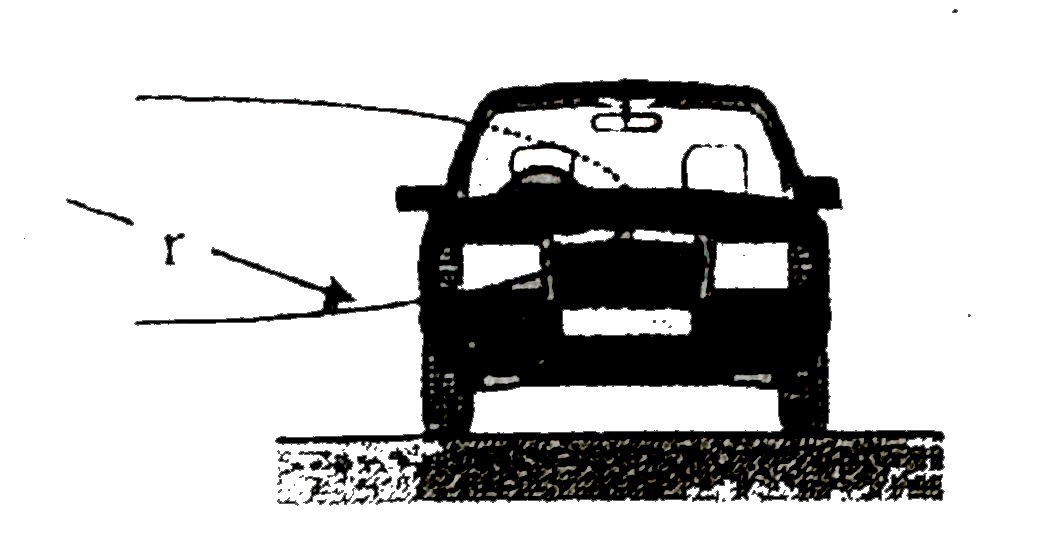
Two-wheeler can tilt while turning. But four-wheeler cannot. Estimate maximum safe speed of a four-wheeler on turn of radius 10m assuming coefficient of static friction between tires and the flat road to be 0.64 and acceleration due to gravity to be 10 `m//s^(2)` .
A
6.4 m/s
B
2.8 m/s
C
8 m/s
D
10 m/s
Text Solution
Verified by Experts
The correct Answer is:
C
`v_("max")=sqrt(mu_(s)rg)=8.0 m//s`
Topper's Solved these Questions
TEST PAPERS
ALLEN |Exercise PAPER 2|60 Videos
TEST PAPERS
ALLEN |Exercise PAPER 3|92 Videos
TEST PAPER 4
ALLEN |Exercise PHYSICS|45 Videos
UNIT & DIMENSIONS, BASIC MATHS AND VECTOR
ALLEN |Exercise Exercise (J-A)|7 Videos
Similar Questions
Explore conceptually related problems
If coeffiecient of friction between the block of mass 2kg and table is 0.4 then out acceleration of the system and tension in the string. (g=10m//s^(2))
Find the maximum speed at which a car can take turn round a curve of 30 cm radius on a level road if the coefficient of friction between the tyres and the road is 0.4. Take g = 10 ms^(-2) .
The fricition coefficient between the table and block shown in fig. is 0.2 find the acceleration of the system (Take g=10 m//s^(2) )
A cyclist speeding at 18 km// h on a level road takes a sharp circular turn of radius 3 m without reducing the speed . The coefficient of static friction between the tyres and the road is 0.1 Will the cyclist slip while taking the turn ?
A cyclist speeding at 18 km/h on a level road takes a sharp circular turn of radius 3 m without reducing the speed. The co-efficient of static friction between the tyres and the road is 0.1. Will the cyclist slip while taking the turn?
A cyclist moving on level circular path of radius 4 m with speed of 4.9 m/s takes sharp turn. Co-efficient of friction between tyre and road will b e .......
A cyclist on a level road takes a sharp circular tu rn of rad iu s 3 m (g = 10 ms^(- 2) ). If th e coefficient of static friction between the cycle tyres and the road is 0.2, at which of the following speeds will the cyclist not skid while taking the turn ?
A man standing stationary with respect to a horizontal conveyor belt that is accelerating with 1 m s- 2 . What is the net force on the m an ? If the coefficient of static friction between the man’s shoes and the belt is 0.2 up to what acceleration o f the belt can the man continue to be stationary relative to the belt ? (Mass of the man = 65 kg).
A cylinder of 10 kg is sliding in a plane with an initial velocity of 10 m / s . If the coefficient of friction between the surface and cylinder is 0.5 then before stopping, it will cover. (g=10m//s^(2))