The area of cross-section of the two vertical arms of a hydraulic press are 1 `cm ^(2)` and `10 cm^(2)` respectively. A force of 10N applied. As shown in the figure, to a tight fitting light piston in the thinner arm balances a force F applied to the corresponding piston in the thicker arm. Assuming that the levels of water in both the arms are the same, we can conclude:-
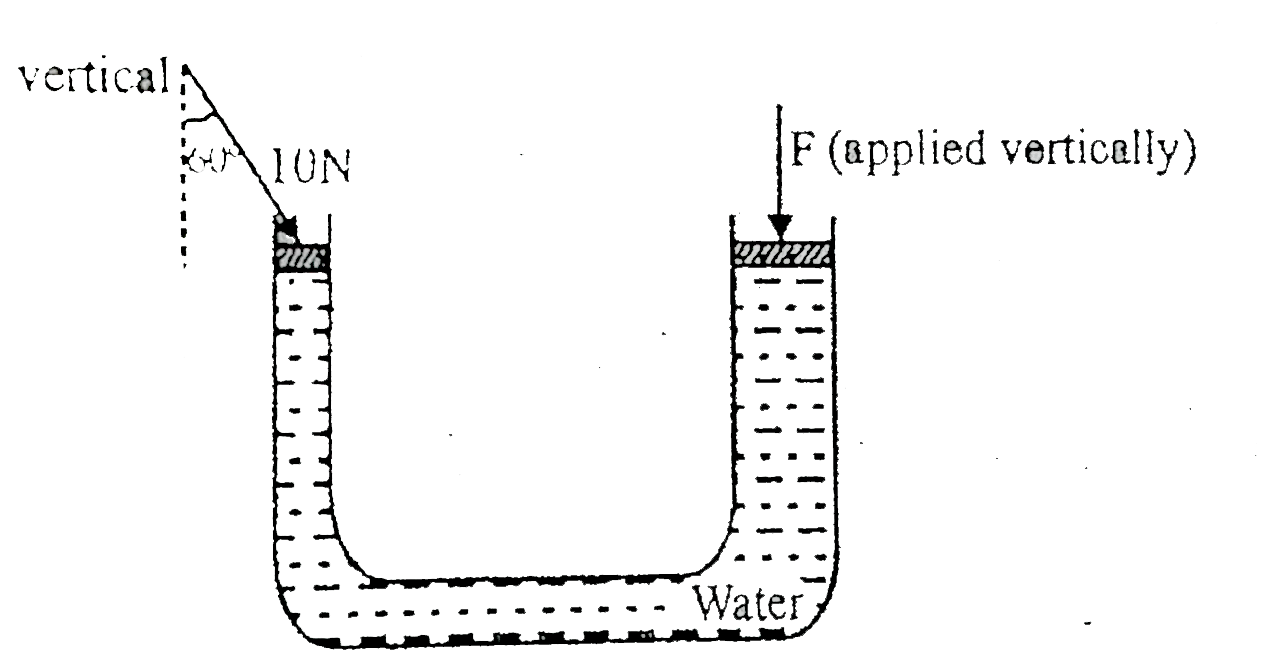
The area of cross-section of the two vertical arms of a hydraulic press are 1 `cm ^(2)` and `10 cm^(2)` respectively. A force of 10N applied. As shown in the figure, to a tight fitting light piston in the thinner arm balances a force F applied to the corresponding piston in the thicker arm. Assuming that the levels of water in both the arms are the same, we can conclude:-
A
F=100N
B
F=50N
C
F=25N
D
F, as applied, cannot balance the effect of the force on the first piston
Text Solution
Verified by Experts
The correct Answer is:
B
`(10xx cos 60^(@))/(1)=(F)/(10)rArrF=50N`



Topper's Solved these Questions
Similar Questions
Explore conceptually related problems
The area of cross section of a steel wire (Y=2.0 xx 10^(11) N//m^(2)) is 0.1 cm^(2) . The force required to double is length will be
Two syringes of different cross sections (without needles)filled with water are connected with a tightly fitted rubber tube filled with water .Diameters of the smaller piston and larger piston 1.0 cm and 3.0 cm respectively .(a)Find the force exerted on the large piston when a force of 10 N is applied to the smaller piston .(b) If the smaller piston is pushed in through 6.0 cm how much does the larger piston move out ?
Two bodies A and B of masses 10kg and 15kg respectively kept on a smooth, horizontal surface are tied to the ends of a light string. If T represents the tension in the string when a horizontal force F=500N is applied to A (as shown in figure 1) and T' be the tension when it is applied to B (figure2), then which of the following is true?
Diameters of the arms of a U tube are 10 mm and 1 mm . It is partially filled with water and it is held in a vertical plane . Find the difference in heights of water in both the arms . (Surface tension of water =70 dyne cm^(-1) angle of contact =0^(@).g=980cms^(-2))
A vertical U-tube of uniform cross-section contains mercury in both arms A glycerine (relative density =1.3) column of length 10 cm is introduced into one of the arms. Oil of density 800 gm m^(-3) is poured into the other arm until the upper surface of the oil and hlycerine are at the same horizontal level, find the length of the column. Density of mercury is 13.6xx10^(3)kgm^(-3)
A vertical cylinder of cross-sectional area 0.1m^(2) closed at both ends is fitted with a frictionless piston of mass M dividing the cylinder into two parts. Each part contains one mole of an ideal gas in equilibrium at 300K . The volume of the upper part is 0.1m^(3) and that of lower part is 0.05m^(3) .What force must be applied to the piston so that the volumes of the two parts remain unchanged when the temperature is increased to 500K ?
A large cylinderical tank of cross-sectional area 1m^(2) is filled with water . It has a small hole at a height of 1 m from the bottom. A movable piston of mass 5 kg is fitted on the top of the tank such that it can slide in the tank freely. A load of 45 kg is applied on the top of water by piston, as shown in figure. The value of v when piston is 7 m above the bottom is (g=10m//s^(2) ) (a). sqrt(120)m//s (b). 10m//s (c). 1m//s (d). 11m//s
An ideal monoatomic gas is confined in a cylinder by a spring-loaded piston of cross-section 8.0xx10^-3m^2 . Initially the gas is at 300K and occupies a volume of 2.4xx10^-3m^3 and the spring is in its relaxed (unstretched, unompressed) state, fig. The gas is heated by a small electric heater until the piston moves out slowly by 0.1m. Calculate the final temperature of the gas and the heat supplied (in joules) by the heater. The force constant of the spring is 8000 N//m , atmospheric pressure is 1.0xx10^5 Nm^-2 . The cylinder and the piston are thermally insulated. The piston is massless and there is no friction between the piston and the cylinder. Neglect heat loss through lead wires of the heater. The heat capacity of the heater coil is negligible. Assume the spring to be massless.