Home
Class 12
PHYSICS
In the circuit shown the capacitor is in...

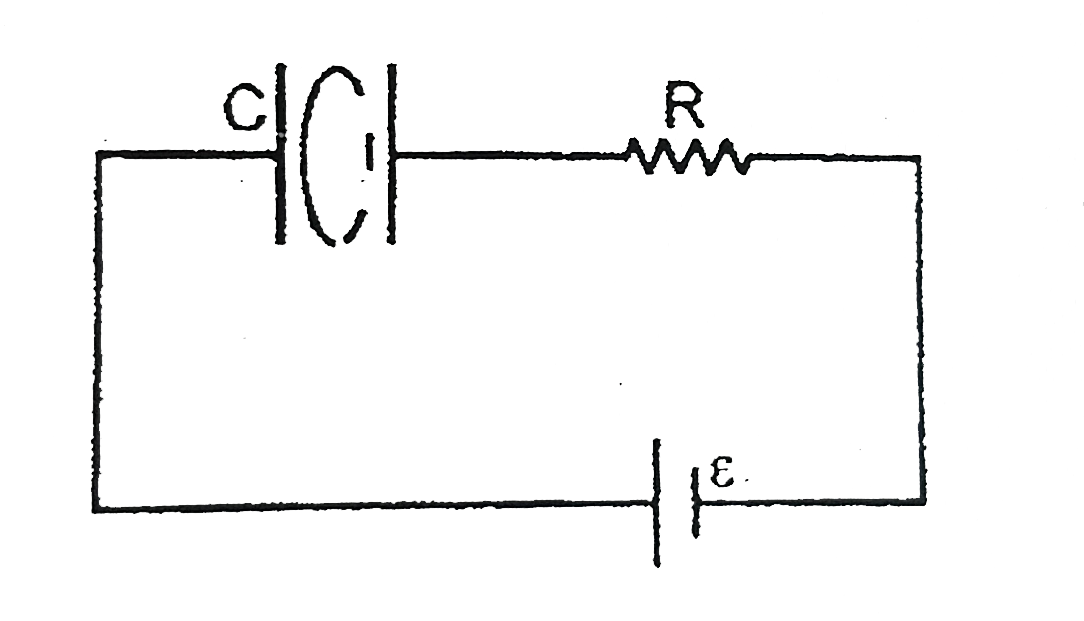
In the circuit shown the capacitor is initially uncharged. The charge passed through an imaginary circular loop parallel to the plates (also circular ) and having the area equal to half of the area of the plates, in one time constant will be , -

A

`0.63 epsilonC`

B

`0.37 epsilonC`

C

`(epsilonC)/(2)`

D

zero

Text Solution

Verified by Experts

The correct Answer is:

D

During the charging process, charge does not jump or cross the area between the plates.
Promotional Banner

Topper's Solved these Questions

  • TEST PAPERS

    ALLEN |Exercise PAPER 3|92 Videos
  • TEST PAPERS

    ALLEN |Exercise Part-1 Physics|15 Videos
  • TEST PAPERS

    ALLEN |Exercise MATHS|1 Videos
  • TEST PAPER 4

    ALLEN |Exercise PHYSICS|45 Videos
  • UNIT & DIMENSIONS, BASIC MATHS AND VECTOR

    ALLEN |Exercise Exercise (J-A)|7 Videos

Similar Questions

Explore conceptually related problems

(a) A closed loop is held stationary in the magnetic field between the north and south poles of two permanent magnets held fixed. Can we hope to generate current in the loop by using very strong magnets ? (b) A closed loop moves normal to the constant electric field between the plates of a large capacitor. Is a current induced in the loop (i) when it is wholly inside the region between the capacitor plates (ii) when it is partially outside the plates of the capacitor? The electric field is normal to the plane of the loop. (c) A rectangular loop and a circular loop are moving out of a uniform magnetic field region (Figure) to a field-free region with a constant velocity v. In which loop do you expect the induced emf to be constant during the passage out of the field region? The field is normal to the loops.

A radioactive sample decays with an average life of 20 ms . A capacitor of capacitance 100 muF is charged to some potential and then the plates are connected through a resistance R . What should be the value of R so that the ratio of the charge on the capacitor to the activity of the radioactive sample remains constant in time?

Figure 8.6 shows a capacitor made of two circular plates each of radius 12 cm, and separated by 5.0 cm. The capacitor is being charged by an external source (not shown in the figure). The charging current is constant and equal to 0.15A. (a) Calculate the capacitance and the rate of change of potential difference between the plates. (b) Obtain the displacement current across the plates. (c) Is Kirchhoff’s first rule (junction rule) valid at each plate of the capacitor? Explain.

A rod of mass m and resistance R slides smoothly over two parallel conducting wires kept sloping at an angle theta with respect to the horizontal as shown in figure. The circuit is closed through a perfect conductor at the top. There is a constant magnetic field vecB along the vertical direction. If the rod is initially at rest, find the velocity of the rod as a function of time.

The capacitance of a parallel plate capacitor formed by the circular plates of diameter 4.0 cm is equal to the capacitance or a sphere of diameter 200 cm. Find the distance between two plates.

An electron passes between two parallel plate of a capacitor as shown in the diagram. The electron enters the plate at t=0 and it comes out of the plates at time t=T. The electron hits the screen at A, as shown. Now a time varying potential difference V is applied between the plates, as shown in the graph. (Neglect the gravity). The point where the electron now will strike (as compared to point A) will be

An accelration produces a narrow beam of protons, each having an initial speed of v_(0) . The beam is directed towards an initially uncharges distant metal sphere of radius R and centered at point O. The initial path of the beam is parallel to the axis of the sphere at a distance of (R//2) from the axis, as indicated in the diagram. The protons in the beam that collide with the sphere will cause it to becomes charged. The subsequentpotential field at the accelerator due to the sphere can be neglected. The angular momentum of a particle is defined in a similar way to the moment of a force. It is defined as the moment of its linear momentum, linear replacing the force. We may assume the angular momentum of a proton about point O to be conserved. Assume the mass of the proton as m_(P) and the charge on it as e. Given that the potential of the sphere increases with time and eventually reaches a constant velue. One the potential of the sphere has reached its final, constant value, the minimum speed v of a proton along its trajectory path is given by

An accelration produces a narrow beam of protons, each having an initial speed of v_(0) . The beam is directed towards an initially uncharges distant metal sphere of radius R and centered at point O. The initial path of the beam is parallel to the axis of the sphere at a distance of (R//2) from the axis, as indicated in the diagram. The protons in the beam that collide with the sphere will cause it to becomes charged. The subsequentpotential field at the accelerator due to the sphere can be neglected. The angular momentum of a particle is defined in a similar way to the moment of a force. It is defined as the moment of its linear momentum, linear replacing the force. We may assume the angular momentum of a proton about point O to be conserved. Assume the mass of the proton as m_(P) and the charge on it as e. Given that the potential of the sphere increases with time and eventually reaches a constant velue. After a long time, when the potential of the sphere reaches a constant value, the trajectory of proton is correctly sketched as

A metallic rod of 1 m length is rotated with a frequency of 50 rev/s, with one end hinged at the centre and the other end at the circumference of a circular metallic ring of radius 1 m, about an axis passing through the centre and perpendicular to the plane of the ring as per figure. A constant and uniform magnetic field of 1T parallel to the axis is present everywhere. What is the emf between the centre and the metallic ring ?

An accelration produces a narrow beam of protons, each having an initial speed of v_(0) . The beam is directed towards an initially uncharges distant metal sphere of radius R and centered at point O. The initial path of the beam is parallel to the axis of the sphere at a distance of (R//2) from the axis, as indicated in the diagram. The protons in the beam that collide with the sphere will cause it to becomes charged. The subsequentpotential field at the accelerator due to the sphere can be neglected. The angular momentum of a particle is defined in a similar way to the moment of a force. It is defined as the moment of its linear momentum, linear replacing the force. We may assume the angular momentum of a proton about point O to be conserved. Assume the mass of the proton as m_(P) and the charge on it as e. Given that the potential of the sphere increases with time and eventually reaches a constant velue. If the initial kinetic energy of a proton is 2.56 ke V , then the final potential of the sphere is

ALLEN -TEST PAPERS-PAPER 2
  1. Consider the shown circuit. The capacitor is uncharged when the swith ...

    Text Solution

    |

  2. An uncharged capacitor is connected in series with a resistor and a ba...

    Text Solution

    |

  3. In the circuit shown the capacitor is initially uncharged. The charge ...

    Text Solution

    |

  4. Two large oppositely charged insulated plates have a uniform electric ...

    Text Solution

    |

  5. An alpha is moving along a circle of radius R with a constant angular ...

    Text Solution

    |

  6. A current 1 flows along a triangle loop having sides of equal length a...

    Text Solution

    |

  7. A small current element of length 'dl' and carrying current is placed ...

    Text Solution

    |

  8. Let B(P) and B(Q) be the magnetic field produced by the wire P and Q w...

    Text Solution

    |

  9. A long straight solid metal wire of radius R carries a current I, unif...

    Text Solution

    |

  10. A current carrying wire AB of the length L is turned along a circle, a...

    Text Solution

    |

  11. An electron moving with a velocity v along the positive x-axis approac...

    Text Solution

    |

  12. If the ratio of time periods of circular motion of two charged particl...

    Text Solution

    |

  13. A current flows through a rectangular conductor in the presence of uni...

    Text Solution

    |

  14. An inductance L and a resistance R are connected in series with a batt...

    Text Solution

    |

  15. If the readings V(1) and V(3) are 10. volt each, then reading of V(2) ...

    Text Solution

    |

  16. In the series LCR circuit as shown in figure, the heat developed in 80...

    Text Solution

    |

  17. An eye can distinguish between two points of an object if they are sep...

    Text Solution

    |

  18. A Galilean telescope of 10-fold magnification has the length of 45 cm...

    Text Solution

    |

  19. The dispersive powers of two materials are 0.30 & 0.28. They are used ...

    Text Solution

    |

  20. Assume standard notations used for dispersion and deviation is a prism...

    Text Solution

    |
