Home
Class 12
PHYSICS
Assertion:A point charge q is placed nea...

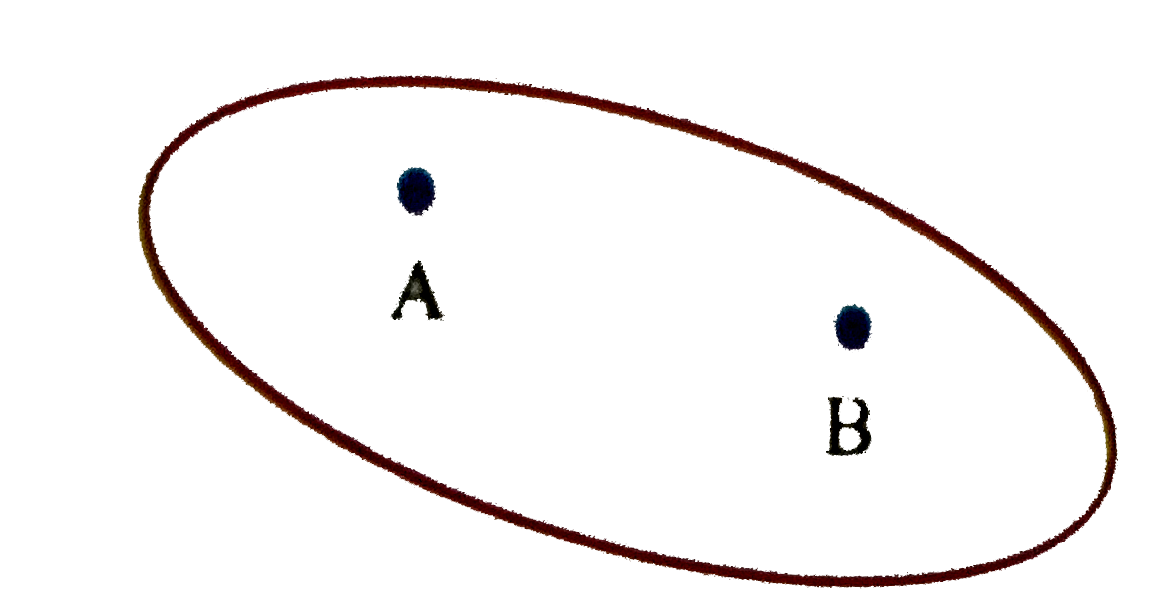
Assertion:A point charge `q` is placed near an arbitrary shaped solid conductor as shown in figures.The potential difference between the points `A` and `B` within the conductor remain same irrespective of the magnitude of charge `q`
Reason: The electric field inside a solid conductor is zero under electrostatic conditions

A

If both Assertion `&` Reason are True `&` the Reason is a correct explanation of the Assertion.

B

If both Assertion `&` Reason are True but Reason is not a correct explanation of the Assertion.

C

If Assertion is True but the Reason is False.

D

If both Assertion `&` Reason are False.

Text Solution

Verified by Experts

The correct Answer is:

A

Since electric field inside the conductor is zero, A and B are always at same potential. Hence `V_(A)-V_(B)=0`.
Promotional Banner

Topper's Solved these Questions

  • TEST PAPERS

    ALLEN |Exercise PAPER 3|92 Videos
  • TEST PAPERS

    ALLEN |Exercise Part-1 Physics|15 Videos
  • TEST PAPERS

    ALLEN |Exercise MATHS|1 Videos
  • TEST PAPER 4

    ALLEN |Exercise PHYSICS|45 Videos
  • UNIT & DIMENSIONS, BASIC MATHS AND VECTOR

    ALLEN |Exercise Exercise (J-A)|7 Videos

Similar Questions

Explore conceptually related problems

Positive and negative charges of 1 muC each are placed at two points as shown in the figure. Find the potential difference between A and B

A charge Q is uniformly distributed over a long rod AB of length L as shown in the figure. The electric potential at the point O lying at distance L from the end A is

A charge 3 coulomb experiences a force 300 N when placed in a uniform electric field. The potential difference between two points separated by a distance of 10 cm along the field line is:

An irregular shaped non conductor has some charge distribution. The potential difference between the two points A and B in it is V. If it is now enveloped in an spherical non conducting shell having uniform charge distribution in it, the new potential difference between the points (neglect any induction due to presence of charge)

In front of an earthed conductor a point charge +q is placed a shown in figure

A solid conducting sphere having a charge Q is surrounded by an uncharged concentric conducting hollow spherical shell. Let the potential difference between the surface of the solid sphere and that of the outer surface of the hollow shell be V. If the shell is now given a charge of -3Q , the new potential difference between the same two surfaces is :

Assertion: A positively charged rod is held near a neutral conducting solid sphere as illustrated below. The sphere lies on a insulated stand. The potential of ground (or earth) is zero. The potential at point A (point A need not be centre of the sphere) is higher compared to potential of gound (earth). Reason: In this situation of assertion, the potential at the centre of conducting sphere is positive. the solid sphere being conducting, potential at each point in the sphere is same.

A point charge Q is placed at the centre of a spherical conducting shell. A total charge of -q is placed on the shell. The magnitude of the electric field at point P_1 at a distance R_1 from the centre is X. The magnitude of the electric field due to induced charges at point P_2 a distance R_2 from the centre is Y. The values of X and Y are respectively.

An electric charge 10^6muC is placed at the origin (0, 0) of X-Y co-ordinate system. Two points A and B are situated at (sqrt2, sqrt2) and (2, 0) respectively. The potential difference between the points A and B will be

As shown in figure a closed surface intersects a spherical conductor. If a negative charge is placed at point P. What is the nature of the electric flux coming out of the closed surface?

ALLEN -TEST PAPERS-PAPER 2
  1. A ray R(1) is incident on the plane surface of the glass slab (kept in...

    Text Solution

    |

  2. Assertion: A positively charged rod is held near a neutral conducting ...

    Text Solution

    |

  3. Assertion:A point charge q is placed near an arbitrary shaped solid co...

    Text Solution

    |

  4. Assetrion: If a proton and electron are placed in the same uniform ele...

    Text Solution

    |

  5. Assertion:- In a given situation of arrangement of charges, an extra c...

    Text Solution

    |

  6. STATEMENT 1: The current density vec J at any point in ohmic resistor ...

    Text Solution

    |

  7. Assertion:- To cells of unequal emf E(1) and E(2) having internal resi...

    Text Solution

    |

  8. Statement I : In the circuit in Fig. 7.46, both cells are ideal and of...

    Text Solution

    |

  9. Assertion:- Time constants of the cirucits shown in the figure are sam...

    Text Solution

    |

  10. Assertion:- If dipole (vecP(1)) is moved along the line normal to the ...

    Text Solution

    |

  11. Assertion:- Average power consumed in an accircuit is equal to average...

    Text Solution

    |

  12. Assertion:- Electric field produced by changing magnetic field is nonc...

    Text Solution

    |

  13. Assertion (A) : When tiny circular obstacle is placed in the path of l...

    Text Solution

    |

  14. Assertion:- In standard YDSE set up with visible light, the position o...

    Text Solution

    |

  15. Assertion:- In glass, red light travels faster than blue light. Reas...

    Text Solution

    |

  16. Assertion:- When a width of one of the slits of Young's double slit ex...

    Text Solution

    |

  17. Assertion:- The formula ((1)/(v)+(1)/(u)=(1)/(f)) connecting u and v f...

    Text Solution

    |

  18. Assertion:- Paraxial rays are always parallel to the principal axis. ...

    Text Solution

    |

  19. Assertion:- Images formed by TIR (Total internal reflection) are much ...

    Text Solution

    |

  20. Assertion:- The image focus (2^(nd) focus) and the object focus (1^(st...

    Text Solution

    |
