Home
Class 12
PHYSICS
A bead is free to slide down a smooth wi...

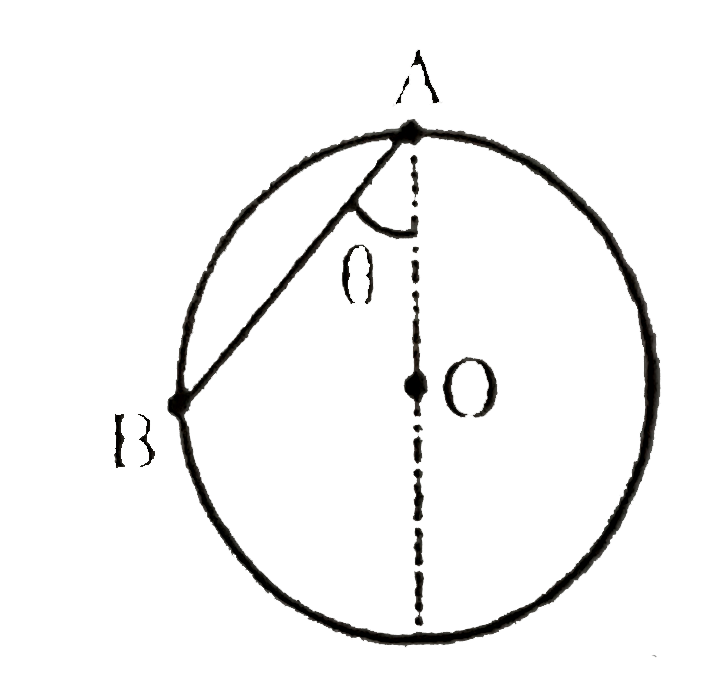
A bead is free to slide down a smooth wire tightly stretched between points A and on a verticle circle of radius R. if the bead starts from rest at 'A', the highest point on the circle, its velocity when it arrives at B is :-

A

`2sqrt(gR)`

B

`2sqrt(gR) cos theta`

C

`(2sqrt(R))/(g)`

D

None of these

Text Solution

Verified by Experts

The correct Answer is:
B

`a=g costheta`
`AB=2Rcos thetarArrv^(2)=u^(2)+2as`

`v^(2)=0+2(g cos theta)xx2Rcos theta rArr v^(2)=4gR cos ^(2)theta`
`rArrv=2sqrt(gR) cos theta`
Promotional Banner

Topper's Solved these Questions

  • TEST PAPERS

    ALLEN |Exercise Part-1 Physics|15 Videos
  • TEST PAPERS

    ALLEN |Exercise part-2 physics|73 Videos
  • TEST PAPERS

    ALLEN |Exercise PAPER 2|60 Videos
  • TEST PAPER 4

    ALLEN |Exercise PHYSICS|45 Videos
  • UNIT & DIMENSIONS, BASIC MATHS AND VECTOR

    ALLEN |Exercise Exercise (J-A)|7 Videos

Similar Questions

Explore conceptually related problems

A stone of m ass m tied to the end of a string revolves in a vertical circle of radius R. The net force at the lowest and highest points of the circle d irected vertically dow nw ards are : [Choose the correct alternative] Lowest Point (a) mg - T_(1) (b) mg + T_(1) (c) mg + T_(1) - (mv_(1)^(2))//R (d) mg - T_(1) - (mv_(1)^(2))//R Highest Point mg + T_(2) mg - T_(2) mg - T_(2) + (mv_(1)^(2))//R mg + T_(2) + (mv_(1)^(2))/R T_(1) and denote the tension and speed at the lowest point. T_(2) and v_(2) denote corresponding values at the highest point.

A bead slides on a frictoinless strainght rod fixed between points A and B of a vertical circular loop of radius as shown in the figure. Line BC is a vertical diameter. Denoting acceleration due to gravity by g , which of the following is correct expression for the time taken by the bead to slide from A to B

A 14.5 kg mass, fastened to the end of a steel wire of unstretched length 1.0 m, is whirled in a vertical circle with an angular velocity of 2 rev/s at the bottom of the circle. The crosssectional area of the wire is 0.065 cm. Calculate the elongation of the wire when the mass is at the lowest point of its path. [Y_("Steel") =2 xx 10 ^(11) N,m ^(-2)]

A 14.5 kg mass, fastened to the end of a steel wire of unstretched 1.0 m, is whirled in a vertical circle with an angular velocity of 2 rev/s at the bottom of the circle. The cross- sectional area of the wire is 0.065" cm"^(2) . Calculate the elongation of the wire when the mass is at the lowest point of its path.

Two beads of masses m_(1) and m_(2) are closed threaded on a smooth circular loop of wire of radius R. Intially both the beads are in position A and B in vertical plane . Now , the bead A is pushed slightly so that it slide on the wire and collides with B . if B rises to the height of the centre , the centre of the loop O on the wire and becomes stationary after the collision , prove m_(1) : m_(2) = 1 : sqrt(2)

A particle goes from point A to point B, moving in a semicircle of radius 1 m in 1 second. Find the magnitude of its average velocity.

A wire, which passes through the hole in a small bead, is bent in the form of quarter of a circle. The wire is fixed vertically on ground as shown in the figure. The bead is released from near the top of the wire and it slides along the wire without friction. As the bead moves from A to B, the force it applies on the wire is

A piece of wire is bent in the shape of a parabola y=kx^(2) (y-axis vertical) with a bead of mass m on it. The bead can slide on the wire without friction. It stays at the lowest point of the parabola when the wire is at rest. The wire is now accelerated parallel to the x-axis with a constant acceleration a. The distance of the new equilibrium position of the bead, where the bead can stay at rest with respect to the wire, from the y-axis is:

The diagram show a small bead of mass m carrying charge q . The bead can freely move on the smooth fixed ring placed on a smooth horizontal plane . In the same pane a charge +Q has also been fixed as shown. The potential at the point P due to +Q is V . The velocity which the bead should projected from the point P so that it can complete a circle should be greater than .

A wire of resistance 12 Omega m^(-1) is bent to from a complete circle of radius 10 cm . The resistance between its two diametrically opposite points, A and B as shown in the figure, is

ALLEN -TEST PAPERS-PAPER 3
  1. Four tuning forks of frequencies 200,201,204 and 206 Hz are sounded to...

    Text Solution

    |

  2. Electrons used in an electron microscope are accelerated by a voltage ...

    Text Solution

    |

  3. A bead is free to slide down a smooth wire tightly stretched between p...

    Text Solution

    |

  4. As shown in the figure, initially both th springs are in normal length...

    Text Solution

    |

  5. One mole of an ideal gas undergoes a process whose molar heat capacity...

    Text Solution

    |

  6. A diatomic gas (gamma=1.4) does 2000J of work when it is expanded isob...

    Text Solution

    |

  7. n moles of an ideal triatomic linear gas undergoes a process in which ...

    Text Solution

    |

  8. A particle with the potentila energy shown in the graph is moving to t...

    Text Solution

    |

  9. The logic circuit shown has the input waveforms 'A' and 'B' as shown. ...

    Text Solution

    |

  10. If the B-H curves of two samples of P and Q of iron are as shown below...

    Text Solution

    |

  11. The image formed by an objective of a telescope is-

    Text Solution

    |

  12. In an amplitude modulated wave for audio frequency of 500 "cycle"//sec...

    Text Solution

    |

  13. Length of a year on a planet is the duration in which it completes one...

    Text Solution

    |

  14. The specific conductivity of a saturated solution of AgCl is 3.40xx10^...

    Text Solution

    |

  15. A solid is formed and it has three types of atoms X, Y and Z, X forms ...

    Text Solution

    |

  16. When 20g of naphtholic acid (C(11)H(8)O(2)) is dissolved in 50g of ben...

    Text Solution

    |

  17. Number of atoms present in 224 dm^(3) of oxygen gas at STP is :-

    Text Solution

    |

  18. For the formation of atomic hydrogen from the molecular hydrogen, the ...

    Text Solution

    |

  19. 1 gm metal carbonate requires 200 ml of 0.1N HCl for complete neutrali...

    Text Solution

    |

  20. When a solute undergoes association in a solution- which of the follow...

    Text Solution

    |

