Home
Class 11
PHYSICS
Spring Gun Recoil A loaded spring gun,...

Spring Gun Recoil
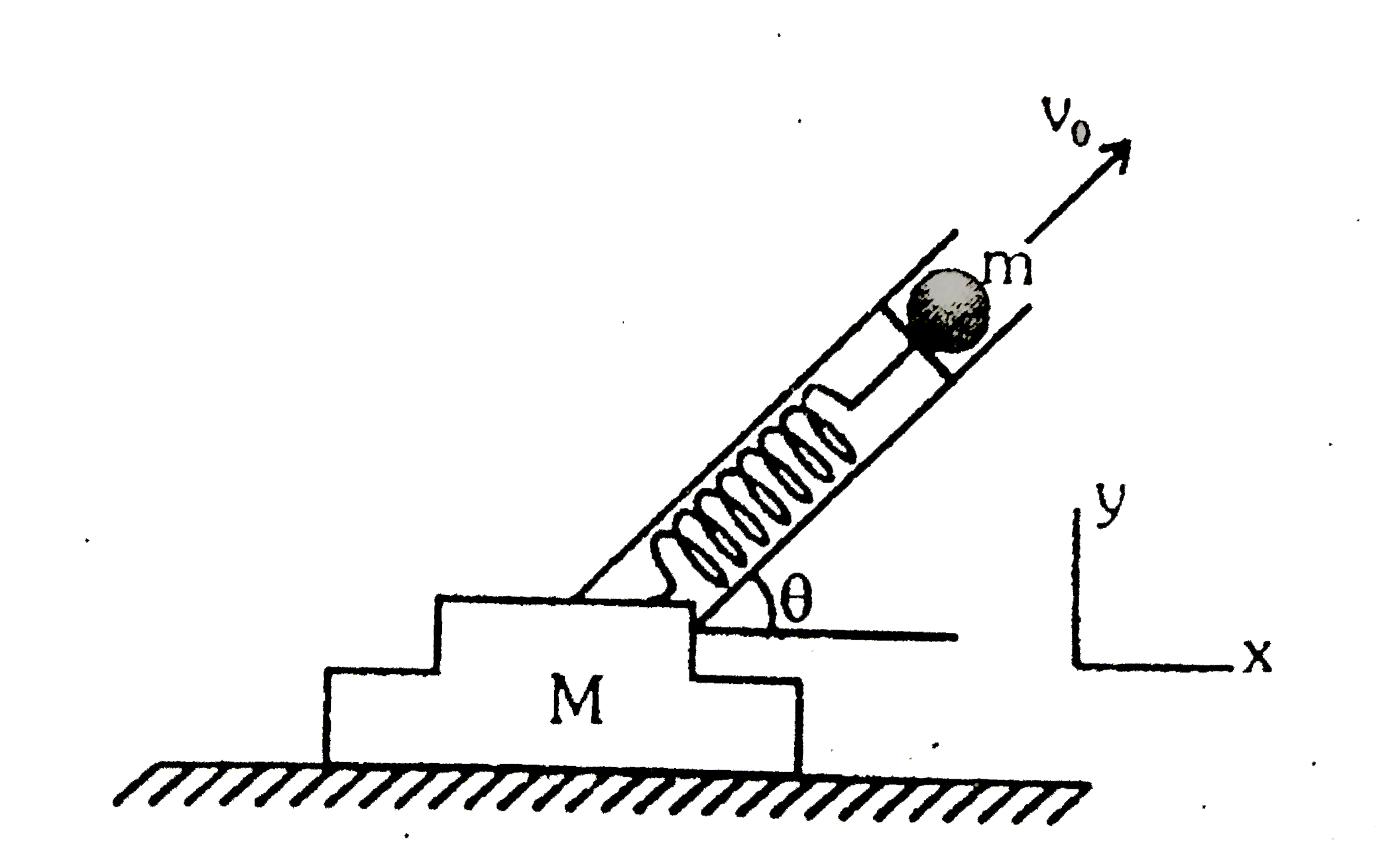
A loaded spring gun, initially at rest on a horizontal frictionless surface, fires a marble at angle of elevation theta. The mass of the gun is M, the mass of the marble is m, and the muzzle velocity of the marble is `v_0`. What is the final motion of the gun ?

Text Solution

Verified by Experts
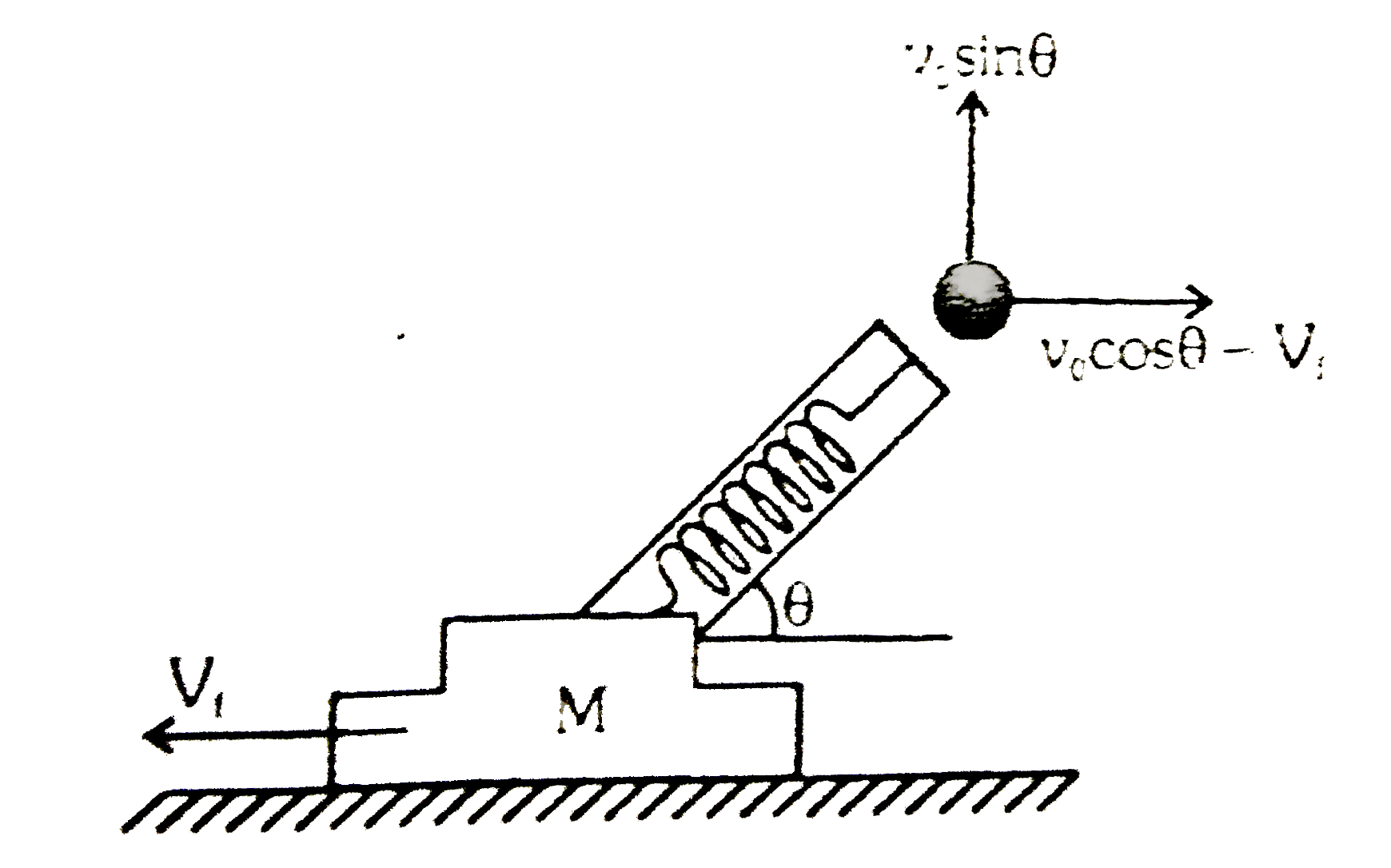
Take the physical system to be the gun and marble. Gravity and the normal force of the table act on the system. Both these forces are vertical. Since there are no horizontal external forces, the x component of the vector equation `F=dP/dt` is `0=dP_x/dt` According to equation (1), `P_x` is conserved:
`P_(x. "initial") = P_(x."final")`
Let the initial time be prior to firing the gun. Then `P_(x."initial") = 0`, since the system is initially at rest. After the marble has left the muzzle, the gun recoils with some speed `V_(1)`, and its final horizontal momentum is `MV_(1)`, to the left. FInding the final velocity of the marble involves a subtle point, however. Physically, the marble's accelaration is due to the force of the gun, and the gun's recoil is due to the reaction force of the marble. The gun stops accelerating once the marble leaves the barrel, so that at the instant the marble and the gun part company, the gun has its final speed `V_(f)`. At that same instant the speed of the marble relative to the gun is `v_(0)`. Hence, the final horizontal speed of the marble relative to the tablet is `v_(0) cos theta-V_(f)`. By conservation of horizontal momentum, we therefore have

`0=m(v_(0)costheta-V_(f))-MV_(f)`
or `V_(f) = (mv_(0)costheta)/(M+m)`
By using conversation of momentum we found the final motion of the system in a few steps. To show the advantage of this method, let us repeat the problem using Newton's laws directly. Let v(t) be the velocity of marble at time t and let `V(t)` be the velocity of the gun. While the marble is going fired, it is acted on by the spring, by gravity, and by friction forces with the muzzle wall. Let the net force on the marble be f(t). The x equation of motion for the marble is
`m(dv_(x))/dt=f_(x)(t)` Formal integration of equation (3) gives
`mv_(x)(t)=mv_(z)(0) + int_(0)^(t) f_(x)dt`
The external forces are all vertical, and therefore the horizontal force `f_(x)` on the marble is due entirely to the gun. By newton's third law, there is a reaction force- `f_(x)` on the gun due to the marble. No other horizontal forces acts on the gun, and the horizontal equation of motion for the gun is therefore `M(dV_x)/(dt)=-f_x(t)`, which can be integrated to give
`MV_(x)(t)=MV_(x)(0) - int_(0)^(t) f_(x)dt` we can eliminate the integral by combining equation (4) and (5).
`MV_(x)(t)+mv_(x)(t)=MV_(x)(0)+mv_(z)(0)`
we have rediscovered that the horizontal component of momentum is conserved. What about the motion of the center of mass? Its horizontal velocity is
`R_(x)(t)=(MV_(x)(t) +mv_(x)(t))/(M+m)` Using equation (6), the numerator can be rewritten to give
`R_(x)(t)=(MV_(x)(0)+mv_(x)(0))/(M+m)=0`
SInce the system is initially at rest. `R_x` is constant, as we expect.
We did not include the small force of air friction. Would the center of mass remain at rest if we had included it? The essential step in our derivation of the law of conservation of momentum was to use Newton's third law. Thus, conservation of momentum appears to be natural consequence of newtonian mechanics. It has been found, however, that conservation of momentum holds true even in areas where newtonian mechanics proves inadequate, including the realms of quantum mechanics and relativity. In addition, conservation of momentumcan be generalized to apply to systems like the electromagnetic field, which possess momentum but not mass. For these reasons, conservation of momentum is generally regarded as being more fundamental than newtonian mechanics. From the point of view, Newton's thitd law is a simple consequance of conservation of momentum for interacting particles. For our present purposes it is purely a matter of taste whether we wish to regard Newton's third law or conservation of momentum as more fundamental.
Promotional Banner

Topper's Solved these Questions

  • CENTRE OF MASS

    ALLEN |Exercise EXERCISE-I|40 Videos
  • CENTRE OF MASS

    ALLEN |Exercise EXERCISE-II|43 Videos
  • BASIC MATHEMATICS USED IN PHYSICS &VECTORS

    ALLEN |Exercise EXERCISE-IV ASSERTION & REASON|11 Videos
  • ELASTICITY, SURFACE TENSION AND FLUID MECHANICS

    ALLEN |Exercise Exercise 5 B (Integer Type Questions)|3 Videos

Similar Questions

Explore conceptually related problems

A shell of mass 0.020 kg is fired by a gun of mass 100 kg. If the muzzle speed of the shell is 80 m s^(-1) , what is the recoil speed of the gun ?

If the range of a gun which fires a shell with muzzle speed V is R , then the angle of elevation of the gun is

Two masses A and B of mass M and 2M respectively are connected by a compressed ideal spring. The system in placed on a horizontal frictionless table and given a velocity uhat(k) in the z-direction as shown in the figure. The spring is then released. In the subsequent motion the line from B to A alwyas points along the hat(i) unit vector. All some instant of time mass B has a x-component of velocity as v_(x)hat(i) . The velocity vec(v)_(A) of mass A at that instant is :-

A cannon of mass 5m (including a shell of mass m) is at rest on a smooth horizontal ground, fires the shell with its barrel at an angle theta with the horizontal at a velocity u relative to cannon. Find the horizontal distance of the point where shell strikes the ground from the initial position of the cannon :-

Two blocks of equal mass m are connected by an unstretched spring and the system is kept at rest on a frictionless horizontal surface. A constant force F is applied on the first block pulling away from the other as shown in Fig. If the extension of the spring is x_(0) at time t , then the displacement of the second block at this instant is

Two blocks of equal mass m are connected by an unstretched spring and the system is kept at rest on a frictionless horizontal surface. A constant force F is applied on the first block pulling away from the other as shown in Fig. If the extension of the spring is x_(0) at time t , then the displacement of the first block at this instant is

Two blocks each of mass m, connected by an un-stretched spring are kept at rest on a frictionless horizontal surface. A constant force F is applied on one of the blocks pulling it away from the other as shown in figure. (a)Find accelaration of the mass center. (b) Find the displacement of the centre of mass as function of time t. (c) If the extension of the spring is X_(0) at an instant t, find the displacements of the two blocks relative to the ground at this instant.

Two blocks of masses m and M are held against a compressed spring on a frictionless horizontal floor with the help of a light thread. When the thread is cut, the smaller block leaves the spring with a velocity u relative to the larger block. Find the recoil velocity of the larger block.

ALLEN -CENTRE OF MASS-EXERCISE-V B
  1. Spring Gun Recoil A loaded spring gun, initially at rest on a horizo...

    Text Solution

    |

  2. Two particles of masses m(1) and m(2) in projectile motion have veloci...

    Text Solution

    |

  3. Two blocks of masses 10 kg and 4 kg are connected by a spring of negli...

    Text Solution

    |

  4. If components of the momentum of a body along x and y-axis are p(x)=2 ...

    Text Solution

    |

  5. Two small particles of equal masses stant moving in opposite directio...

    Text Solution

    |

  6. Look at the drawing given in the figure which has been drawn with ink ...

    Text Solution

    |

  7. A particle of mass m is projected from the ground with an initial spee...

    Text Solution

    |

  8. A tennis ball dropped on a barizoontal smooth surface , it because bac...

    Text Solution

    |

  9. Two balls , having linear momenta vec(p)(1) = p hat(i) and vec(p)(2) =...

    Text Solution

    |

  10. STATEMENT-l : In an elastic collision between two bodies, the relative...

    Text Solution

    |

  11. Satement-1: if there is no external torque on a body about its centre ...

    Text Solution

    |

  12. A small block of mass M move on a frictionless surface of an inclimed...

    Text Solution

    |

  13. A small block of mass M move on a frictionless surface of an inclimed...

    Text Solution

    |

  14. A small block of mass M move on a frictionless surface of an inclimed...

    Text Solution

    |

  15. Two blocks of masses 2kg and M are at rest on an inclined plane and ar...

    Text Solution

    |

  16. A car P is moving with a uniform speed 5sqrt3 m//s towards a carriage ...

    Text Solution

    |

  17. A particle of mass m, moving in a cicular path of radius R with a cons...

    Text Solution

    |

  18. Two point masses m1 and m2 are connected by a spring of natural length...

    Text Solution

    |

  19. A rectangular plate of mass M and dimension axxb is held in horizonta...

    Text Solution

    |

  20. Three objects A , B and C are kept in a straight line on a smooth hori...

    Text Solution

    |
