Home
Class 11
PHYSICS
The Atwood machine in figure has a third...

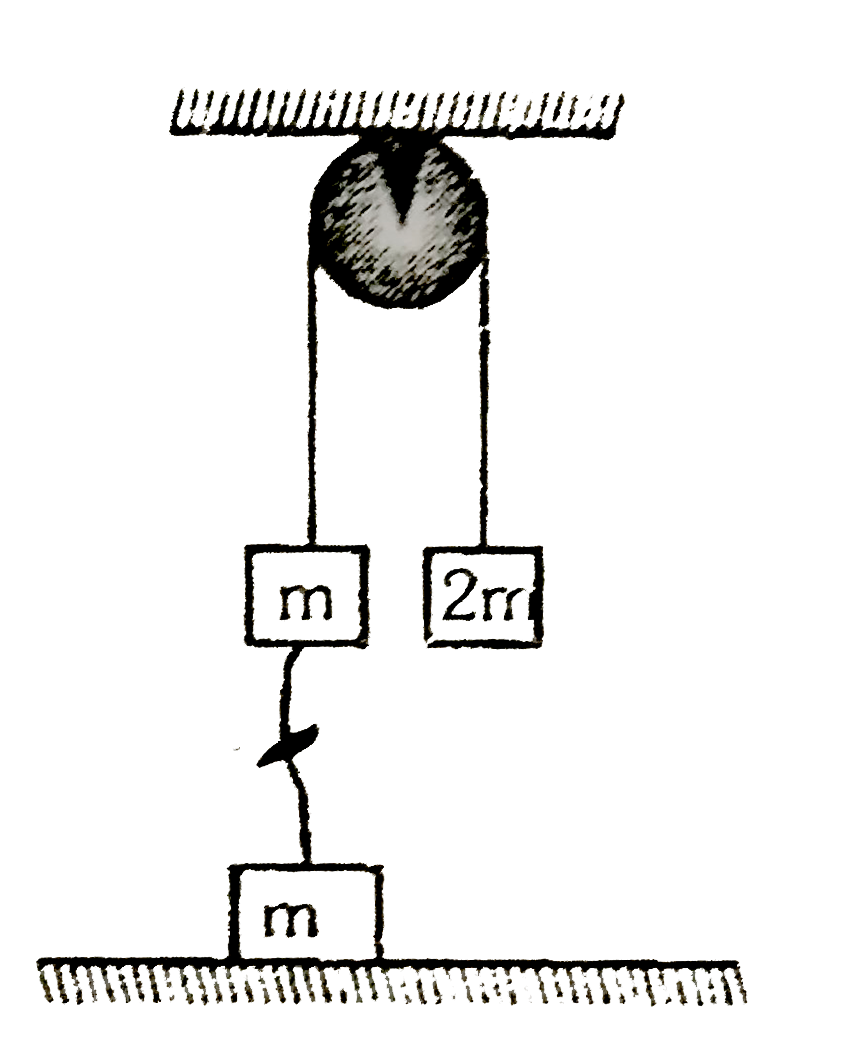
The Atwood machine in figure has a third mass attached to it by a limp string. After being released, the `2m` mass falls a distance x before the limp string becomes laut. Thereafter both the mass on the left rise at the same speed. What is the final speed ? Assume that pulley is ideal.

Text Solution

Verified by Experts

The correct Answer is:
`sqrt(3gx)/(8)`

`2 mg - T = 2ma, T - mg = ma, a = (g)/(3)`

Velocity of m & `2m` after falling through a distance `x = sqrt(2ax) = sqrt((2gx)/(3))`
Impulse equation
`T Deltat = 2m (v - sqrt((2gx)/(3)))`
`T Deltat - T' Deltat = m (v - sqrt((2gx)/(3)))`
`T' Deltat = m(v- 0), v = sqrt((3gx)/(8))`
Promotional Banner

Topper's Solved these Questions

  • CENTRE OF MASS

    ALLEN |Exercise EXERCISE-V A|20 Videos
  • CENTRE OF MASS

    ALLEN |Exercise EXERCISE-V B|19 Videos
  • CENTRE OF MASS

    ALLEN |Exercise EXERCISE-IV A|32 Videos
  • BASIC MATHEMATICS USED IN PHYSICS &VECTORS

    ALLEN |Exercise EXERCISE-IV ASSERTION & REASON|11 Videos
  • ELASTICITY, SURFACE TENSION AND FLUID MECHANICS

    ALLEN |Exercise Exercise 5 B (Integer Type Questions)|3 Videos

Similar Questions

Explore conceptually related problems

A bead can slide on asmooth straight wire and a particle of mass m attached to the bead by a light string of length L. The particle is held in contact with the wire and with the string taut and is then let fall. If the bead has mass 2m then when the string makes an angle theta with the wire, the bead will have slipped a dsitance.

The left and of the spring tied to a wall and at the right end is attached to a block of mass m, which is placed on a frictionless ground. The force F displaces the block by distance x where it is exactly balanced by the spring force. What is the maximum speed of the block in the ensuing motion after the force F is removed?

The left end of the spring tied to a wall and at the right end is attached to a block of mass m , which is placed on a frictionless ground. The force F displaces the block by distance x where it is exactly balanced by the spring force. What is the maximum speed of the block in the ensuing motion after the force F is removed?

Simple Atwood Machine as System of Particles The system shown in the figure is known as simple Atwood machine. Initially the masses are held at rest and then let free. Assuming mass m_(2) more than the mass m_(1) , find acceleration of mass center and tension in the string supporting the pulley.

In the given figure, Find mass of the block A, if it remains at rest, when the system is released from rest. Pulleys and strings are massless. [g=10m//s^(2)]

Two particles each of mass m are connected by a light inextensible string and a particle of mass M is attached to the midpoint of the string. The system is at rest on a smooth horizontal table with string just taut and in a straight line. The particle M is given a velocity v along the table perpendicular to the string. Prove that when the two particles are about to collide : (i) The velocity of M is (Mv)/((M + 2m)) (ii) The speed of each of the other particles is ((sqrt2M (M + m))/((M + 2m)))v .

Figure 14.26 (a) shows a spring of force constant k clamped rigidly at one end and a mass m attached to its free end. A force F applied at the free end stretches the spring. Figure 14.26 (b) shows the same spring with both ends free and attached to a mass m at either end. Each end of the spring in Fig. 14.26(b) is stretched by the same force F. If the mass in Fig. (a) and the two masses in Fig. (b) are released, what is the period of oscillation in each case ?

A stone is tied to an elastic string of negligible mass and spring constant k. The unstretched length of the string is L and has negligible mass. The other end of the string is fixed to a nail at a point P. Initially the stone is at the same level as the point P. The stone is dropped vertically from point P. (a) Find the distance 'y' from the top when the mass comes to rest for an instant, for the first time. (b) What is the maximum velocity attained by the stone in this drop ? (c) What shall be the nature of the motion after the stone has reached its lowest point ?

A puck of mass m is moving in a circle at constant speed on a frictionless table as shown in the figure . The puck is connected by a string to a suspended bob, also of mass m , which is at rest below the table. Half of the length of the string is above the tabletop and half below. What is the magnitude of the centripetal acceleration of the moving puck ? Let g be the acceleration due to gravity.

