Home
Class 12
PHYSICS
Two gases have the same initial pressure...

Two gases have the same initial pressure, volume and temperature. They expand to the same final volume, one adiabatically and the other isothermally

A

In case of isothermal process, final pressure is greater.

B

In case of adiabatic process, work done is greater.

C

In case of adiabatic process, work done is greater.

D

In case of isothermal process, work done is greater/

Text Solution

Verified by Experts

The correct Answer is:
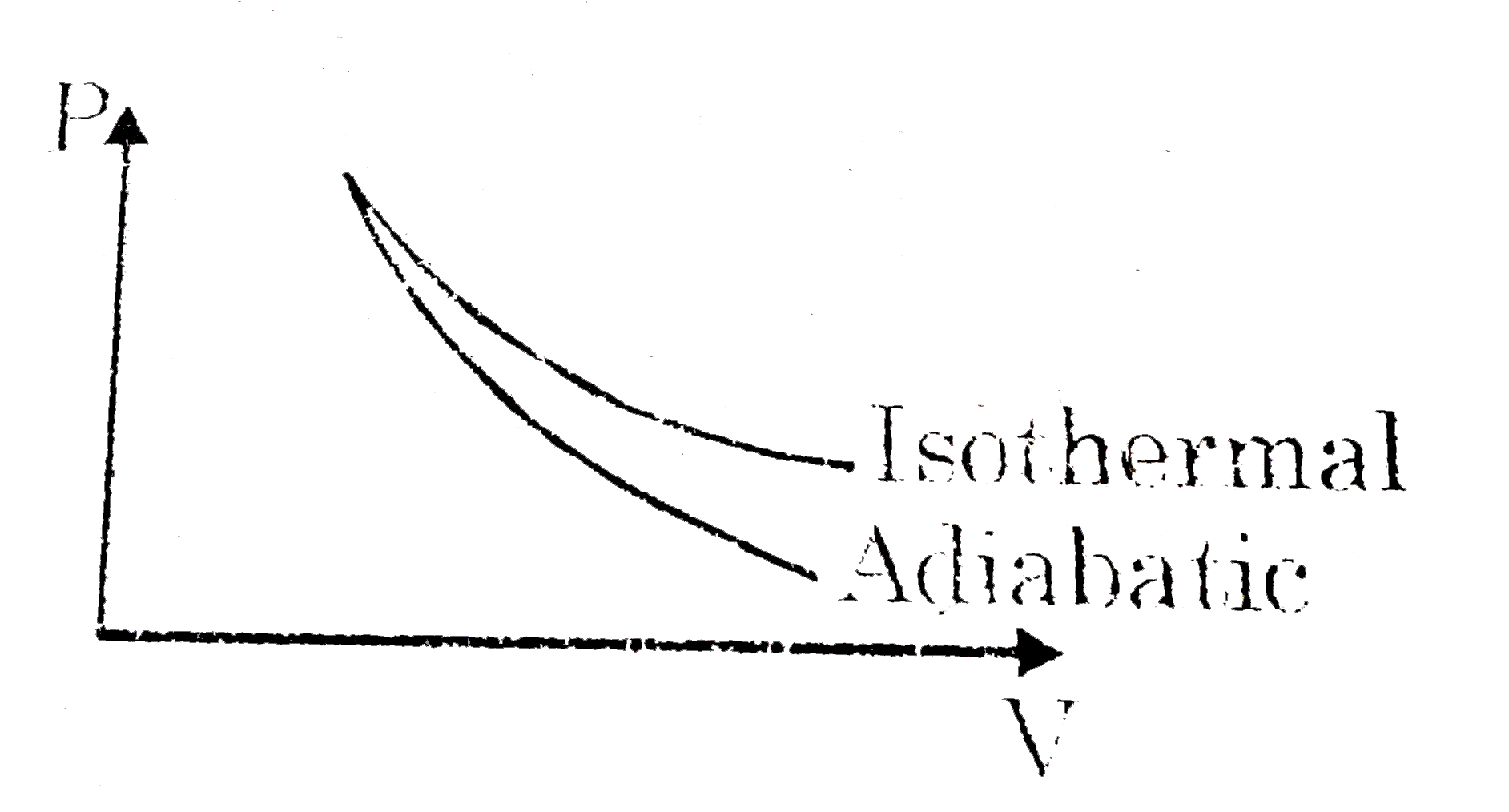
A, D


` (P_(f))_("isothermal").^(gt) (P_(f)) _("Adiabatic")`
`(T_(f))_("isothermal").^(gt) (T_(f))_("adiabatic")`
Area under isothermal curve is move than area under adiabatic curve.
`implies W_("isothermal").^(gt)W_("adiabatic")`
Promotional Banner

Topper's Solved these Questions

  • TEST PAPERS

    ALLEN |Exercise part-2 physics|73 Videos
  • TEST PAPERS

    ALLEN |Exercise part-2 physic|48 Videos
  • TEST PAPERS

    ALLEN |Exercise PAPER 3|92 Videos
  • TEST PAPER 4

    ALLEN |Exercise PHYSICS|45 Videos
  • UNIT & DIMENSIONS, BASIC MATHS AND VECTOR

    ALLEN |Exercise Exercise (J-A)|7 Videos

Similar Questions

Explore conceptually related problems

Consider two containers A and B containing identical gases at the same pressure, volume and temperature. The gas in container A is compressed to half of its original volume isothermally while the gas in container B is compressed to half of its original value adiabatically. The ratio of final pressure of gas in B to that of gas in A is

An ideal gas having initial pressure p, volume V and temperature T is allowed to expand adiabatically until its volume becomes 5.66V, while its temperature falls to T//2 . (a) How many degrees of freedom do the gas molecules have? (b) Obtain the work done by the gas during the expansion as a function of the initial pressure p and volume V. Given that (5.66)^0.4=2

Solutions having the same osmotic pressure are called:

For an ideal gas of fixed amount, the initial pressure and volume are equal to the final pressure and volume

The rectangular box shown in Fig has partition which can slide without friction along the length of the box. Initially each of the two chambers of the box has one mole of a mono-atomic ideal gas (lambda=5//3) at a pressure P_0 , volume V_0 and temperature T_0 . The chamber on the left is slowly heated by an electric heater. The walls of the box and the lead wires of the heater is negligible. The gas in the left chamber expands pushing the partition until the final pressure in both chambers becomes 243P_0//32 . Determine (i) the final temperature of the gas in each chamber and (ii) the work done by the gas in the right chamber.

Three moles of an ideal gas (C_p=7/2R) at pressure, P_A and temperature T_A is isothermally expanded to twice its initial volume. It is then compressed at constant pressure to its original volume. Finally gas is compressed at constant volume to its original pressure P_A . (a) Sketch P-V and P-T diagrams for the complete process. (b) Calculate the net work done by the gas, and net heat supplied to the gas during the complete process.

An ideal gas has an initial pressure of 3 pressure units and an initial volume of 4 volume units. The table gives the final pressure and volume of the gas (in those same units) in four processes. Whish process starts and ends on the same isotherm ltimg src="https://d10lpgp6xz60nq.cloudfront.net/physics_images/ALN_PHY_R04_E09_009_Q01.png" width="80%"gt

An insulated container of gas has two chambers separated by an insulating partition. One of the chambers has volume V_1 and contains ideal gas at pressure P_1 and temperature T_1 .The other chamber has volume V_2 and contains ideal gas at pressure P_2 and temperature T_2 . If the partition is removed without doing any work on the gas, the final equilibrium temperature of the gas in the container will be

A gas takes part in two processes in which it is heated from the same initial state 1 to the same final temperature. The processes are shown on the p-V diagram by the straight lines 1-3 and 1-2. 2 and 3 are the points on the same isothermal curve. Q_1 and Q_2 are the heat transfer along the two processes. Then,

